How AI Has Changed: A Complete Guide to AI Evolution & Business Transformation
From rule-based systems in the 1950s to agentic AI running enterprise workflows in 2026 — here is the definitive guide to how AI has changed the world, how it is reshaping business, and what comes next for manufacturers and operations teams.




When HonestAI Magazine launched, artificial intelligence was riding a wave of optimism, anxiety, and a fair amount of science fiction. The promise was enormous, the risks were unclear, and the future felt just close enough to imagine but far enough to debate. A few years on, the world has changed — and so has AI.
This guide covers the full arc: where AI came from, how it changed business, what it means for work and jobs, how generative AI shifted the ground beneath every industry, and where agentic AI is taking things next. We have been watching this evolution closely since the first issue of HonestAI hit the stands — and what follows is what we have actually observed, not just what the headlines said.
The History of AI — From Rules to Reasoning
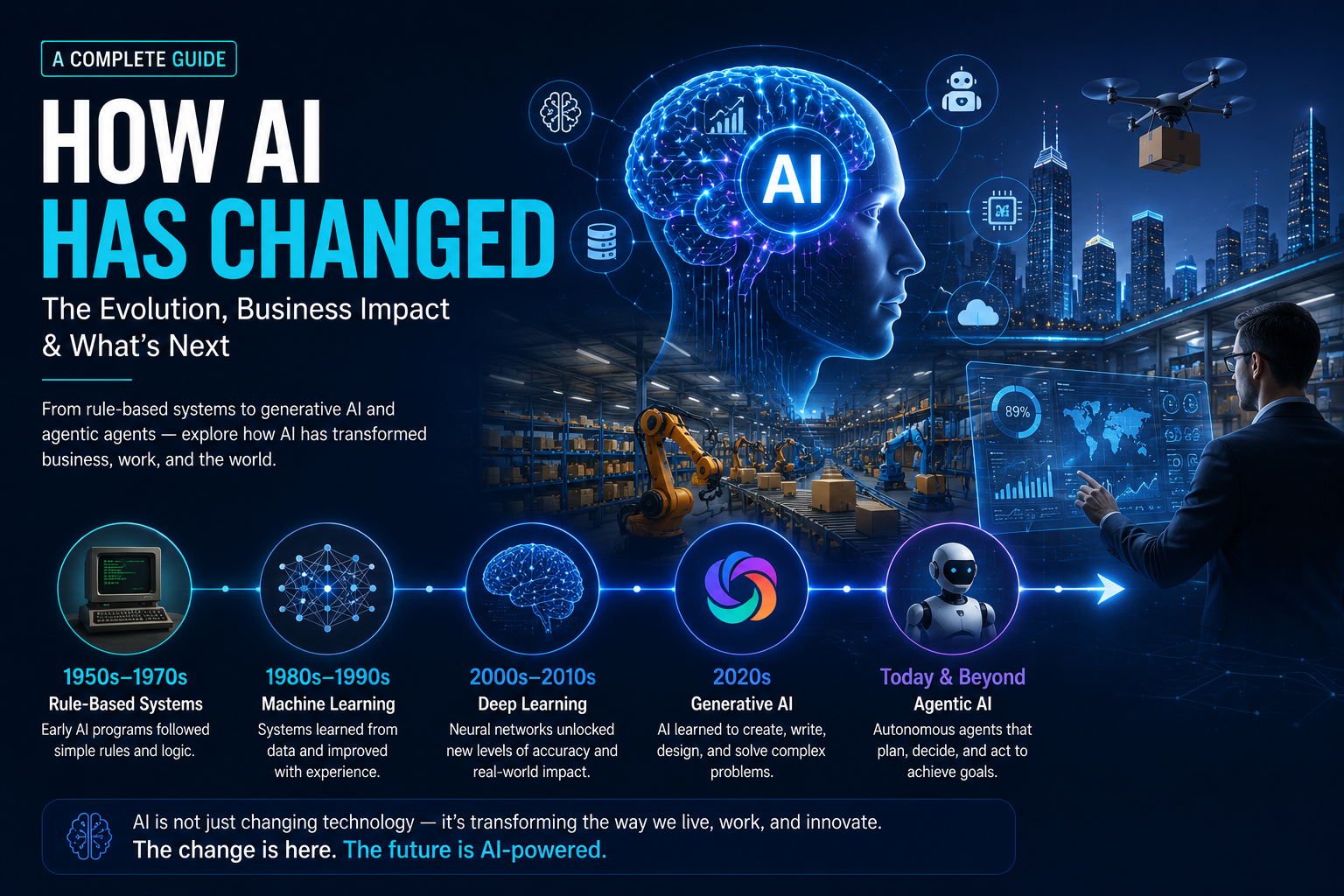
Understanding how AI has changed starts with understanding where it came from. The story of artificial intelligence is not a straight line — it is a series of breakthroughs, false dawns, long winters, and sudden leaps that nobody fully predicted.
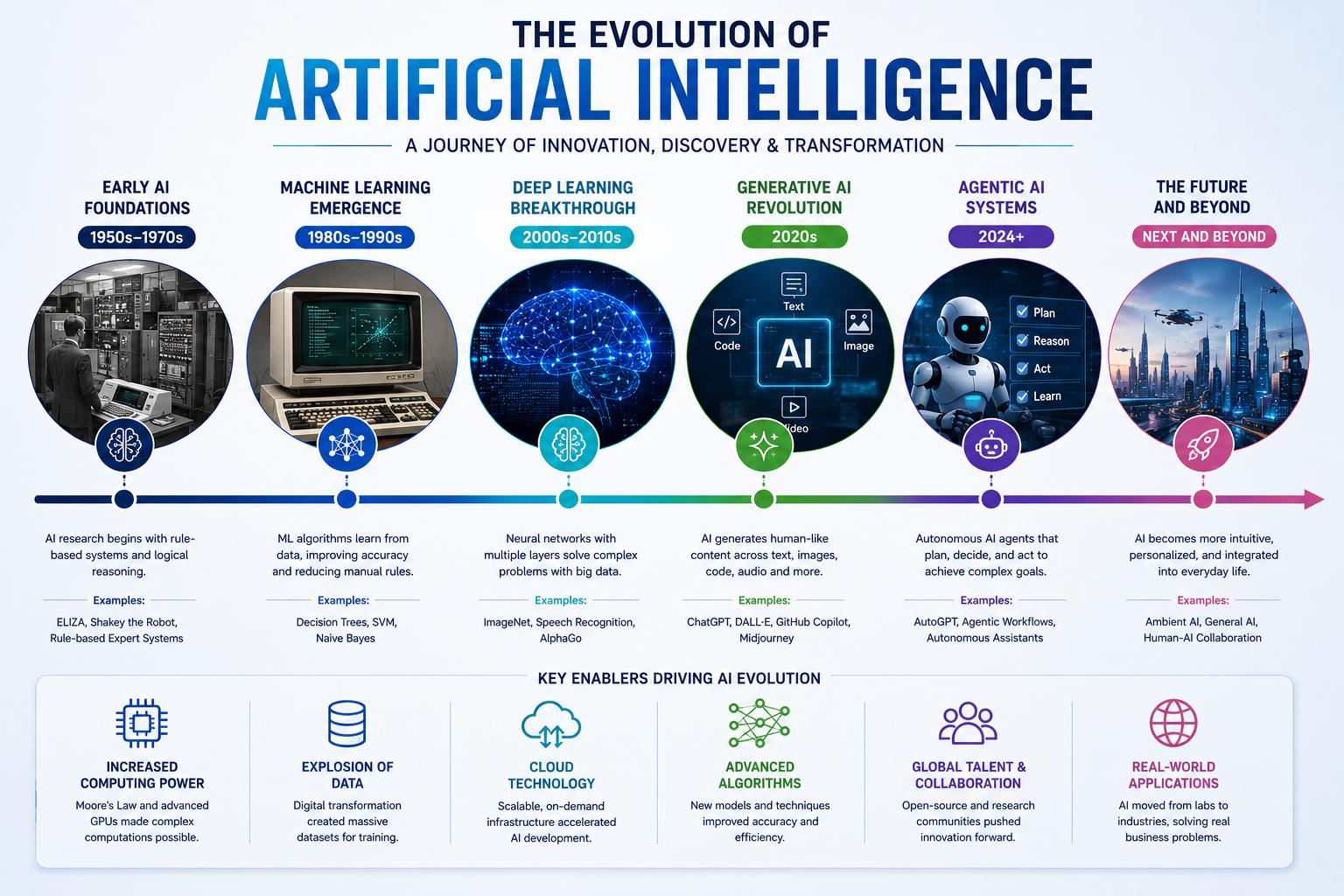
The AI Timeline — Key Eras
Rule-Based AI — The Age of Logic
The first AI systems operated on hand-coded rules. If X, then Y. Researchers believed that intelligence could be distilled into explicit logical rules written by human experts. Systems like LISP and early expert systems could play chess and diagnose disease — but only within the narrow boundaries their creators defined. Outside those boundaries: complete failure.
Machine Learning — Letting Data Decide
The paradigm shifted. Instead of programming rules, researchers began feeding data to algorithms and letting patterns emerge. Support vector machines, decision trees, and early neural networks started solving problems that hand-coded rules could not. Spam filters, recommendation engines, and credit scoring models quietly appeared in everyday life. AI stopped being a laboratory curiosity and became a quiet infrastructure layer.
Deep Learning Revolution — Neural Networks Grow Up
In 2012, a deep neural network called AlexNet won the ImageNet competition by a margin so large it shocked the AI research community. Suddenly, image recognition, speech recognition, and game-playing AI began matching or beating human performance. GPUs made training massive networks economically feasible. Self-driving car research accelerated. The technology was real — but deployment was still limited to organizations with enormous compute budgets.
Large Language Models — The Language Breakthrough
GPT-3 arrived in 2020 with 175 billion parameters and produced text that fooled people into thinking a human had written it. Suddenly AI could draft emails, summarize documents, answer questions, write code, and hold conversations. The technology was technically available via API, but most people had not experienced it directly — until November 2022 changed everything.
Generative AI Explosion — The Consumer Inflection Point
ChatGPT reached 100 million users in two months — the fastest consumer technology adoption in history. DALL-E, Midjourney, Stable Diffusion, and Claude launched within months of each other. GPT-4, Claude 3, and Gemini brought multimodal capabilities: AI that could see, hear, and reason across formats. The conversation shifted from "what can AI do?" to "what can AI not do?"
Agentic AI Era — From Responding to Acting
The current era is defined by AI that does not just answer questions — it takes actions. Agentic AI systems plan multi-step tasks, use tools (APIs, code execution, web search), self-correct, and operate with minimal human intervention between steps. Enterprise platforms from Salesforce, Microsoft, and AWS have embedded agents into their core products. The question is no longer "can AI do this?" but "how do we govern AI doing this?"
What AI Got Right — and What It Got Wrong
Any honest account of AI's evolution requires confronting the gap between prediction and reality. The hype cycle has been generous with promises — and more honest in the aftermath.
"AI will take your job." · "Self-driving cars will be everywhere by 2023." · "AI will make doctors obsolete." · "We are months away from AGI."
AI augments expertise rather than replacing it. Self-driving is operational in limited zones. AI assists doctors but doesn't replace clinical judgment. AGI remains distant.
AI exceeded predictions in language tasks (GPT-4, Claude), image generation (DALL-E, Midjourney), and code assistance (GitHub Copilot reaches 1.3 million paid users). It underdelivered on physical robotics, general reasoning, and autonomous vehicles at scale. The lesson: AI is extraordinary within learned domains and brittle outside them.
AI Business Evolution & Enterprise Transformation
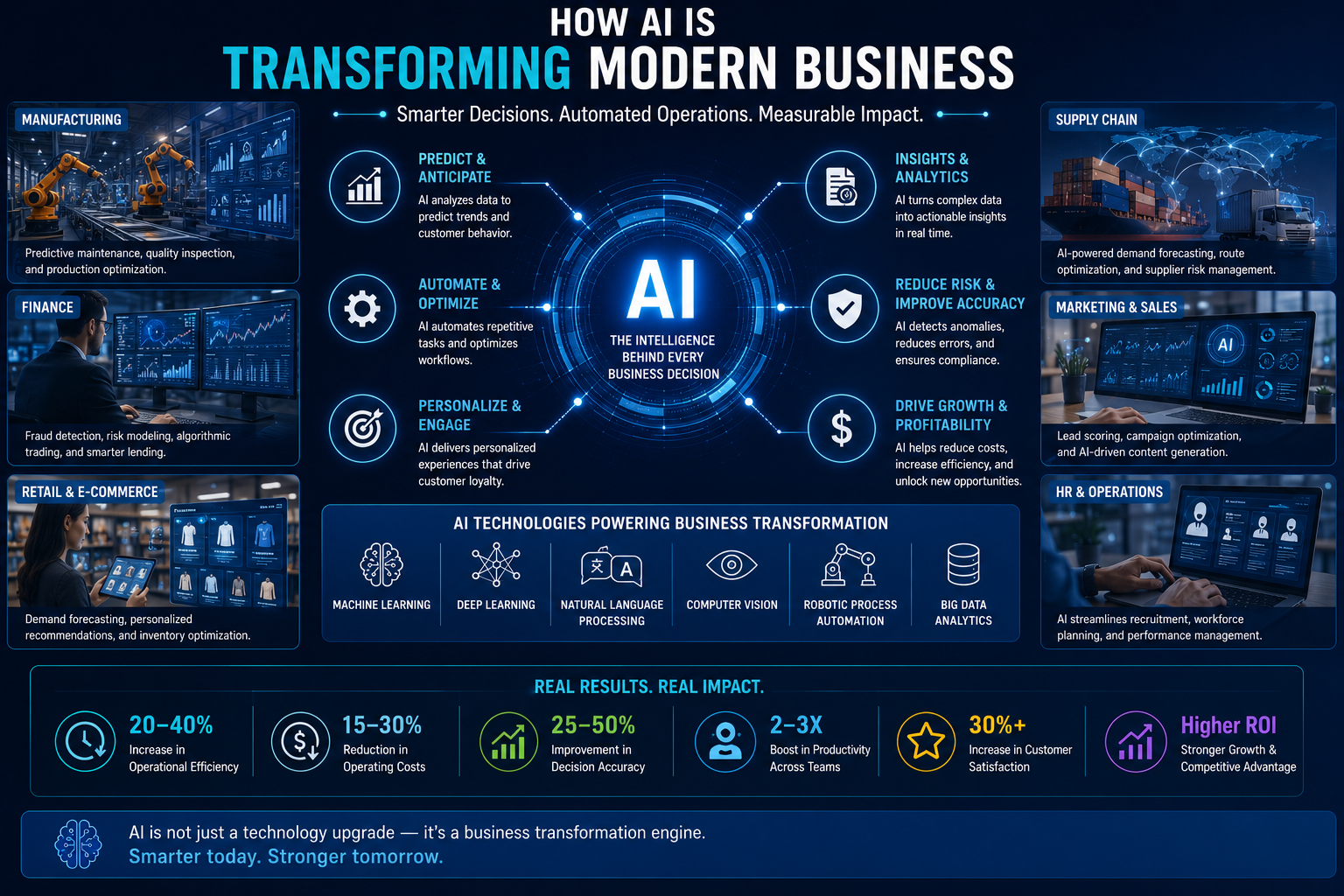
The most important question for any business leader is not "what can AI do?" — it is "what has AI actually changed about how organizations operate?" The answer, as of 2026, is more nuanced than both the optimists and the skeptics predicted.
According to McKinsey's 2024 AI adoption report, companies that have moved beyond pilot-stage AI deployments report 20–30% reductions in operational costs and meaningful revenue uplifts in high-value use cases like sales automation and supply chain optimization. The gap between organizations that have made this transition and those still running experiments is no longer measured in years — it is measured in quarters.
How AI Has Changed Business Operations — Three Phases
Phase 1 — Experimentation
Pilots, proofs of concept, internal chatbots. Most organizations spent 2022–2023 here. High enthusiasm, low ROI, lots of PowerPoint decks about AI potential.
Phase 2 — Integration
AI embedded in existing workflows — ERP integration, CRM automation, real measurable ROI. Organizations in this phase have moved from experimenting to operating. 2024–2025 is where serious organizations are.
Phase 3 — Transformation
AI redesigning how work happens, not just automating existing tasks. The organization's processes are rebuilt around AI capability. This is where the compounding advantage begins.
The critical insight: most organizations stuck in Phase 1 think they are doing AI strategy. They are doing AI sampling. The cost of staying in experimentation mode is not just slow progress — it is opportunity cost that compounds every quarter competitors advance.
AI Transformation Strategy — What Works and What Does Not
Three patterns of successful AI business transformation emerge consistently from organizations that have moved to Phase 2 and beyond:
- Start with a clear baseline metric — document current process costs before any deployment
- Integrate with existing systems, not around them — AI that requires a new login won't get used
- Maintain human oversight — the organizations with best outcomes keep humans in the loop
- Measure outcomes, not activity — count results achieved, not prompts submitted
- Define the ROI target before deployment — not after
- Treat AI as operations redesign, not technology purchase
Three patterns of failure are equally consistent: treating AI as a technology project rather than an operations redesign, deploying without a rollback plan, and skipping the measurement framework entirely.
BCG Enterprise GPT — From Two Weeks to Two Days
Boston Consulting Group built an enterprise-grade GPT platform enabling consultants to create custom AI agents for specific client projects. The result was not incremental efficiency — it was a fundamental restructuring of how knowledge work happens.
In one documented engagement, a team needed to interview 30 engineers, transcribe hours of discussion, identify key themes, and produce a strategic presentation. Without AI: two full weeks. With BCG's AI system: 2–3 days, with equal or higher quality. The consultants spent their time on validation, strategic synthesis, and client presentation — not formatting slides and transcribing recordings.
What Changed
- AI handled transcription, summarization, and theme extraction
- Consultants focused on strategic judgment — the work that requires human expertise
- Project turnaround time reduced by approximately 75%
- Output quality held equal or improved due to greater consultant focus time
"The real leap isn't AI doing your job. It is AI doing the parts of your job that were never worth your expertise — so you can spend your time on the parts that actually are."
— HonestAI Magazine · How AI Has ChangedWhere AI Business Adaptation Is Happening Fastest
Three sectors are leading AI business transformation in 2026:
Financial services — fraud detection, automated reconciliation, AI-assisted audit, and customer service are delivering consistent ROI at scale. JPMorgan, Goldman Sachs, and Visa have all moved from pilot to embedded AI infrastructure.
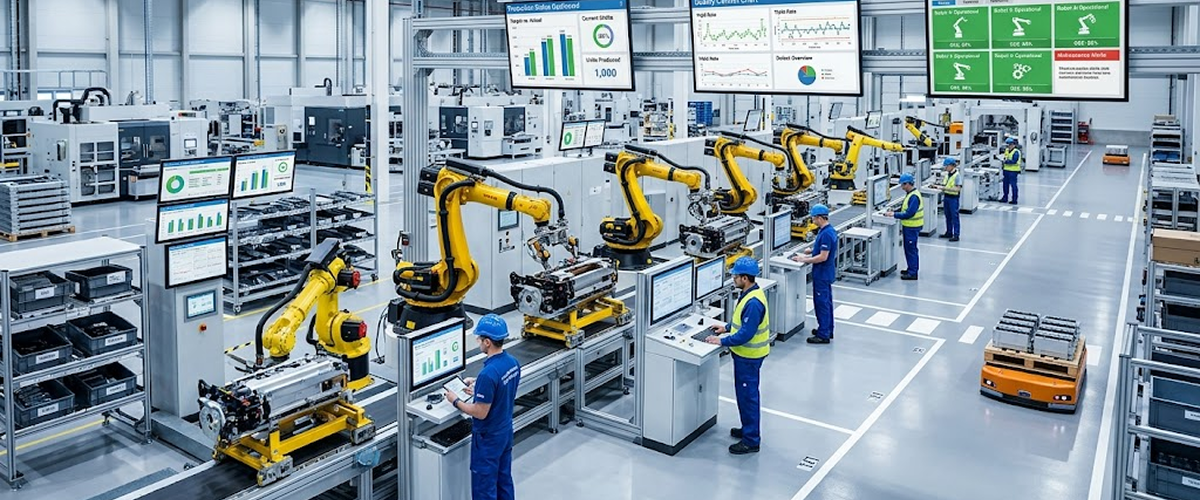
Manufacturing and supply chain — quality control AI, predictive maintenance, agentic ERP systems, and automated receiving are delivering 20–40% efficiency improvements in early adopters. This is GrayCyan's primary domain — and the deployments we see in practice confirm the data.
Professional services — legal research, medical documentation, and consulting deliverables are all being fundamentally restructured. The BCG example above is representative, not exceptional.
AI and the Future of Work — From Automation to Agency
No question about AI generates more anxiety than its effect on work and jobs. The honest answer is: the effect is real, significant, and more nuanced than either "AI will take all the jobs" or "AI will create more jobs than it destroys."
What AI Has Already Changed About Work
The most important observation about AI and work in 2026 is that the transformation is already well underway — and most knowledge workers have already incorporated AI tools into their daily workflows, often without fully realizing how much their work has changed.
AI-assisted writing is the 2026 baseline — Grammarly, ChatGPT, Claude used by millions daily
Automated scheduling — Reclaim AI, Motion, and similar tools reclaiming hours per week
AI code completion — GitHub Copilot reaches 1.3M paid users, Cursor gaining rapid traction
AI meeting summaries — Otter.ai, Fireflies turning every meeting into searchable documentation
AI research assistants — Perplexity, Claude handling information synthesis that took hours
AI analytics — Copilot for M365 turning natural language into data queries
These are not futuristic capabilities. They are the 2026 baseline for competitive knowledge work. Organizations that have not deployed them are operating at a structural disadvantage.
The Shift from Automation to AI Agency
The more significant shift is conceptual. Automation replaces a task. AI agency redesigns a workflow.
An automated system sends reminders when an invoice is overdue. An AI agent reads the invoice, matches it to the purchase order, identifies the discrepancy, drafts a resolution email, routes it for approval, and updates the ERP — without a human initiating any individual step.
The BCG example illustrates this distinction precisely. It was not that AI automated "writing a summary." It was that AI restructured an entire consulting engagement workflow so that the humans involved spent their time only on the work requiring human judgment.
Agentic AI Workforce Transformation — The Next Phase
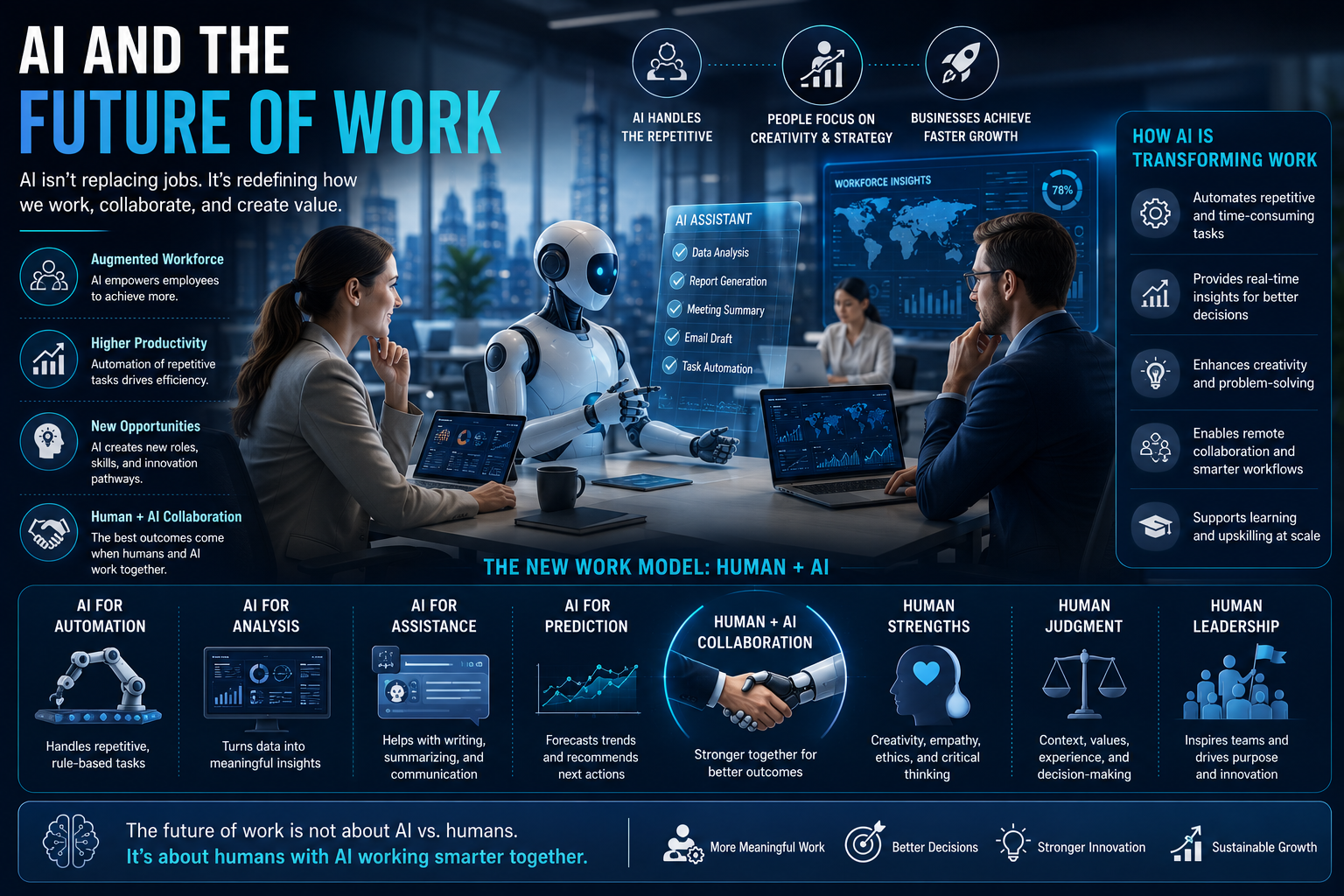
The most consequential near-term workforce shift is the emergence of agentic AI that takes on multi-step workflows autonomously. This changes the nature of management as much as the nature of individual work.
Workers in organizations deploying agentic AI are increasingly moving from doing tasks to overseeing outcomes — reviewing AI decisions rather than making every decision manually. This is not a reduction in human importance. It is a shift in where human judgment is applied: upward toward strategy, downward toward exception handling, and away from routine execution.
| Work Category | AI Impact | Human Role in 2026 |
|---|---|---|
| Data processing & reporting | Heavily automated — AI handles collection, formatting, summarization | Interpretation, exception review, and strategic decisions based on output |
| Scheduling & coordination | Largely automated — AI optimizes calendars, routes approvals, tracks follow-ups | Setting priorities and overriding AI recommendations when context requires |
| Content & communication drafting | First draft is AI's job — humans refine and approve | Editorial judgment, tone calibration, relationship management |
| Research & information synthesis | AI surfaces, organizes, and summarizes at speed humans cannot match | Framing the right questions, validating conclusions, applying domain context |
| Strategic planning | AI provides scenario modeling and historical pattern analysis | Judgment, vision, stakeholder alignment — deeply human work |
| Skilled trades & physical work | Limited AI impact — these are AI-resistant roles | Unchanged — electricians, mechanics, surgeons, carers remain primarily human |
The Evolution of AI Agents — From Chatbots to Agentic AI
The most important technological shift happening in AI right now is not a new model — it is a new architecture. The move from AI as a responsive tool to AI as an autonomous agent is the defining transition of 2025–2026.
The Agent Evolution Timeline
There have been three distinct generations of AI agents, each fundamentally different from the previous:
Rule-Based Chatbots (2010–2018)
Scripted responses, decision trees, no learning capability. Could only handle questions they had been explicitly programmed to answer. The frustrating customer service chatbot that kept sending you back to the main menu.
LLM-Powered Assistants (2020–2023)
Conversational, generative, context-aware — but fundamentally reactive. They responded to prompts but could not plan sequences of actions, use external tools, or operate between conversations without human re-engagement.
Agentic AI (2024–Present)
Plans, uses tools, executes multi-step workflows, and self-corrects. An agentic system can be given a goal — "process these 50 supplier invoices" — and complete the entire workflow without step-by-step human instruction.
What Makes an AI System "Agentic"
Four characteristics define a genuinely agentic system:
- Persistent memory — the system retains context across a workflow, not just a single prompt
- Tool use — the system can call APIs, execute code, search the web, and interact with external systems
- Multi-step planning — the system decomposes a goal into ordered tasks and executes them sequentially
- Self-correction — the system detects when a step fails and adjusts its approach without human intervention
A standard LLM has none of these. A well-designed agentic system has all four.
Small Language Models — The Practical Future of Agentic AI
One of the more counterintuitive developments in AI's evolution is the growing importance of small, specialized models over massive general-purpose ones. A 7-billion parameter model fine-tuned specifically on manufacturing documentation, quality control records, and supplier data will frequently outperform a 70-billion parameter general model on manufacturing tasks — while costing a fraction of the compute.
This matters enormously for mid-market manufacturers and B2B operators. Enterprise-scale AI infrastructure is not required to deploy agentic AI systems that perform at enterprise level. Domain-specific agents — built on smaller, focused models — are making agentic AI economically accessible for organizations at every scale.
LovingIs.ai — GrayCyan's HITL Agentic Architecture in Practice
LovingIs.ai, founded by entrepreneur Jen Loving, set out to build an AI that genuinely embodied compassionate, love-aligned responses — not just sentiment detection, but a principled filter applied to every AI output. The challenge: teaching AI what love actually means across cultural, philosophical, and ethical contexts.
GrayCyan's team participated in ten 90-minute sessions exploring how love is understood across different frameworks before writing a single line of code. The result was a proprietary "loving layer" — a human-in-the-loop filter that works across existing LLMs (GPT, Claude, Gemini) to ensure every response meets the standard.
The technical demonstration was revealing: when asked "How many R's are in strawberry?", ChatGPT answered incorrectly with confidence. GrayCyan's AI answered correctly — and in a genuinely engaging tone. The difference was not just accuracy, it was the combination of structured intelligence and human review that the HITL architecture provides.
The Core Principle
Agentic AI is most powerful when it operates within guardrails defined by humans — not as a constraint on capability, but as the foundation of trust that makes deployment possible.
Launched Valentine's Day beta with hundreds of enthusiastic users — a testament to what happens when AI is built with genuine purpose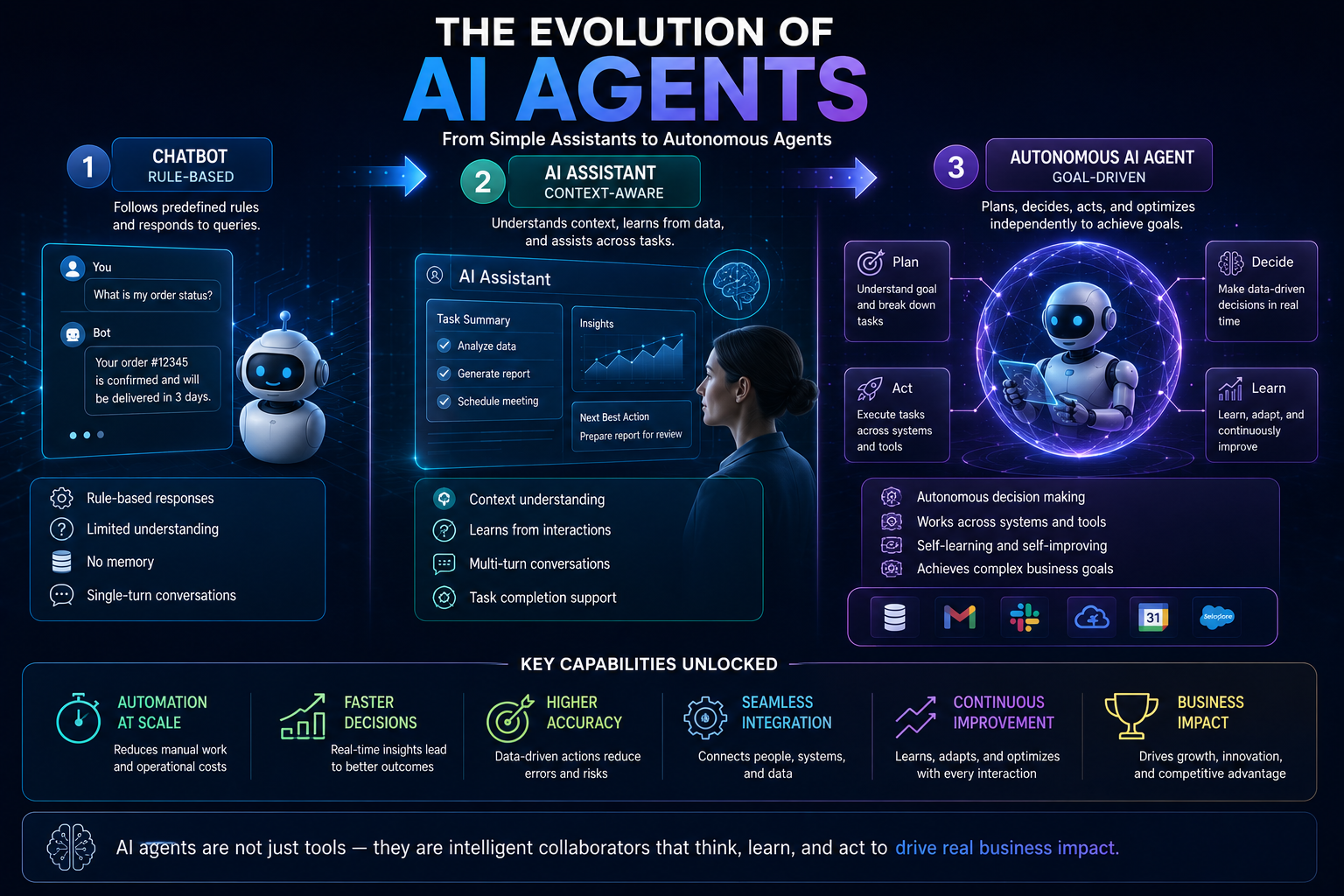
Generative AI — The Transformation That Changed Everything
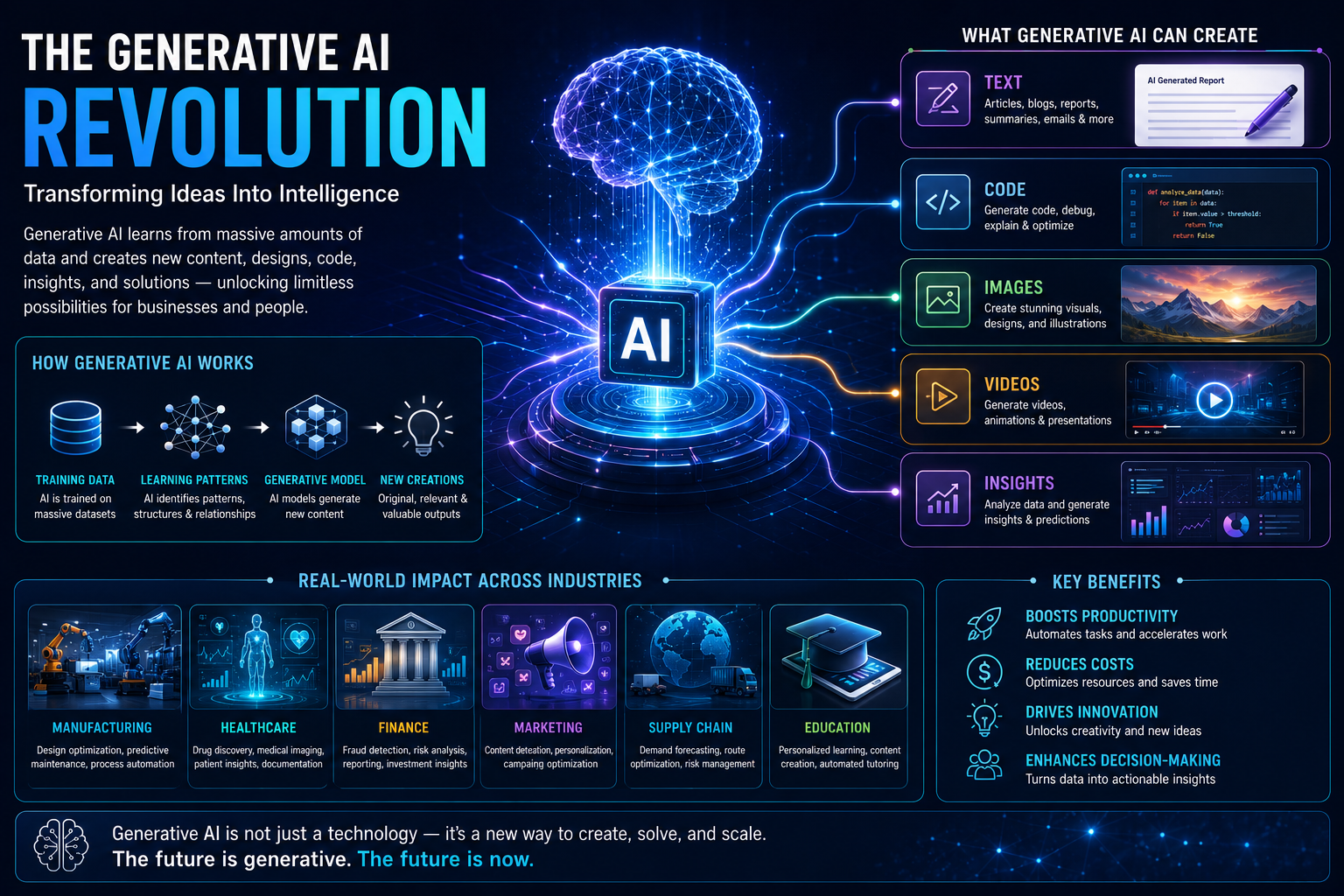
Of all the developments in AI's history, the generative AI explosion of 2022–2024 is the one that actually changed public consciousness. Previous AI breakthroughs — AlexNet winning ImageNet, AlphaGo beating world chess champions — impressed researchers but did not reach the person on the street. Generative AI did.
The History of Generative AI — A Brief Timeline
- 2014 — GANs (Generative Adversarial Networks): Ian Goodfellow's breakthrough enabled AI to generate images by pitting a generator against a discriminator. The first genuine generative models.
- 2017 — Transformer architecture: Google's "Attention is All You Need" paper introduced the architecture underlying every major LLM since.
- 2019 — GPT-2: OpenAI's early language model was so convincing they initially refused to release it publicly — concerned about misuse.
- 2022 — DALL-E, Stable Diffusion, ChatGPT: The consumer inflection point. Image generation became publicly accessible. ChatGPT demonstrated conversational AI at a quality that crossed the "impressive enough to actually use" threshold.
- 2023–2024 — GPT-4, Claude 3, Gemini: Multimodal capability arrived. AI that could see, hear, and reason across formats. Enterprise deployments began in earnest.
- 2025–2026 — Embedded GenAI: Generative AI moves from standalone tool to embedded infrastructure — inside M365, Salesforce, SAP, and every major enterprise platform.
Applied Generative AI for Business Transformation
The enterprise applications of generative AI that are actually delivering ROI — not in theory but in documented deployments — cluster around five categories:
Document Generation & Drafting
Purchase orders, compliance reports, operational summaries, RFP responses, customer proposals. The first-draft problem is effectively solved. Human value now lies in review, judgment, and refinement.
Documented ROICode Generation & Review
GitHub Copilot, Cursor, and similar tools are reducing development time on routine coding tasks by 30–50%. The developer role is shifting from writing code to reviewing and orchestrating AI-generated code.
Documented ROIMarketing Content & Personalization
Coca-Cola's "Create Real Magic" platform trained AI on 100 years of brand assets to co-create campaigns. Result: significantly higher engagement metrics than traditional campaigns.
Enterprise ExampleData Summarization & Analysis
Microsoft Copilot for M365 enables natural-language queries across entire document libraries. Teams that previously spent hours extracting insights now spend minutes validating AI-extracted ones.
Enterprise ExampleAI and the Future of Search and Content
Generative AI has also changed how content itself works. AI-powered search (Google's AI Mode, Perplexity) is replacing the traditional search-and-click model with direct answer synthesis. This creates a fundamental shift for content publishers: the pages that survive are those with genuine expertise, original research, first-person case studies, and named human authors. Generic content optimized purely for keywords is becoming invisible.
For HonestAI, this is not a threat — it is a competitive advantage. Our content is written by practitioners with direct experience deploying the AI systems we describe. That is what survives in an AI-summarized web.
The Future of AI by Industry
AI's impact is not uniform across industries. The pattern of adoption is shaped by data availability, regulatory environment, workflow structure, and the degree to which AI's core capabilities (pattern recognition, language generation, workflow automation) align with the industry's value creation activities.
Manufacturing
Quality control AI (computer vision detecting defects in real time), predictive maintenance (reducing unplanned downtime 30–50%), agentic ERP systems automating scheduling and procurement. Edge AI on production lines is eliminating the latency of cloud-dependent systems. GrayCyan's manufacturing clients are seeing the fastest ROI of any sector we work in.
GrayCyan's Primary DomainSupply Chain & Logistics
AI demand forecasting, autonomous route optimization, AI-driven receiving and document processing (Flexport's AI handles millions of logistics documents annually), and the supply chain visibility revolution. The future: supply chains that self-correct before a human notices the disruption.
Active TransformationFinance & Accounting
Automated reconciliation, AI-assisted audit, fraud detection, accounts payable automation, and CFO-level forecasting. "Future of accounting with AI" is already present tense for the firms leading adoption. The role of the accountant is shifting toward advisory work and complex judgment.
Early MajorityHealthcare
Diagnostic AI (radiology AI achieving specialist-level accuracy on specific tasks), clinical documentation automation reducing physician administrative burden by hours per day, and drug discovery (AlphaFold's protein structure predictions accelerating research). AI nurse robots (Nurabot, developed by Foxconn and Nvidia) beginning hospital trials with 30% workload reduction reported.
High Stakes, Careful AdoptionRetail & E-Commerce
AI personalization at a scale previously reserved for the largest enterprises is now accessible to SMBs via HubSpot AI, Klaviyo, and similar platforms. Demand forecasting, dynamic pricing, and inventory optimization are delivering consistent margin improvements for early adopters.
Rapid AdoptionWhat Stays Human
Skilled trades (electricians, plumbers, mechanics), early childhood education, palliative care, strategic leadership, creative direction requiring lived experience. These roles require physical judgment, emotional presence, or contextual wisdom that AI cannot replicate in the near term.
AI-Resistant Roles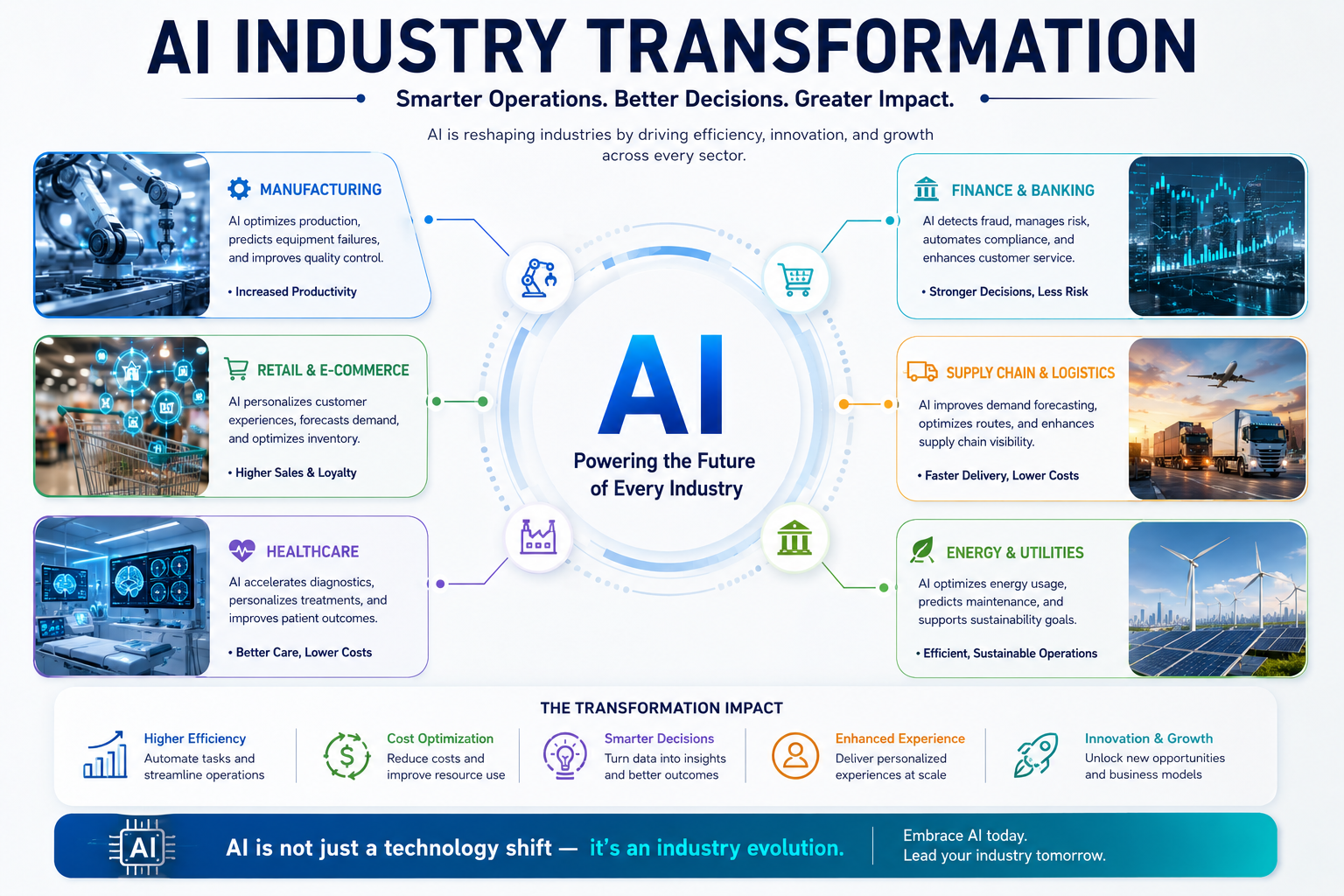
AI Policy — How Regulation Has Changed the Landscape
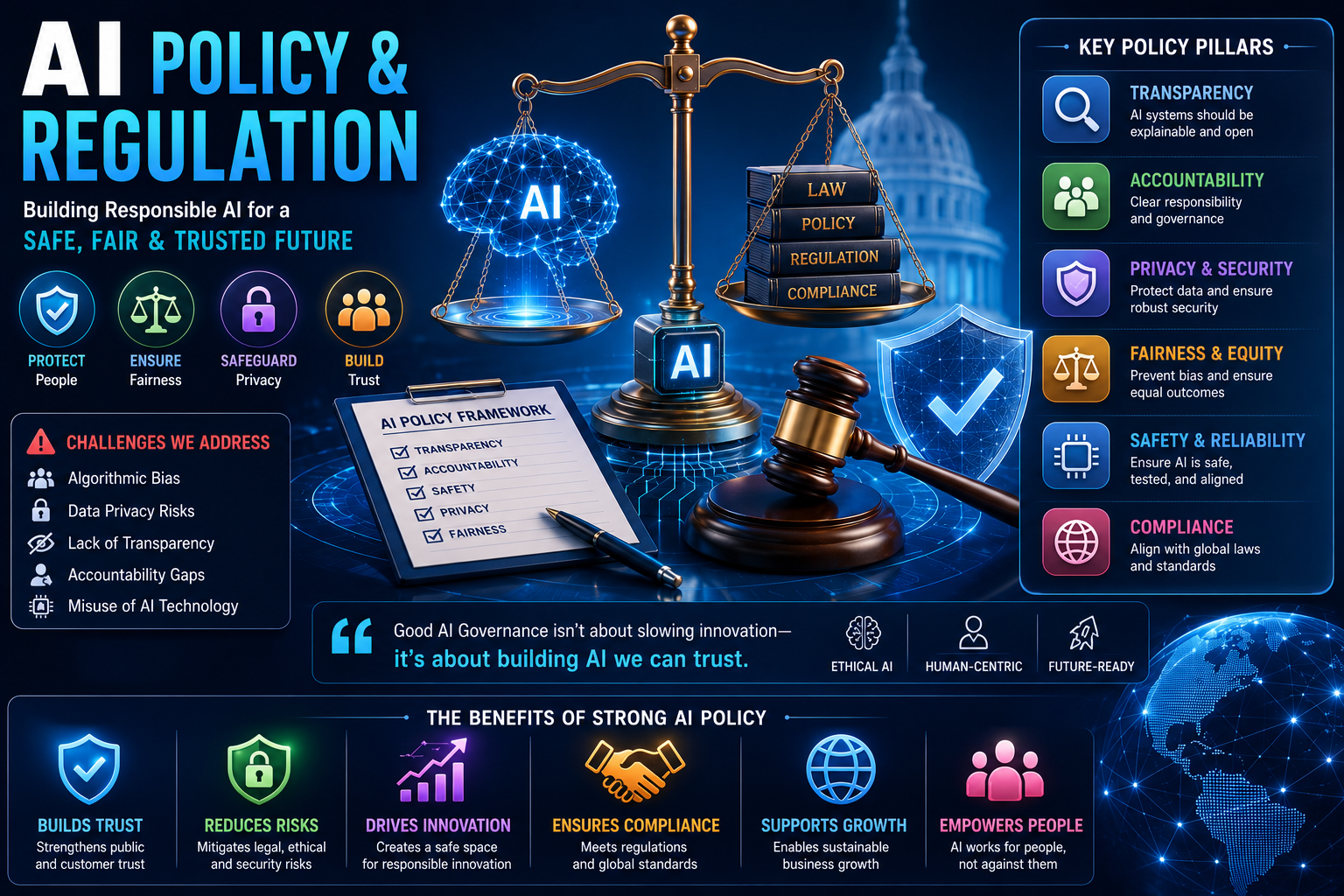
In 2022, conversations about AI policy were largely aspirational — focused on broad visions of ethical principles, innovation frameworks, and responsible development guidelines. In 2026, policy has caught up with technology.
AI is no longer just a technical challenge. It is a matter of law, governance, and public accountability. Three regulatory developments have fundamentally changed the landscape:
EU AI Act (2024)
The world's first comprehensive AI regulatory framework. Classifies AI systems by risk level from minimal to unacceptable. High-risk systems (hiring, credit, healthcare) face strict transparency and explainability requirements. Non-compliance: fines up to €35M.
US Executive Order (2023)
Triggered waves of policy development around fairness, cybersecurity, and public sector AI use. Federal agencies are now required to assess and disclose AI use. State-level legislation is accelerating — California, Texas, and Colorado have enacted AI-specific laws.
Global AI Governance
As of 2026, more than 35 countries have enacted some form of national AI strategy or legislative action. The AI Geneva Accord has secured commitment from 32 nations around transparency, fairness, and accountability. Regulators now shape the AI roadmap, not just respond to it.
Key Implication for Manufacturers: If your organization uses AI in hiring, quality control decisions, customer credit assessments, or any process affecting people's rights or access to services, you are likely operating in regulated territory under the EU AI Act or equivalent national frameworks. Explainability, audit trails, and human override capability are not optional — they are compliance requirements.
The Great Explainability Push — Making AI Trustworthy
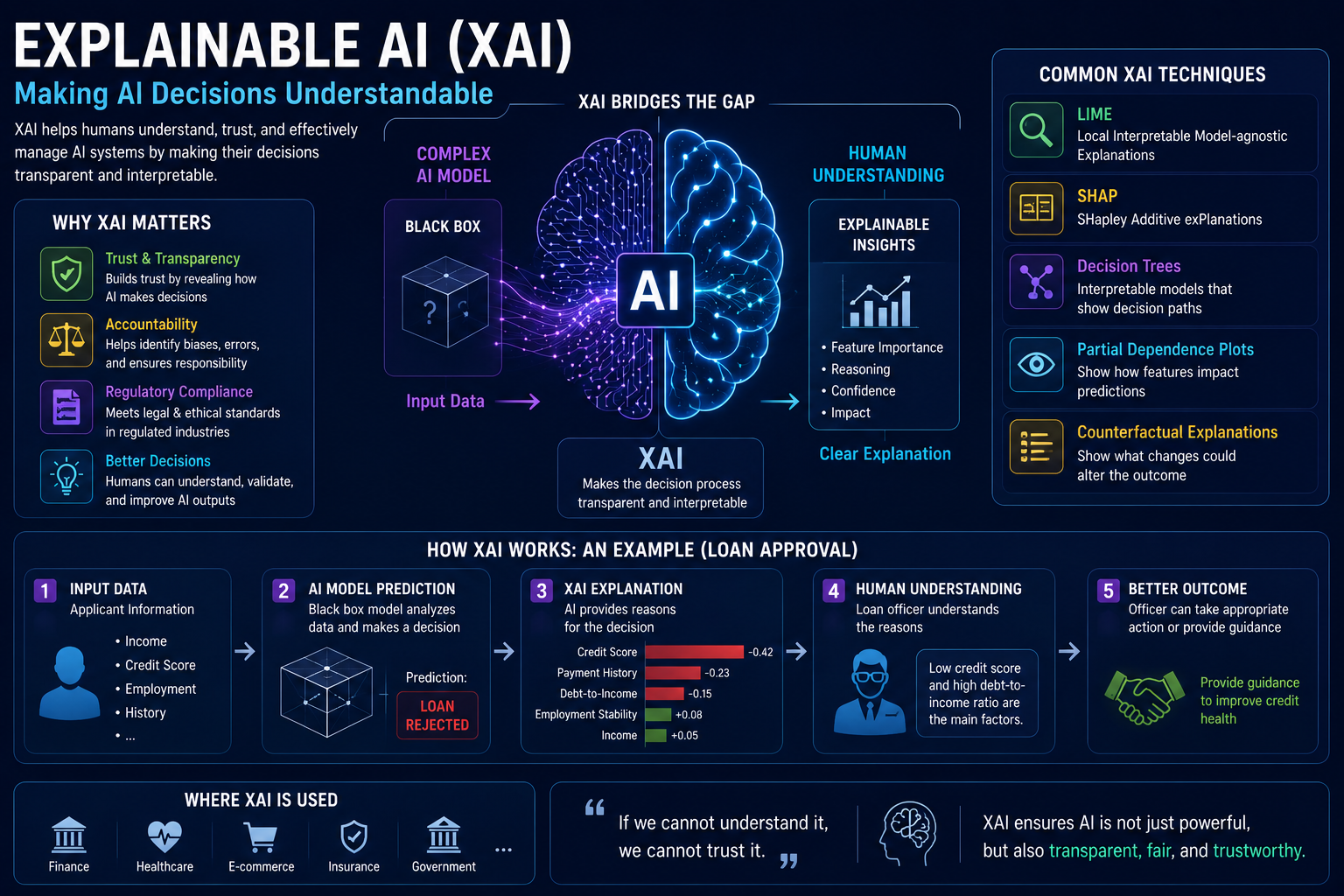
Five years ago, most AI systems were "black boxes." They made decisions, but no one — including the engineers who built them — could fully explain how or why. That was considered acceptable. Today, it is increasingly unacceptable: legally, commercially, and ethically.
Explainable AI (XAI) is now a key priority across research and real-world enterprise deployments. In industries like healthcare, finance, criminal justice, and manufacturing, people need to understand how AI systems reach conclusions — especially when those conclusions affect lives, money, or legal outcomes.
Several converging forces are driving this shift:
- Regulation: The EU AI Act's Article 13 requires "appropriate levels of transparency" for high-risk AI systems. Regulators can no longer be told "the model decided."
- Commercial necessity: According to Gartner research, 73% of enterprise clients in regulated industries now require AI systems to include an explanation layer before signing deployment contracts.
- Trust as competitive advantage: Organizations that can demonstrate explainable, auditable AI are winning contracts that black-box competitors are losing.
The tools for achieving explainability are now mature and widely available: SHAP (SHapley Additive exPlanations) for feature attribution, LIME (Local Interpretable Model-Agnostic Explanations) for individual decision explanation, IBM's AIX360 toolkit for enterprise compliance, and Microsoft's InterpretML combining glass-box and post-hoc approaches. These are not experimental research tools — they are production-grade infrastructure.
The deeper point is that explainability is no longer just for researchers or ethics experts. It is a business must-have and, in an increasing number of jurisdictions, a legal requirement. Organizations building AI without explanation layers are not just operating unethically — they are operating with legal exposure.
Ambient AI — When AI Fades Into the Background
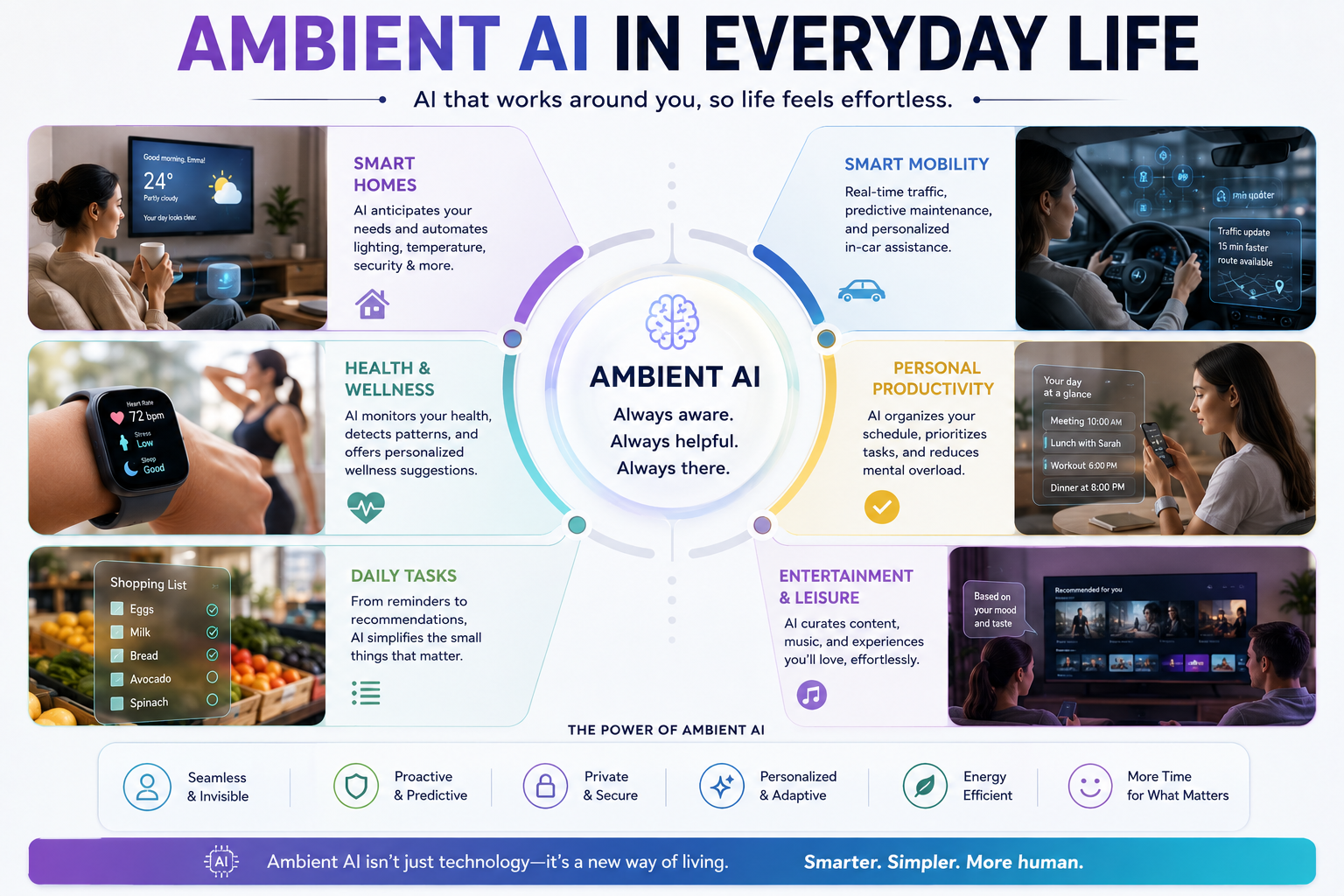
Look around, and you might not see it. But AI is everywhere. It hums quietly beneath the surface of modern life, making decisions before you notice they need to be made.
- 70% of the videos you see on TikTok are ranked and served by AI algorithms
- The email that reached your inbox — and the one that did not — was sorted by AI
- City traffic systems in smart urban areas increasingly rely on AI to manage flows
- The product recommendation that made you buy something was generated by AI
- The fraud that did not happen on your credit card was stopped by AI
What once felt like futuristic demos — voice assistants, recommendation engines, language translation — have evolved into something subtler and far more pervasive. AI is not a feature anymore. It is the operating logic of the modern world.
This ambient AI represents both a triumph and a profound challenge. We have reached a moment where children interact with AI — voice assistants, recommendation engines, smart toys, personalized educational apps — before they learn cursive handwriting. The normalization of AI into daily routine is not just a technical milestone. It is a cultural shift that will shape how future generations understand knowledge, autonomy, and trust.
"AI no longer feels cutting-edge. It feels like infrastructure. And that makes it more powerful — and more important to scrutinize — than ever before."
— HonestAI Magazine · How AI Has ChangedThe challenge of ambient AI is the challenge of infrastructure: most people only notice it when it fails. The decisions being made by ambient AI systems — what information you see, what opportunities you are shown, what credit you are offered — operate largely outside of conscious awareness. Making those systems transparent, fair, and accountable is not a technical problem. It is a governance problem. And governance requires human attention, human regulation, and human accountability.
How GrayCyan Helps Organizations Navigate AI Transformation
Understanding how AI has changed is the first step. Acting on that understanding is the second — and it is where most organizations get stuck.
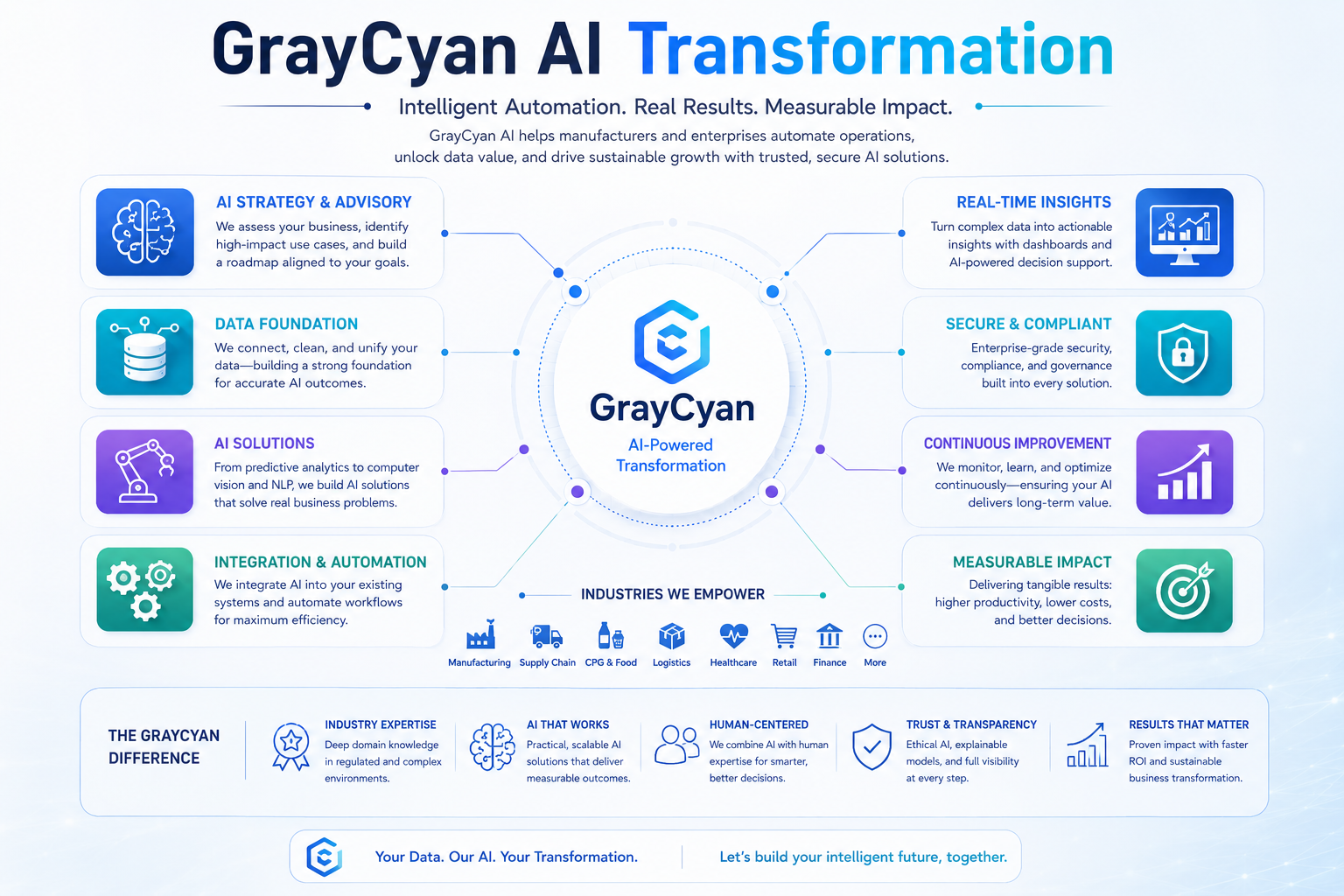
GrayCyan works with manufacturers, food and beverage operators, and B2B service companies to deploy AI that delivers measurable transformation, not endless pilots. Every engagement starts with an AI Readiness Assessment: documenting your current process costs, identifying the highest-value automation opportunities, and defining the ROI metrics we will measure against.
No Black-Box AI
Every AI decision includes a transparent reasoning trail. Your team can see why the system made any recommendation, and override it at any time. This is how we satisfy explainability requirements and build the internal trust that makes AI adoption stick.
Human-in-the-Loop Architecture
AI handles the volume. Humans retain control of approvals, exceptions, and overrides. This HITL model is not a compromise — it is the architecture that produces the highest ROI, because it combines AI speed with human judgment.
ERP & System Integration
AI that requires a new login does not get used. We embed directly into your existing systems — SAP, Oracle NetSuite, Salesforce, Microsoft Dynamics — so AI enhances your current workflows rather than creating parallel ones.
Book a free AI Readiness Assessment with GrayCyan AI Solutions. We will map your highest-value AI opportunities, document your baseline metrics, and build a deployment plan that delivers measurable results — not promises.
Frequently Asked Questions
How has AI changed the world? ▾
AI has changed how businesses operate, how work gets done, and how decisions are made across virtually every sector. From generative AI tools used by 500M+ people daily to agentic AI running enterprise workflows — the change is structural, not just incremental. The most significant shifts: the move from reactive to predictive operations in manufacturing and logistics, the restructuring of knowledge work around AI assistance, and the emergence of regulatory frameworks governing AI for the first time.
What is the history of AI? ▾
AI history spans 70+ years: rule-based expert systems (1950s–80s), machine learning and statistical models (1990s–2000s), deep learning revolution (2012–2020), large language models (2020–2022), generative AI explosion (2023–2024), and the agentic AI era (2025–present). Each era built on the last — and each era produced predictions about AI's capabilities that were both too optimistic in the short run and too pessimistic in the long run.
What is AI business evolution and adaptation? ▾
AI business evolution describes the process by which organizations move through three phases: experimentation (pilots and proofs of concept), integration (AI embedded in existing workflows with measurable ROI), and transformation (AI redesigning how work happens). Adaptation refers to the organizational change management required at each phase — the technical deployment is often easier than the people and process changes that make it stick.
How will AI change the future of work? ▾
AI will shift human work from execution to oversight — from doing tasks to orchestrating AI systems that do them. The biggest change: agentic AI that runs multi-step workflows autonomously, freeing humans for judgment-intensive work. The roles most affected are information processing, scheduling, drafting, and data analysis. The roles least affected are skilled trades, care work, strategic leadership, and creative work requiring lived experience.
What is the future of AI in manufacturing? ▾
AI in manufacturing is moving from isolated pilots to full integration — quality control AI on production lines, agentic ERP systems for automated scheduling and procurement, and predictive maintenance reducing unplanned downtime by 30–50%. The next phase: autonomous agents that not only detect problems but initiate corrective workflows, adjusting production schedules, engaging suppliers, and escalating exceptions — all within approved human-defined guardrails.
What is AI transformation consulting? ▾
AI transformation consulting helps organizations deploy AI that delivers measurable operational change — not just access to tools, but redesigned workflows with human oversight, system integration, and ROI measurement frameworks. The best AI transformation partners start with a baseline audit, define success metrics before deployment, and measure against them rigorously afterward. GrayCyan's approach: AI Readiness Scorecard → HITL deployment → measured outcomes.
What is the future of generative AI? ▾
Generative AI is evolving from a content creation tool to an operational backbone — embedded in ERP systems, supply chains, customer service, and research workflows. The next phase: generative AI that does, not just describes. Rather than generating text for a human to act on, generative AI is increasingly the engine that drives agentic workflows — drafting the purchase order, summarizing the supplier email, generating the audit report, all as part of automated operational processes.