



The shift from cloud-based to local and decentralized AI is no longer theoretical. It is now the dominant direction of enterprise AI, with local LLM deployments and on-device AI becoming practical options for businesses that value privacy, speed, and operational control. Rather than sending sensitive information to cloud providers, organizations are increasingly running on device AI models on laptops, edge devices, private servers, and on-premise infrastructure.
This quarterly roundup tracks the most important developments shaping the local AI ecosystem. Instead of focusing on consumer chatbots, it highlights the technologies changing how enterprises deploy AI securely and cost-effectively.
Inside, you'll find updates on four key themes: the latest local LLM models and tools, edge AI deployments across industries, federated learning that enables collaborative AI without sharing sensitive data, and decentralized AI infrastructure that is making high-performance computing more accessible beyond the largest cloud providers.
Whether you're evaluating AI for manufacturing, healthcare, or enterprise operations, understanding these trends will help you make informed technology decisions as local and privacy-first AI continues to mature throughout 2026.
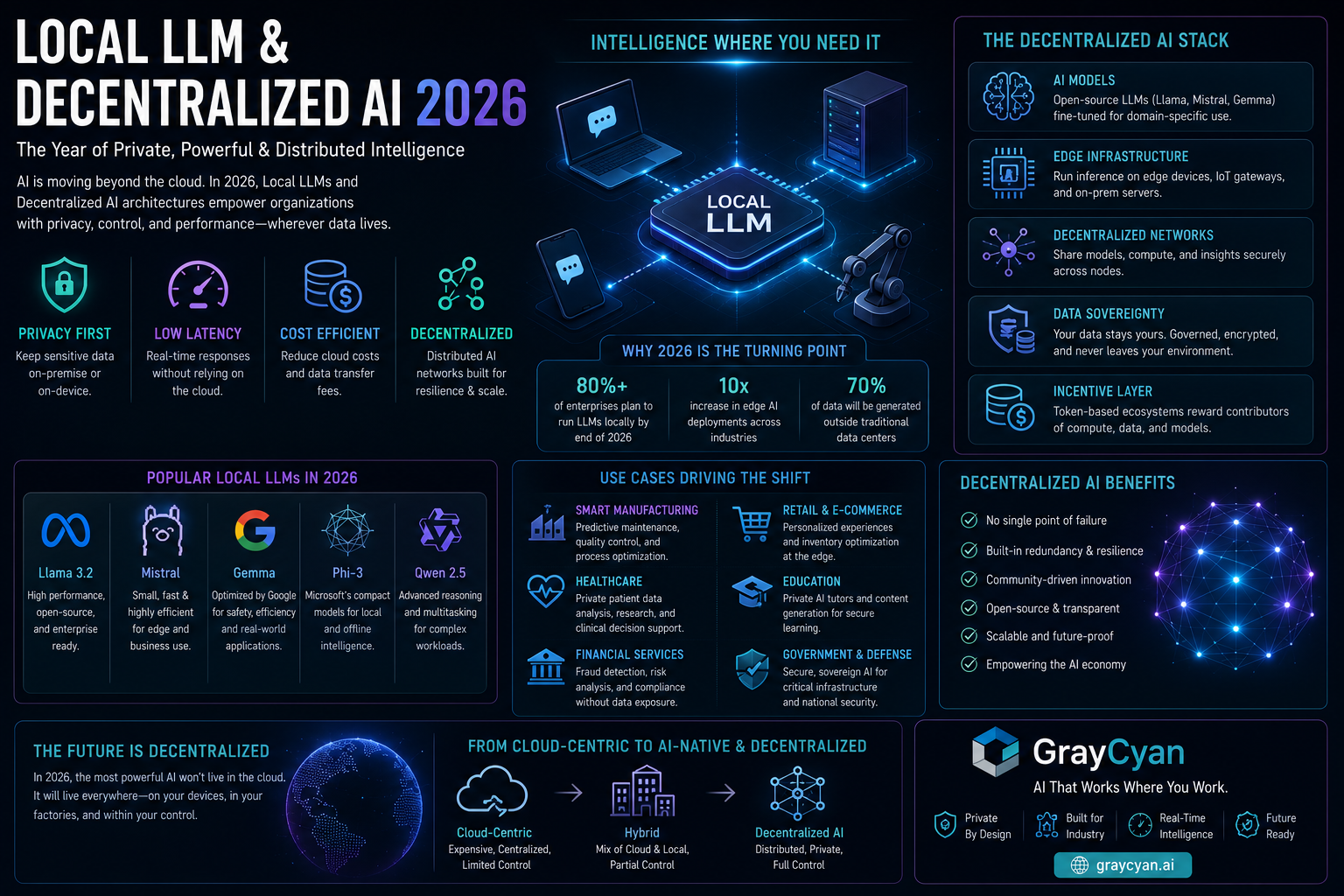
Local LLM and decentralized AI 2026 — the shift from cloud-first to privacy-first enterprise AI
What Is Local AI — and Why It's Replacing Cloud for Many Use Cases
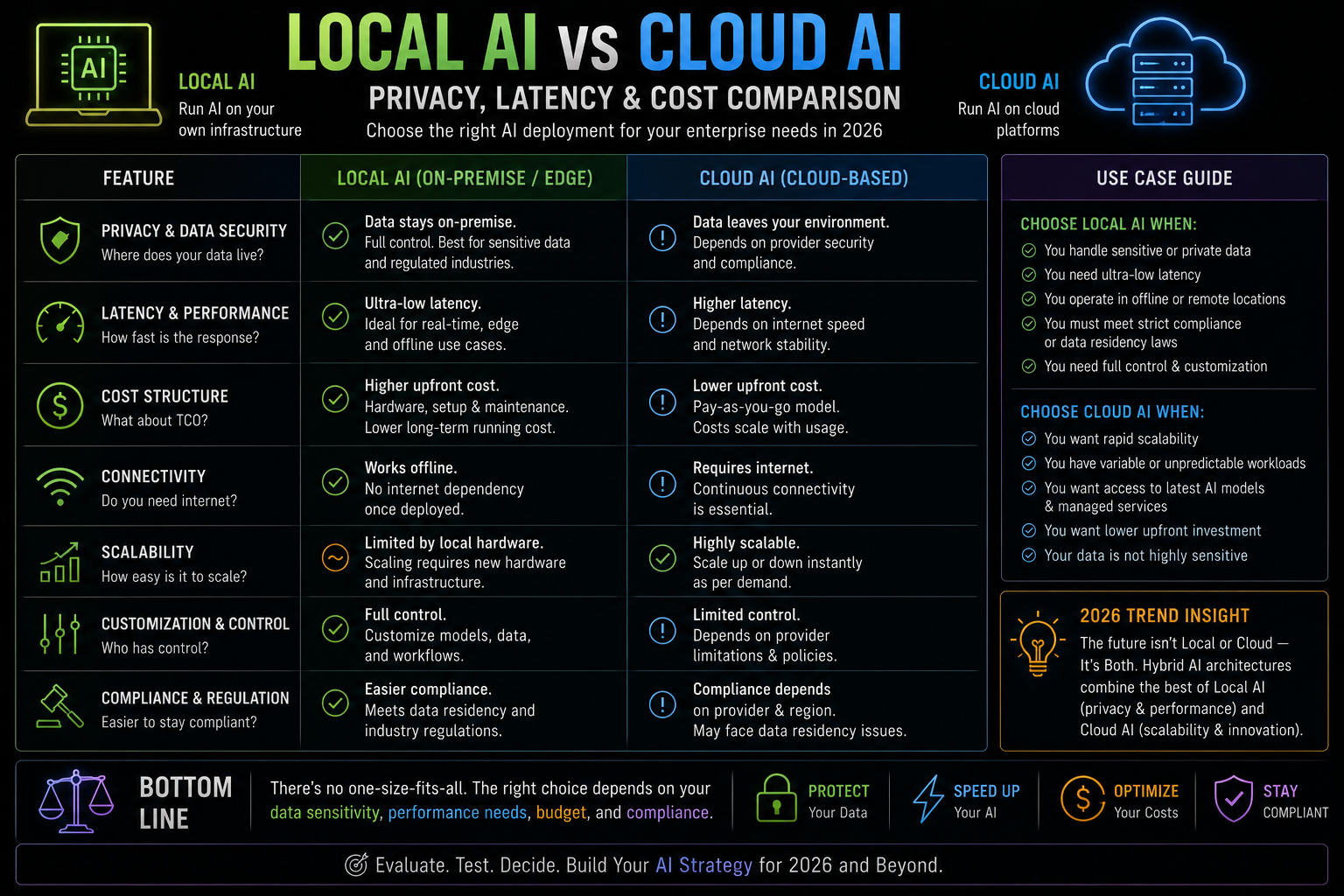
Local AI vs cloud AI — comparing privacy, latency, and cost for enterprise deployment
Local AI is the term used for AI models that can function locally on a device, a private server, or on edge infrastructure without transmitting all of its calls to the AI service in the cloud.
The use of local AI is increasing due to the following three benefits.
Privacy
As data remains local to the device or network, no transmission of sensitive data to an external cloud vendor is necessary. Local AI is particularly useful for manufacturers, hospitals, banks, and other enterprises that handle sensitive data regarding their operations or customers.
Latency
Local AI reduces latency by removing the process of sending requests to the remote server and waiting for the answer. It enables near-instant processing and, therefore, allows for real-time decision-making for use cases like quality control, robotics, automation in manufacturing, autonomous driving, or predictive maintenance.
Costs
When companies cloud AI solutions, they typically have to pay for every request sent through the APIs at usage-based rates. Local model execution does not involve any recurrent costs and, thus, becomes economically more beneficial after the initial setup expenses.
The two technologies, namely Edge AI vs vs cloud AI, comes down to how best they can be used in any particular situation since neither will completely replace the other. While Cloud AI technology continues to serve its role in training massive neural networks and performing high computations, local and edge AI technologies are better suited for cases where privacy and reliability become a priority. Enterprises today have found that a combination of the two serves their purposes best.
Local LLM News — Q2 2026
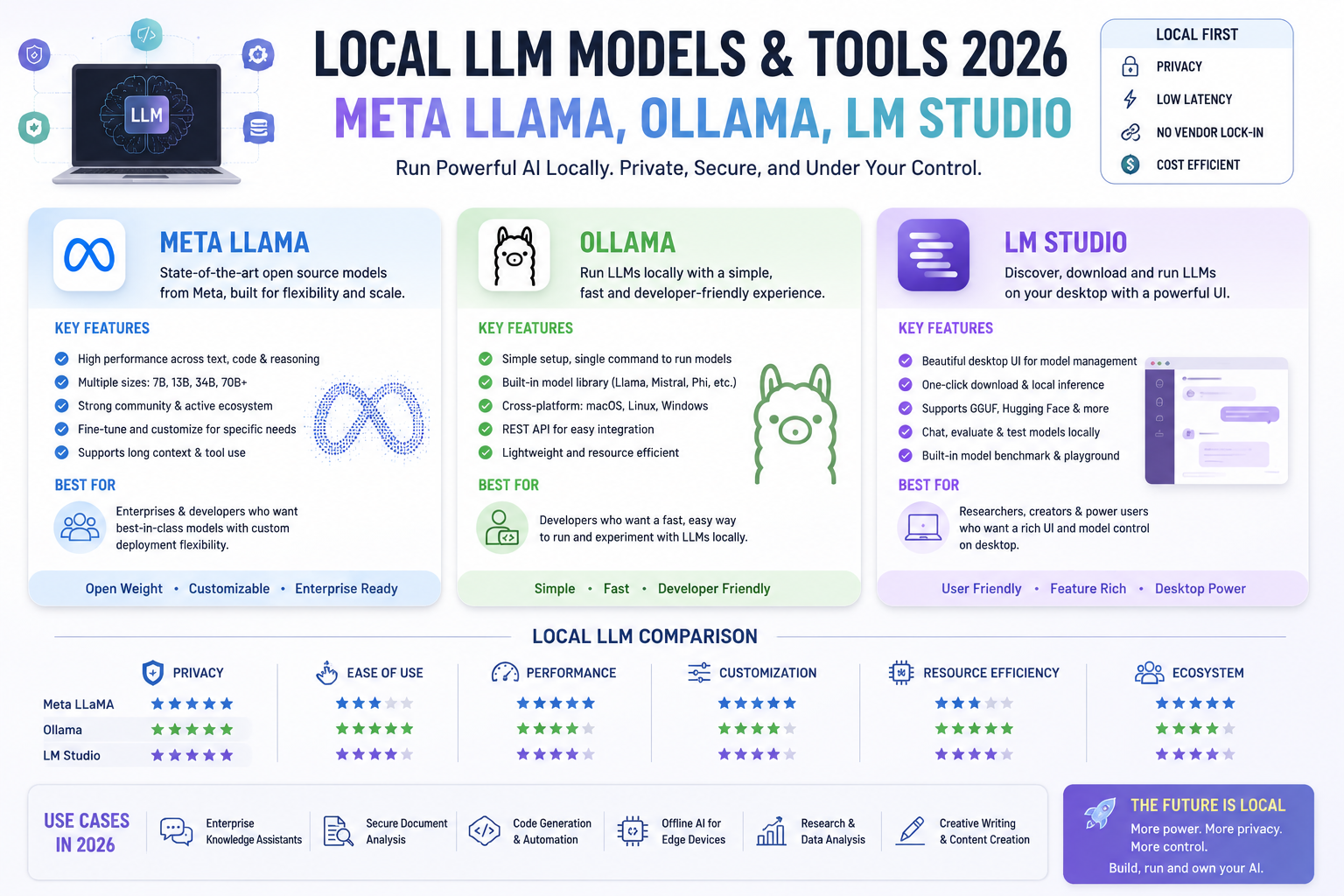
Meta LLaMA, Ollama, and LM Studio continue to lead the local LLM ecosystem in 2026
Meta LLaMA: Local AI's Most Important Model Family
Meta's family of LLaMA models remains at the heart of the open-source local AI paradigm, with Llama 3.3 emerging as the standard for developers and enterprises creating AI systems that do not require access to cloud services. Known as one of the best local LLM today, the models are characterized by excellent reasoning capabilities and code generation skills along with good performance on local devices.
Another important reason why LLaMA models are popular is their versatility. With 4-bit and 8-bit quantization, the models can run on consumer-grade hardware without using enterprise-grade clusters with GPUs. Local LLM hardware requirements for running local LLM models usually depend on the size of the model. Easier-to-use 8B models will typically work fine on GPUs with 8-12 GB of VRAM or even newer Apple Silicon Macs, while larger models will require more GPU memory or multiple GPUs. On consumer-grade hardware, optimized runs will produce approximately 10-20 tokens per second.
The open design of LLaMA makes it possible to conduct fine-tuning in-house, utilize Retrieval-Augmented Generation (RAG), and deploy LLaMA on-premises without any of the company's sensitive data leaving the premises. Given the growing popularity of AI solutions that can be implemented locally, the LLaMA framework by Meta is a very robust foundation indeed.
Ollama: The Tool Making Local LLMs Accessible
In terms of local AI apps, Ollama local LLM has emerged as the simplest way to use large language models on Windows, Mac OS, and Linux. In the period since Ollama was launched, its user base has already surpassed one million, and the app has gained popularity among developers, researchers, startups, and enterprises working with local AI.
Its user-friendly approach is based on running the models with just one command that allows downloading and using popular models such as Llama, Qwen, Mistral, Gemma, DeepSeek, Phi, and Code Llama in a few minutes' time. Some of the latest developments in the platform have included support for multimodal models, custom model files, APIs, and an official Python SDK in order to make local LLMs easier to implement in business applications.
The fact that it is lightweight has made Ollama popular in the case of enterprise proof-of-concept, internal copilots, document search, and coding assistants when companies want full control over their data. They are able to avoid using any external API providers and deploy AI locally without unpredictable operational costs and extra privacy risks.
LM Studio & the Local LLM Desktop Ecosystem
IM studio local LLM desktop app is arguably among the most widely used graphical user interfaces for locally executing AI models without using the command line. Individuals have access to hundreds of AI models and have the chance to test and monitor GPU memory, inference speed, and hardware through a desktop interface.
Apart from LM Studio, initiatives like Jan AI and GPT4All keep enhancing the local AI environment and giving individuals access to powerful language models that they can use in developing or conducting various tasks, including coding and research. This tool allows individuals to access a broad spectrum of open-source models for coding, research, and enterprise knowledge management.
In the case of developers looking for the best local LLM for coding, this desktop environment makes it possible to compare AI models and develop AI assistants without sending proprietary source code and business data to cloud AI services.
Edge AI Deployments — Q2 2026
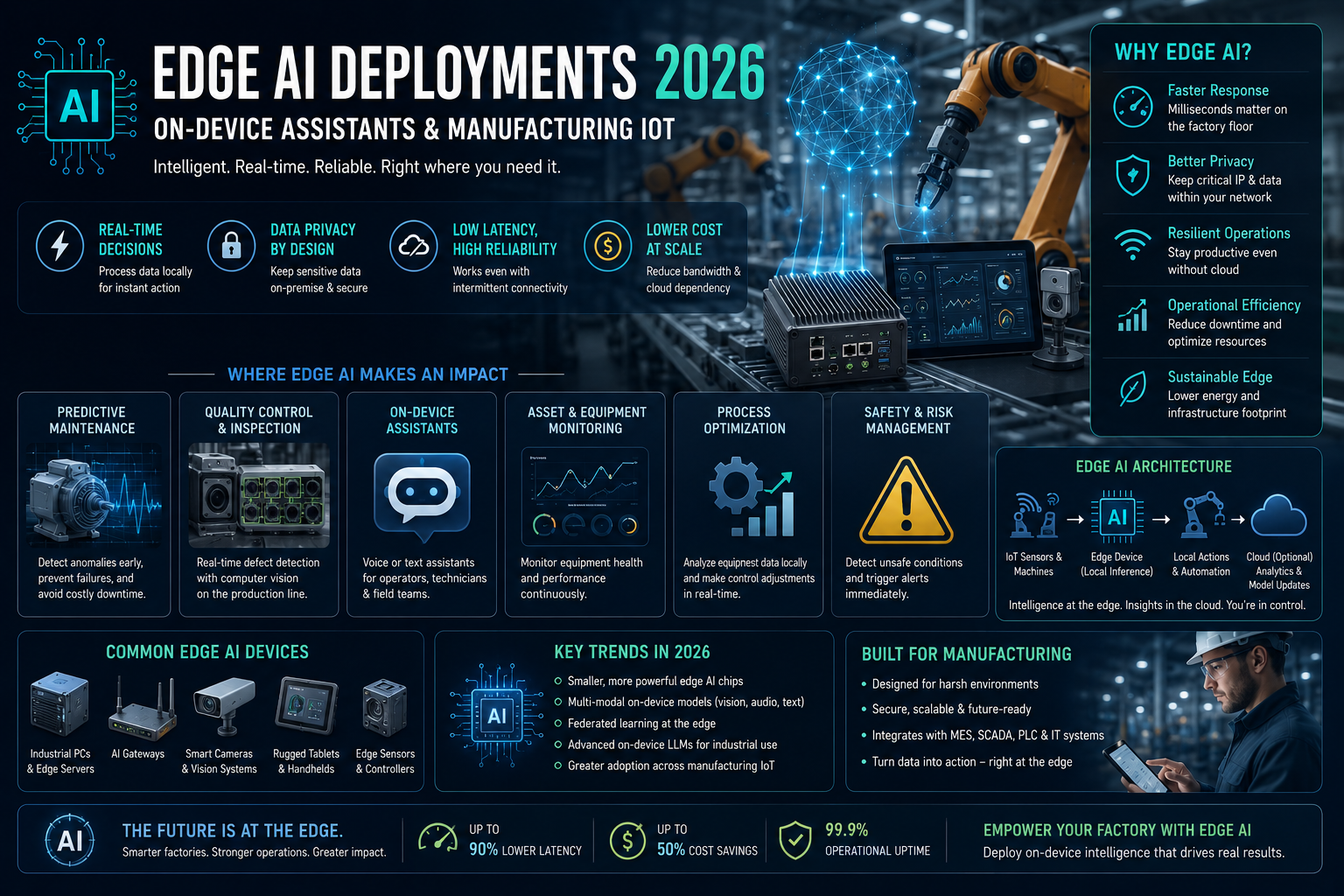
Edge AI is moving from phones and laptops to the factory floor and IoT devices
On-Device AI Assistants: The Race to Your Pocket
The most exciting Edge AI news in the world of edge AI is not about AI assistants in the making. Rather, the trend is that of Edge AI use cases being run locally on phones, laptops, and personal devices. On device AI news today from the frontiers of device AI reveals that big tech companies have started to take away their essential AI features from the cloud and make them accessible on consumer devices.
Apple on-device AI news reports that Apple continues its work on developing Apple Intelligence by adding local computing along with Private Cloud Compute, which enables performing activities like writing help, notifications summary, image creation, and voice interaction while ensuring that personal information stays local on the device.
Gemini Nano follows a similar approach, as Google allows the use of AI-based features on Pixel phones without being connected to the cloud continuously, for summarization, transcription, and context-aware help. Samsung too is working towards making Galaxy AI a reality by adding more local processing to the flagship smartphones that use this technology.
It is evident that the overall trend in the industry is towards developing AI assistants from cloud-based applications to a hybrid approach, wherein basic requests can be processed locally, whereas the complex ones need to be handled by the cloud.
Edge AI in Manufacturing and IoT
Use cases that provide the most benefit for Edge AI IOT are being discovered on the factory floor and not with end consumer products. With the implementation of AI near machinery, decision-making capabilities are possible even without a constant internet connection.
There is already an example of edge AI that is used by John Deere in their tractors that can assess soil quality and water needs on the spot on farm equipment without any internet connection needed.
AI is being rapidly implemented in manufacturing in many forms of IoT deployments on the edge. Defect detection with the help of vision AI technologies is taking place right there on the assembly line. Smart cameras are assessing components in a split second.
The development of the Internet of Things Edge AI is revolutionizing predictive maintenance as well as sensors that are integrated into production machinery for analysis of vibration, temperature, and performance metrics in real time to predict equipment failure before it occurs. In logistics operations, edge AI is enabling AMR, asset tracking, worker safety, and routing optimization without relying on cloud delay.
Edge AI on premises is helping manufacturers of production-sensitive data to become compliant with regulations easily while minimizing bandwidth cost.
Hugging Face Transformers.js: AI in the Browser
Transformer.js keeps building up its influence for browser-based AI by allowing developers to execute language models, image models, and embeddings in the current version of modern web browsers by using the power of WebGPU. This project has emerged as one of the most popular open-source frameworks for browser-based AI, thanks to the support of its large GitHub community.
In terms of enterprises, browser-based local AI gives another alternative to deploy AI that will keep all documents, customer data, and user interactions stored on the client's device rather than being sent to any server outside.
Federated Learning – How AI Trains Without Sharing Your Data
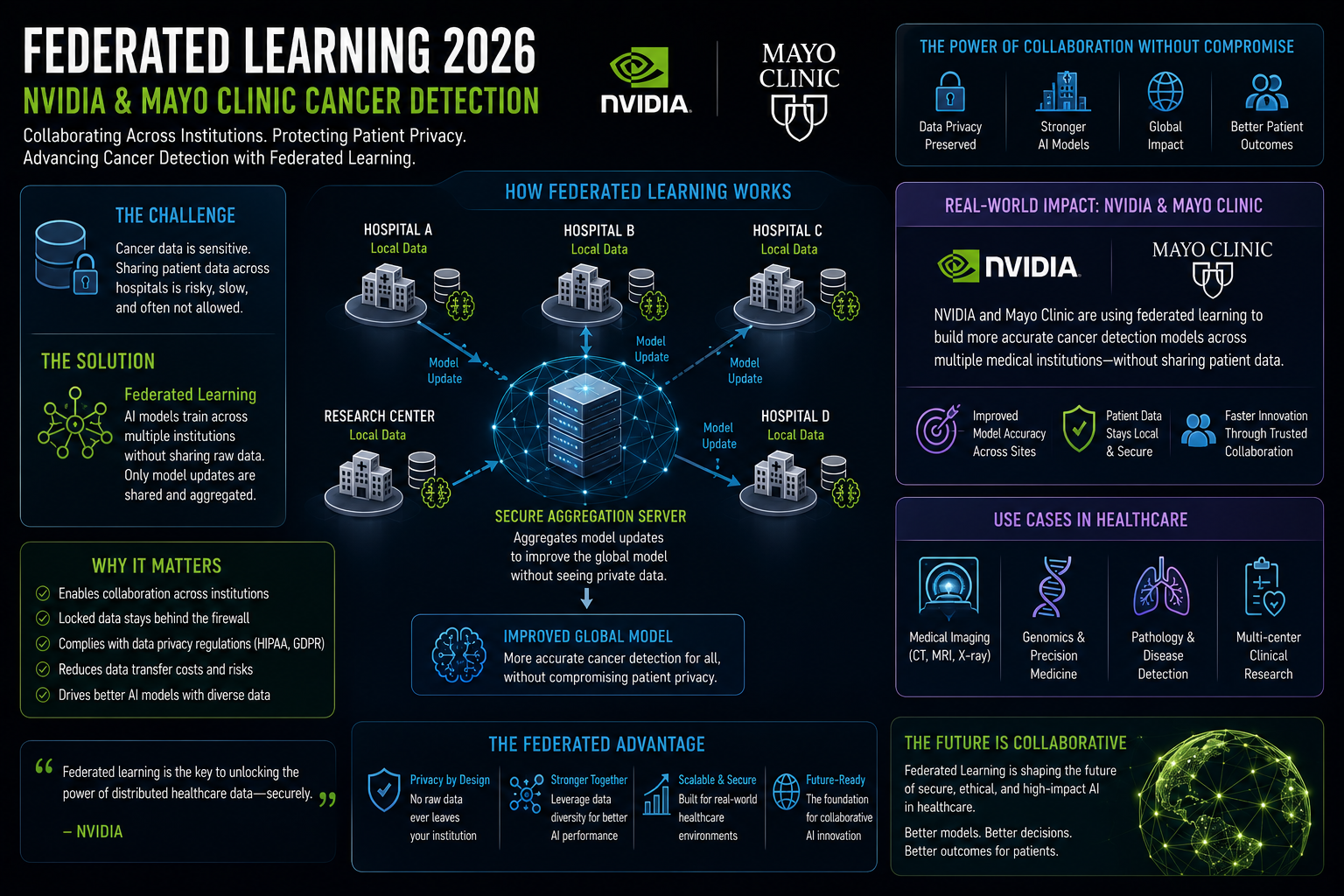
Federated learning lets AI models train across institutions without moving sensitive data
What Is Federated Learning?
The federated learning architecture for AI training implies that the machine learning algorithm goes to the data instead of the data coming to the machine learning algorithm. Instead of gathering confidential information in one place in a database, each institution, such as hospitals, factories, or devices, trains the AI locally, based on its data. The model update results are then aggregated in order to enhance the whole system. Thus, the federated learning system enables organizations to keep their confidential data at their location but still be able to use the power of improvements to AI systems together.
Case Study – Nvidia & Mayo Clinic: Cancer Detection Without Data Sharing
With the rapid development of Artificial Intelligence (AI), it has become a helpful technology for medicine, yet the sharing of personal patients' information between hospitals and the cloud may pose significant risks regarding data security. The issue was solved by Nvidia and the Mayo Clinic as they started running a pilot program based on federated learning that involves more than 40 hospitals.
Rather than transporting patients' data to one common database, the algorithm travels to every single hospital where it undergoes the process of training using local databases. Then, the updated AI returns without carrying any personal data of the patients. The system is based on NVIDIA FLARE, a platform created to run federated learning projects in a distributed healthcare environment.
The deployment incorporates several important privacy protections:
Differential privacy
Prevents individual patients from being identified.
Secure enclaves
Protect sensitive information during computation.
On-premises computing
Hospitals never need to upload confidential records to external cloud environments.
As per the report, there has been an estimated increase of 25% in the accuracy of cancer detection with total HIPAA compliance and no direct access to patients' information. With the continuous rise in federated learning projects in healthcare systems in 2026, this project has emerged as one of the most successful examples of federated learning applications and how organizations can tackle privacy concerns with AI in healthcare while complying with healthcare regulations.
Federated Learning Applications Beyond Healthcare
Federated Learning is also useful outside of the hospital setting. Banks can use Federated Learning applications in 2026 to build better fraud models across several banks while maintaining the privacy of transactions made by their customers. Manufacturing companies make use of Federated Learning applications 2026 to build defect detection models in multiple factories without revealing the manufacturing data. Even companies building autonomous cars are using federated learning to improve the performance of the driving models without having to upload the sensor data of all trips made.
Decentralized AI Infrastructure – Q2 2026
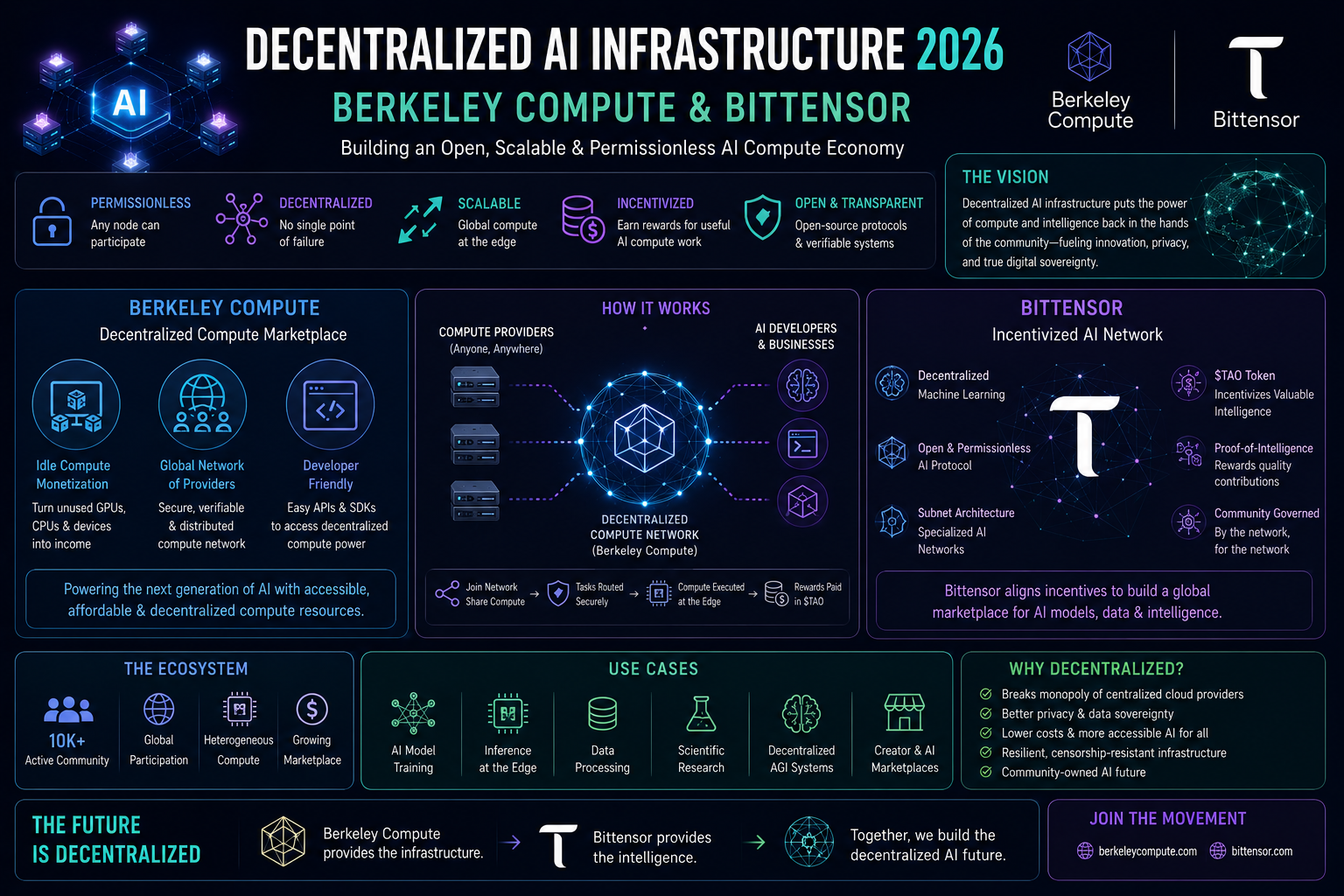
Decentralized GPU networks like Berkeley Compute and Bittensor are reshaping AI compute economics
Berkeley Compute & the Decentralized GPU Mesh
The decentralized AI movement keeps growing since companies prefer to rely on sources other than cloud giants when it comes to acquiring computing power for AI applications. One of the most popular decentralized projects in the field is Berkeley Compute. It is a company created by former Netflix executive Paul Hainsworth.
The idea behind the project is pretty straightforward – create a system where all underutilized GPUs belonging to universities, research facilities, corporations, and edge data centers can form a computing network. Instead of relying on hyperscale clouds, developers can use a common pool of computing resources.
The original network was built with over 15,000 GPU nodes, while the decentralized ecosystem keeps developing further into 2026 due to the increased demand for computing power for AI applications. Marketplaces based on distributed GPUs show that training expenses can be cut by 40%.
Not only does this strategy save on costs but also adds to the resilience of the infrastructure through workload distribution in thousands of individual nodes as opposed to concentration of load in a few large data centers. As more and more Edge AI companies take up the strategy of using distributed computing, decentralized GPU networks are gaining much more significance.
Bittensor and the Token Economy for Decentralized AI
One of the fast-growing decentralized AI projects is called Bittensor, which fuses together the concepts of Artificial Intelligence with economic incentives powered by blockchain technology. Instead of being compensated for contributing AI models, datasets, and computing power, the Bittensor Tao decentralized AI network incentivizes its members to make contributions through the reward of TAO tokens.
The AI models are not developed by a single company, but a multitude of independent developers strive to develop AI outputs that will be rewarded with the help of tokens. Through this economic incentive mechanism, Bittensor has managed to establish an innovative process of creating AI models.
Although it still remains a niche within the AI industry, Bittensor shows how AI development can be made more decentralized without having companies spend billions of dollars to build data centers.
Why Decentralized AI Matters for Mid-Market Manufacturers
The decentralized AI infrastructure is a boon for manufacturers and other mid-size firms, offering them visible benefits apart from technological trends. Cheaper power allows manufacturers to use cheaper compute power to train AI models and thus avoid the costs that used to hinder advanced AI projects for small-scale firms. The firms may further train AI models that are closer to their environment to keep production data and intellectual property safe from the cloud. With advancements in decentralized AI infrastructure, manufacturers can leverage enterprise-level AI without investing in big GPU clusters.
Best Local LLM Tools in 2026 – What to Run and How
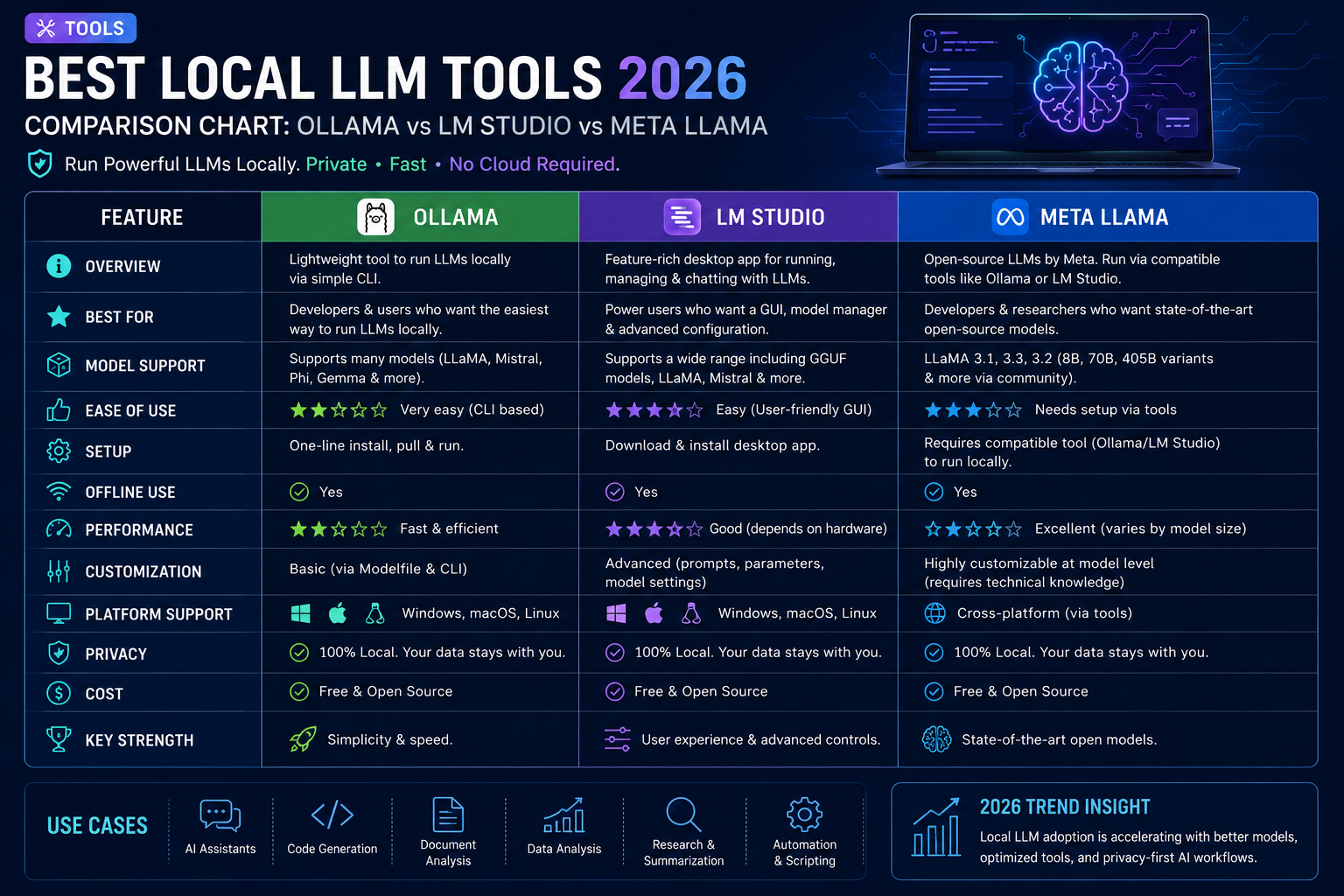
Ollama vs LM Studio vs Meta LLaMA — feature and hardware comparison for 2026
Selecting the best local LLM llm will depend on what you want to achieve, your technical skills, and your hardware setup. Prior to downloading any model, it is imperative that you know the local LLM hardware requirements. Models that are smaller are able to be run efficiently in a modern laptop that has 8GB to 16GB of RAM, but models that are bigger may require specialized hardware like GPUs that need large amounts of VRAM. Quantized models have also made very strong models much more accessible, allowing programmers, scientists, and organizations to use AI on their own hardware rather than using cloud services.
| Tool | Type | Best For | Hardware Requirement |
|---|---|---|---|
| Ollama | Model runner | Fastest way to run almost any local LLM | 8GB RAM minimum (16GB recommended) |
| LM Studio | Desktop GUI | Non-technical users who prefer a visual interface | 16GB RAM, dedicated GPU recommended |
| Transformers.js | Browser runtime | Offline browser applications and web-based AI | Runs directly in modern browsers with no installation |
| Meta LLaMA 3.x | Base model family | General-purpose AI, reasoning, and local LLM for coding | 8B: RTX 3060 or Apple M2; 70B: 48GB+ VRAM |
| Jan AI | Desktop app + API | Privacy-focused enterprise deployments | 8GB RAM minimum |
The best tool for beginners would be Ollama because it downloads, manages, and runs popular models easily through commands. Many developers use it in combination with code editors or APIs to create production-level applications powered by Artificial Intelligence within just a few minutes.
The tool for people who like to have graphical user interfaces would be LM Studio because it allows downloading, benchmarking, and talking to models without any command-line knowledge.
On the other hand, Transformers.js would best suit the needs of web developers as the models run within the browser. It offers offline AI capabilities and stores all the user information locally without the need to send requests to the cloud servers.
Meta LLaMA 3.x is a great family of open-weight models for enterprises creating their custom AI-powered solutions because it provides the best reasoning, multi-language capabilities, and coding performance among other things.
Finally, Jan AI offers the perfect combination of privacy and enterprise capabilities for companies that want a convenient desktop application and an API at the same time. Altogether, the presented tools create a mature system of local AI for everyone.
How GrayCyan Deploys Local AI for Manufacturers
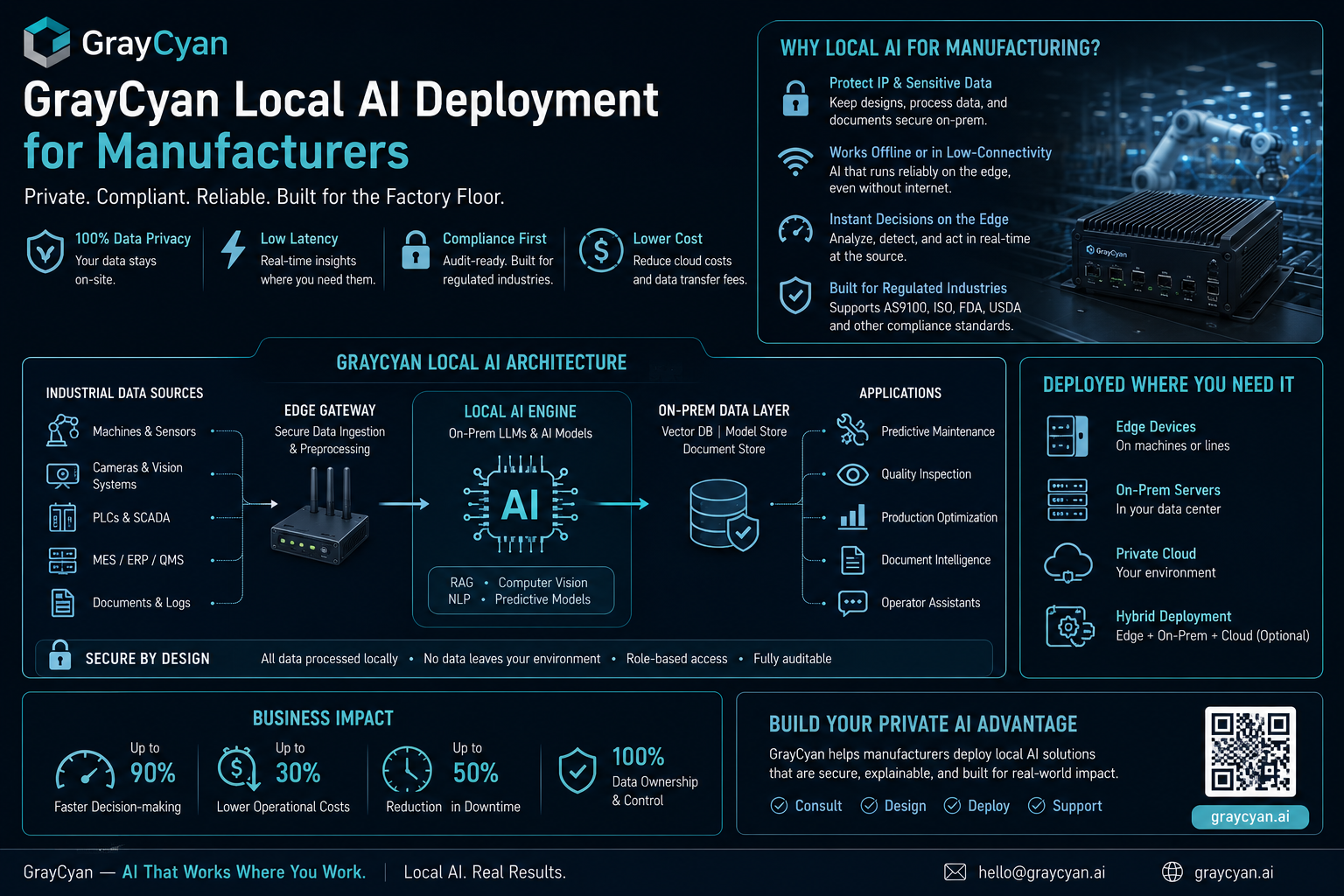
GrayCyan integrates local AI directly into manufacturers' ERP, MES, and document systems
The trend towards local-first AI adoption in enterprises is disrupting the way manufacturers are adopting AI. Whereas most firms start their AI journey through cloud-based AI solutions, a local AI solution becomes necessary in the manufacturing context. The manufacturing data, ranging from ERP, scheduling, quality inspections, vendor documents, engineering drawings, and procedures, usually has classified content and should be kept in the company's internal network only.
GrayCyan responds to this demand by offering local AI solutions that integrate right into the company's ERP, MES, document management, and production systems. Rather than transmitting sensitive data to third-party AI service providers, the models can be hosted locally or internally to provide manufacturers with greater control, among others.
With knowledge-based work, GrayCyan RAG AI Manufacturing solutions employ local vector databases and on-premises model inference, enabling users to look up technical manuals, SOPs, maintenance logs, and engineering documents by way of natural language queries without disclosing confidential information. This way, the user gets quick results and keeps their company's critical knowledge safely within the premises.
Companies that implement local AI now benefit from enhanced data management, reduced operational expenses, and increased flexibility amid constant AI advances. Find out more by taking advantage of GrayCyan's solutions for RAG AI Manufacturing and Custom AI Assistants.
Set up a consultation with GrayCyan to discover the most suitable architecture for your manufacturing facility.
FAQs
Deploy Local AI Built for Your Manufacturing Floor
Set up a consultation with GrayCyan to discover the most suitable local AI architecture for your manufacturing facility.
Schedule a Consultation