Manufacturing Isn't Built on Machines. It's Built on Principles.
Why the Best Manufacturing Leaders Focus on People, Quality, and Operational Discipline Before They Focus on AI
Interview by Nishkam Batta, Founder, HonestAI Magazine




This interview is part of Manufacturing AI Magazine's ongoing series featuring leaders who are shaping the future of manufacturing, industrial operations, and artificial intelligence. In this conversation, Nishkam Batta, Founder of HonestAI Magazine, speaks with Justin from Epic Canning about building manufacturing facilities from the ground up, creating high-performing teams, maintaining uncompromising quality standards, and adopting artificial intelligence in practical ways that strengthen and not replace the human expertise.
Spend enough time talking to manufacturing leaders, and one pattern becomes impossible to ignore. The most successful manufacturers rarely begin by talking about artificial intelligence.They don't start with automation.They don't start with digital transformation.
Instead, they begin with something much more fundamental. Only after those foundations are firmly established do they begin discussing technology.
That perspective immediately stood out during my conversation with Justin from Epic Canning.
At a time when AI dominates manufacturing headlines, Justin repeatedly redirected the conversation back to operational discipline. Technology, he explained, is important but it only creates meaningful value when an organization has already built strong processes, empowered people, and a culture of accountability.
Epic Canning is a fast-growing beverage co-packing company that specializes in helping brands bring canned and bottled beverages to market at scale. Although the company has only recently entered production, it is built on more than a decade of manufacturing experience and the lessons Justin has learned while helping commission and build multiple manufacturing facilities.
As our conversation unfolded, it became clear that this wasn't simply another discussion about AI adoption. It was a conversation about leadership.
About building teams that take ownership. About creating systems where quality is everyone's responsibility and about why the manufacturers that will benefit most from AI are those that have already mastered the fundamentals of operational excellence.
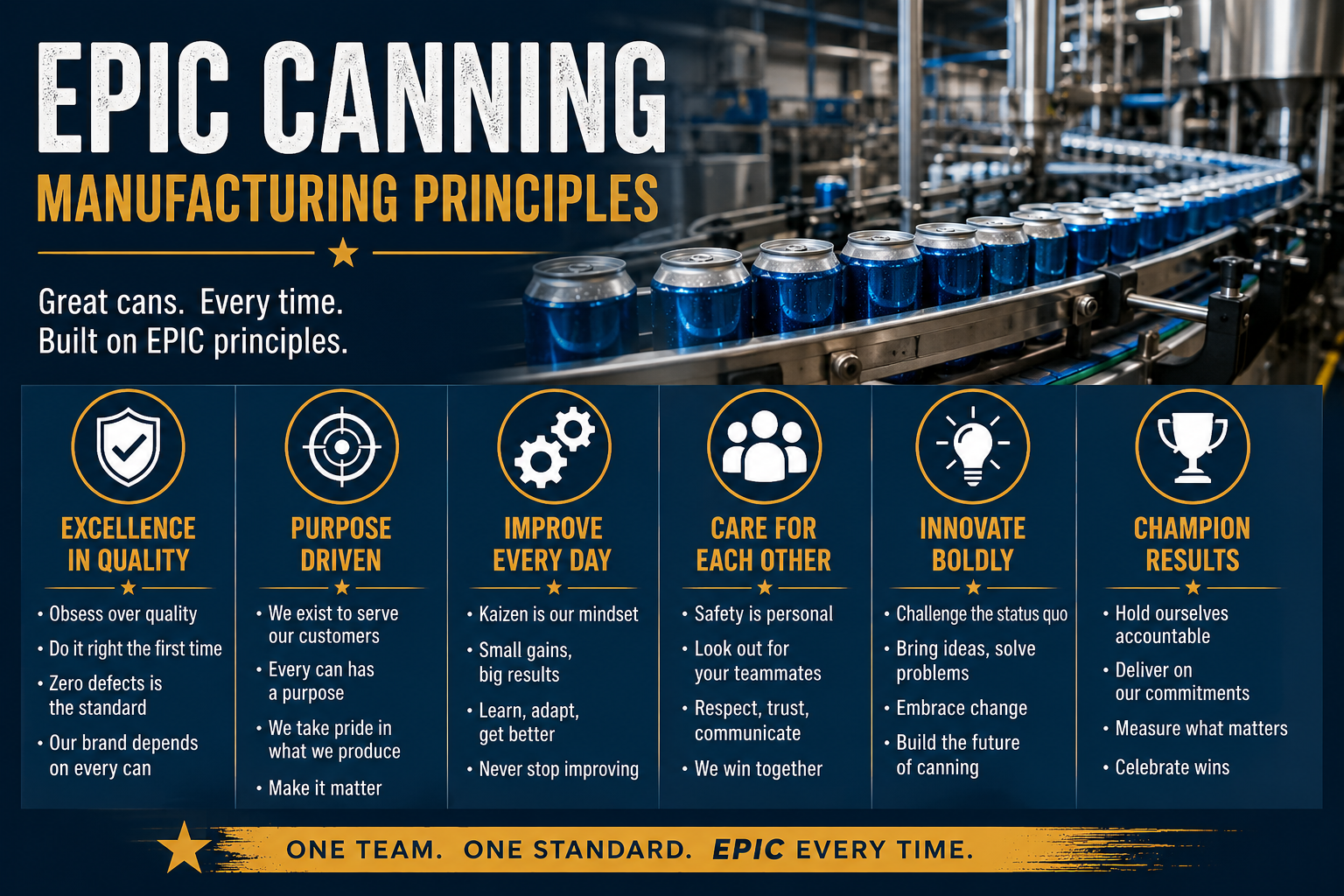
Epic Canning's Justin on why operational discipline, quality, and people come before AI in manufacturing
Building a Manufacturing Company From the Ground Up
Epic Canning's story reflects the changing dynamics of the beverage manufacturing industry.
The company specializes in beverage co-packing, helping brands manufacture canned and bottled beverages while managing the operational complexity required to deliver consistent quality at scale.
For Justin, however, Epic Canning represents more than another manufacturing facility.
It is the culmination of more than a decade spent building manufacturing operations from the ground up.
"I've been in manufacturing for just over ten years," Justin explains. "This is the fourth manufacturing plant I've helped commission and build."
His journey into co-packing began unexpectedly while working at a small distillery.
At the time, the business accepted a project to manufacture Screwball Peanut Butter Whiskey, a rapidly growing beverage brand. The team successfully completed its first production order, but the customer soon moved to a larger manufacturer capable of producing significantly higher volumes.
Rather than viewing that experience as a setback, Justin saw an opportunity.It demonstrated a growing market need for large-scale, high-quality beverage co-packing facilities capable of supporting rapidly expanding consumer brands.
That realization eventually led to Epic Canning. Unlike many manufacturing startups focused solely on increasing production capacity, Epic Canning was designed with flexibility in mind.
Consumer preferences evolve rapidly, packaging formats continue to change, and customer requirements shift constantly, making adaptability a critical competitive advantage for manufacturers that want to remain relevant in a fast-moving market.
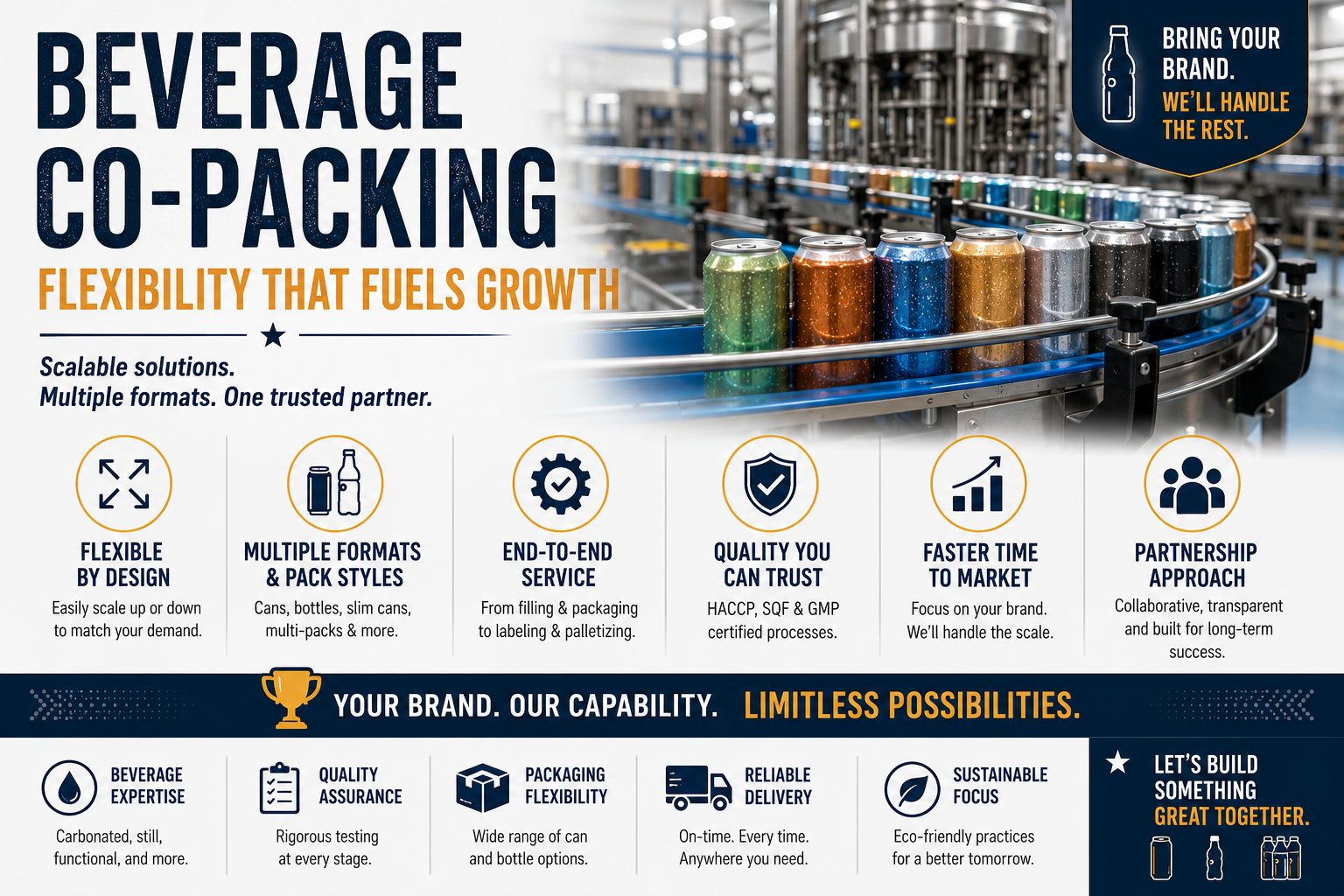
Epic Canning invested in equipment capable of supporting multiple beverage packaging formats
During the pandemic, breweries that traditionally packaged products for restaurants and bars suddenly found themselves redirecting production toward canned beverages as on-premise consumption disappeared almost overnight.
That transition permanently changed consumer behaviour.
"People became accustomed to beverages in cans," Justin explains. "Even today, many restaurants simply open the can and serve it directly."
Recognizing that packaging trends continue to evolve, Epic Canning invested in equipment capable of supporting multiple beverage formats rather than relying on a single production capability.
Whether customers require aluminium cans, bottles, different closures, or evolving packaging specifications, the facility is designed to adapt alongside the market.
That flexibility has become one of the company's competitive advantages.
Manufacturing Is Ultimately a Business of Economics
While manufacturing is often discussed through the lens of engineering, Justin is quick to point out that every operational decision ultimately comes back to economics.
The challenge isn't simply producing more.
The challenge is producing enough, efficiently enough, to cover those costs while consistently delivering high-quality products.
Epic Canning approaches production with clearly defined throughput goals that determine how efficiently each production line must operate.
If a production line is expected to average 300 cans per minute, the equipment itself must be capable of operating significantly faster to accommodate inevitable efficiency losses during normal production.
Every piece of equipment must support the next. Every process must remain balanced.Every bottleneck affects the entire operation.
Justin compares the process to constantly managing an interconnected system where improving one area simply shifts the constraint elsewhere—a reality familiar to manufacturers across every industry.
Yet even operational efficiency has its limits.
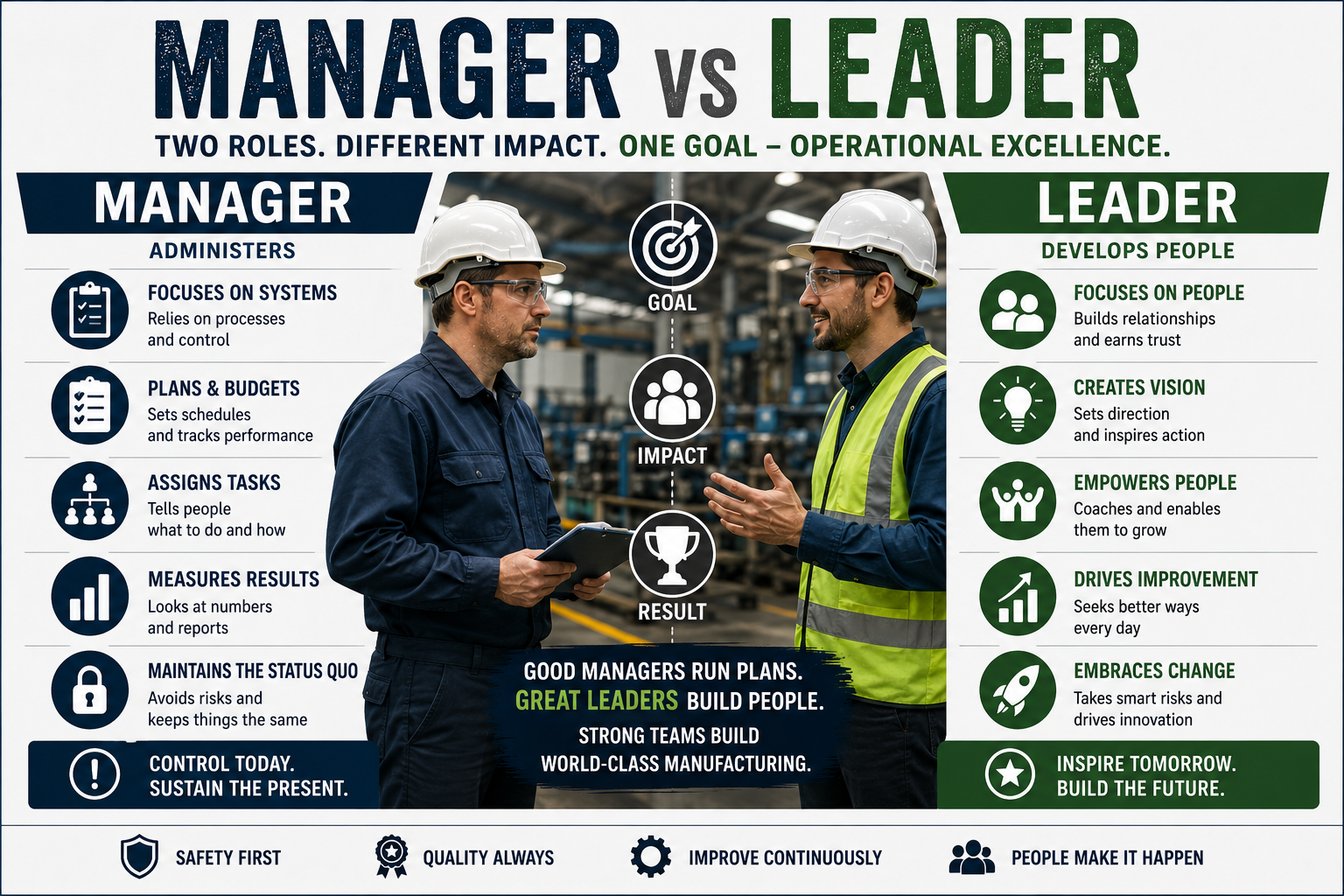
Justin's forest analogy: managers clear the path, leaders make sure everyone is heading in the right direction
One of the most memorable moments of our conversation came when Justin shared an analogy that perfectly captures the difference between management and leadership.
"A manager is responsible for clearing a path through the forest," he says.
"They're organizing the team, sharpening the tools, rotating people in and making sure everyone keeps moving."
"But a leader is standing on top of the tallest tree making sure everyone is actually heading in the right direction."
The analogy illustrates a challenge facing manufacturers everywhere.
Organizations frequently invest enormous effort increasing efficiency, improving throughput, reducing downtime, or optimizing production schedules.
Those initiatives undoubtedly create value, but only if they support the right strategic objective.Otherwise, companies risk becoming exceptionally efficient at solving the wrong problem.
"You can very efficiently march your way into bankruptcy," Justin says with a smile.
The lesson extends far beyond manufacturing. Leadership requires balancing execution with perspective, but direction matters even more.
Building a Culture Where Quality Comes First
If operational discipline defines how a manufacturing facility performs, quality defines whether it deserves to stay in business.
For Epic Canning, quality isn't viewed as the responsibility of a single department or a collection of compliance documents prepared for audits. Instead, it is embedded into every production decision, every process, and every employee's daily responsibilities.
Justin believes that perspective begins with a simple but powerful realization.
Every product leaving the facility will eventually be consumed by another human being.
"It is vitally important that every member of the team understands that what we're making is going into people's bodies," Justin explains. "This isn't just another manufactured product. If we don't pay attention to quality, there are real consequences."
That mindset fundamentally changes how people approach manufacturing.
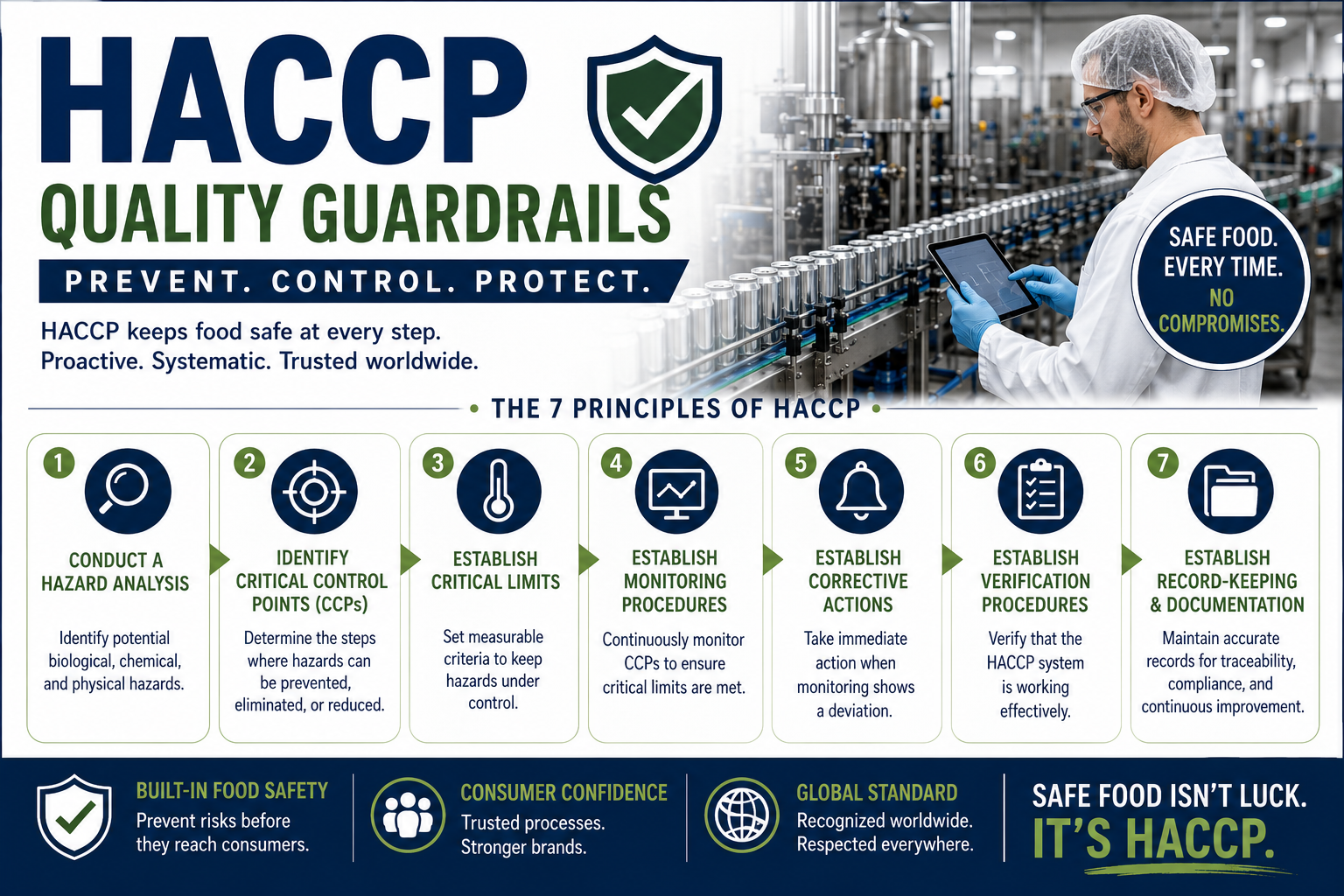
Epic Canning treats HACCP plans as operational guardrails, not just regulatory checkboxes
Rather than viewing HACCP plans, hazard analyses, and critical control points as regulatory requirements, Epic Canning uses them as operational guardrails that help ensure every product meets the highest possible standards before it reaches customers.
"We don't have the opportunity to say something is 'good enough,'" Justin says. "It has to be right."
That philosophy influences every stage of production, from validating new formulations and ingredient specifications to verifying seam integrity, carbonation levels, pH values, packaging quality, and finished product consistency.
Every detail matters because every detail affects the customer experience.
Building Accountability Into Every Day
Maintaining consistent quality requires far more than documented procedures, it requires clear communication and shared accountability. At Epic Canning, every day begins with an all-hands meeting where the team prioritizes safety, reviews outstanding action items, discusses production goals, identifies potential obstacles, and aligns responsibilities before production begins. These daily conversations ensure every department starts the day working toward the same objectives.
"Every day without fail we have an all-hands meeting," Justin explains.
"We review where we stand, what still needs to happen, and what might prevent us from reaching today's goals." Those conversations aren't limited to supervisors or department managers.
Everyone participates. Every employee is encouraged to raise concerns, identify problems, and contribute ideas that improve the operation.
That approach has helped Epic Canning avoid one of manufacturing's most common challenges: organizational silos.
Rather than separating departments into independent functions responsible only for their own performance, the company encourages employees to think collectively about the health of the business.
"The organization runs very flat," Justin says. "Everybody is responsible for the success of the business."
Ownership, in this environment, is not delegated. It is shared.
Great Manufacturing Teams Don't Happen by Accident
Technology can improve efficiency. Equipment can increase throughput. Processes can reduce waste. But none of those investments matter if the wrong people are operating the business.
Justin places enormous emphasis on building the right team.
His hiring philosophy is guided by a framework that has become increasingly popular among leadership experts: people should be humble, hungry, and smart.
While many candidates excel in one or two of those areas, finding individuals who consistently demonstrate all three qualities is far more difficult.
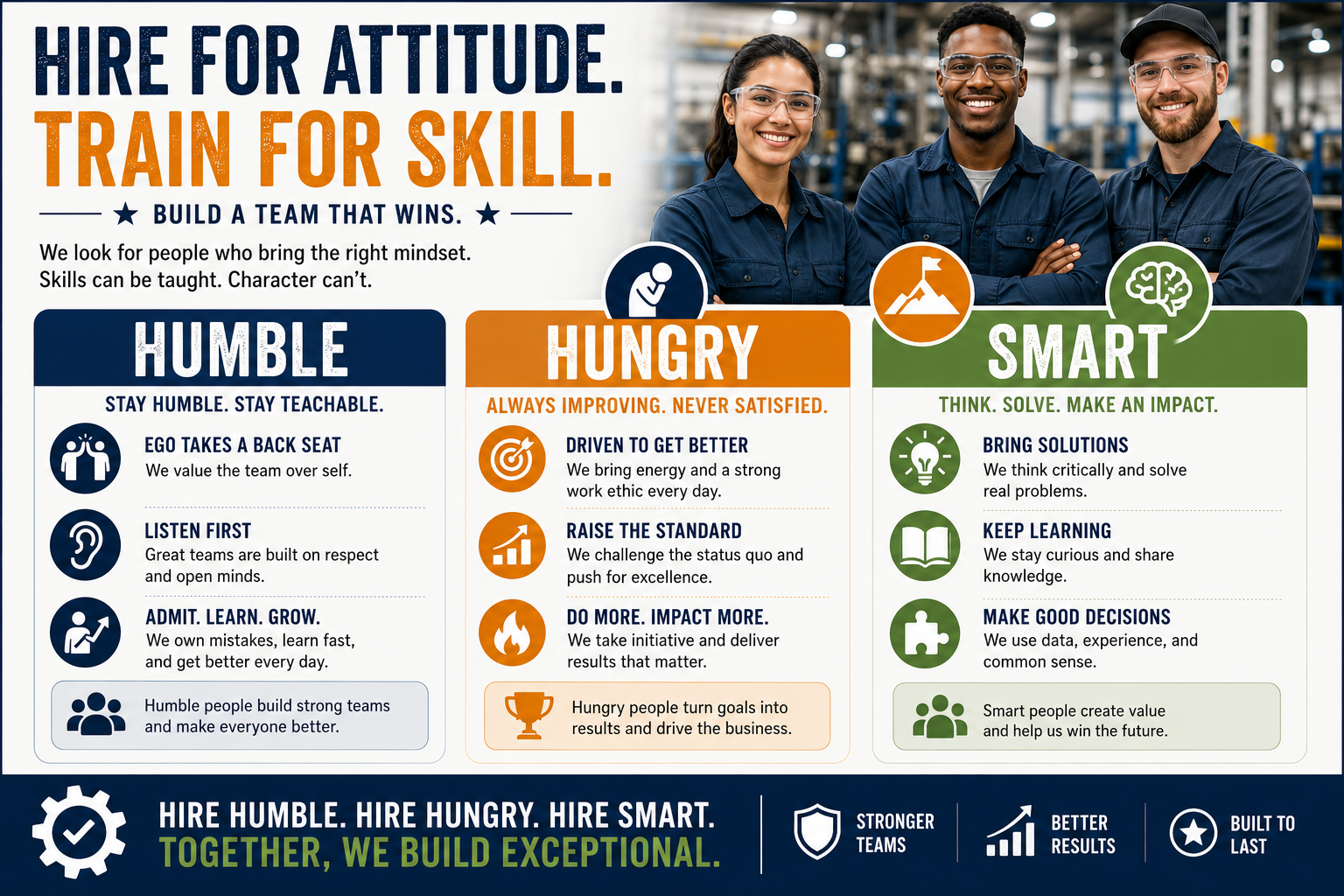
Justin's hiring philosophy centers on finding people who are humble, hungry, and smart
Justin recalls interviewing a highly capable technician who clearly possessed technical expertise and ambition. Yet throughout the interview, the candidate repeatedly emphasized his own importance while showing little willingness to collaborate or acknowledge mistakes.
Reflecting on one candidate, Justin recalls, "As much as I appreciated his confidence, it overshadowed everything else." For him, humility isn't about being modest, it's about being willing to learn, admit mistakes, and help others succeed. In a manufacturing environment where collaboration is essential, those qualities often matter just as much as technical expertise.
The strongest organizations are built by teams that trust one another, communicate openly, and focus on solving problems together.
That philosophy extends well beyond recruitment. Employees are encouraged to confront issues rather than ignore them.
"If you don't confront what you don't condone," Justin explains, "those problems eventually become part of your culture."
Whether addressing unsafe behaviors, quality concerns, or operational inefficiencies, leadership requires difficult conversations. Avoiding those conversations only allows small issues to become much larger ones.
Safety Is Never Negotiable
Nothing illustrates Epic Canning's culture more clearly than its approach to safety.
Justin has spent enough years in manufacturing to witness the consequences of workplace accidents firsthand. Those experiences continue to shape how he leads today. Even seemingly minor behaviors receive immediate attention.
One example involves forklift operations inside the facility.
Rather than allowing operators to drive forward when visibility is restricted, Justin encourages employees to reverse whenever practical, giving them a clearer line of sight and reducing the likelihood of accidents.
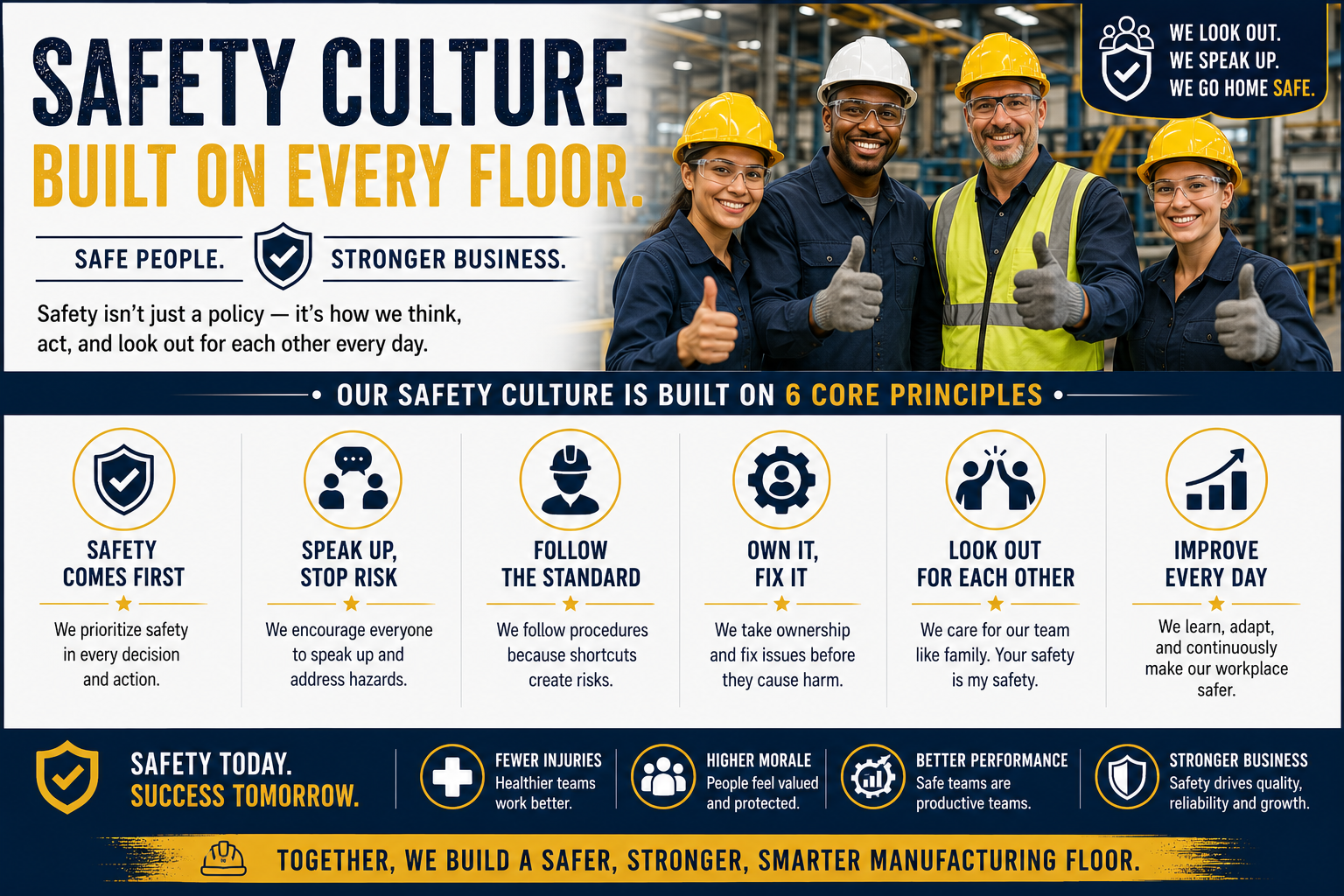
At Epic Canning, safety takes priority over convenience on the production floor
"We're trying to support our families," Justin says. "Nobody should go home injured because we chose convenience over safety."
That philosophy reflects a broader belief that operational excellence cannot come at the expense of people.
Manufacturing Excellence Is Built Together
Justin compares building a manufacturing organization to Michelangelo sculpting the statue of David where success comes from patiently removing every obstacle that stands in the way of the final vision. Whether it's equipment issues, supplier delays, quality concerns, or changing customer requirements, leadership is about ensuring the entire team understands the goal and works together to overcome challenges. "I have to share that vision with everyone," Justin says. "Sometimes people challenge it or point out something I've missed and that's exactly what we want."
For Justin, leadership isn't about unanimous agreement; it's about collective progress. When employees understand the destination, they become active participants in improving the journey.
That collaborative mindset has become one of Epic Canning's defining strengths. It also explains why conversations about technology consistently return to leadership because without engaged people, shared accountability, and operational discipline, even the most advanced manufacturing technologies struggle to deliver lasting value.
And that naturally led our conversation toward the role artificial intelligence is beginning to play inside Epic Canning, not as a replacement for human expertise, but as a tool that helps experienced people work smarter.
AI Isn't Replacing Manufacturing. It's Removing Friction.
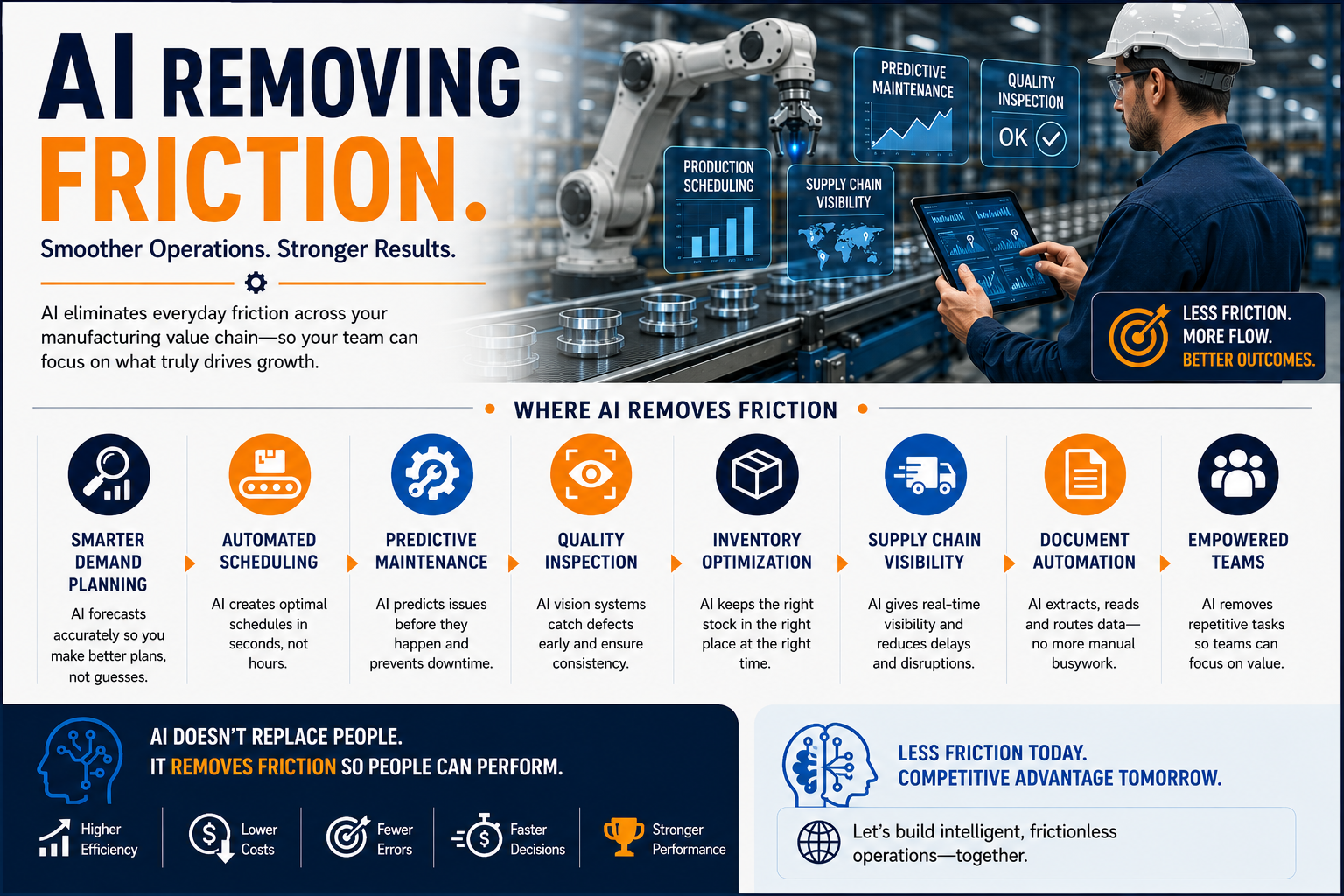
Epic Canning treats AI as a productivity tool, not a replacement for manufacturing expertise
Artificial intelligence dominates nearly every manufacturing conversation today. From predictive maintenance and autonomous production to intelligent scheduling and digital factories, AI is often presented as the technology that will fundamentally reshape manufacturing.
When I asked Justin how Epic Canning uses AI, his answer was refreshingly practical. Rather than viewing AI as a replacement for people or a path to fully autonomous factories, he sees it as a productivity tool that reduces administrative work and allows experienced teams to focus on solving manufacturing challenges.
"I don't think AI replaces expertise," Justin says. "It helps us verify our thinking, communicate better, and move faster."
That philosophy has shaped every AI initiative inside Epic Canning.
Rather than implementing AI across the organization all at once, Epic Canning has adopted it gradually, applying it to specific challenges where it delivers immediate value. The result isn't an AI-driven factory, but a more efficient operation where people are better equipped to do their jobs.
AI Begins With Better Communication
One of the earliest areas where Epic Canning adopted AI was customer communication. Manufacturing contracts can be lengthy, technical, and filled with legal language that introduces significant business risk if interpreted incorrectly.
Only a few years ago, reviewing those agreements required hours of manual reading and research.
Today, Justin approaches the process differently. Whenever a new customer contract arrives, it is first reviewed using AI. Rather than asking the software to approve the agreement, Justin asks it to identify potential risks, highlight ambiguous language, and point out obligations that deserve closer attention.
"I don't want AI telling me everything looks good," he explains. "I want it to tell me where I'm wrong."
That distinction captures Justin's broader philosophy toward artificial intelligence.
When customers conduct production trials, Epic Canning often generates large volumes of operational data.
Historically, engineers would spend hours organizing spreadsheets, summarizing findings, and creating presentations to explain the results.
Today, those reports can be produced far more efficiently.
Justin simply uploads dozens of pages of production data into AI and asks it to organize the information into clear summaries, visualizations, and presentation-ready reports.
"It saves hours of work," he says. "It's not always perfect, but it gives us an excellent starting point."
Instead of spending valuable engineering time formatting reports, the team spends that time interpreting results and making decisions.
That shift represents one of AI's greatest strengths—not replacing expertise, but allowing experts to focus on higher-value work.
Trust Human Experience. Verify With AI.
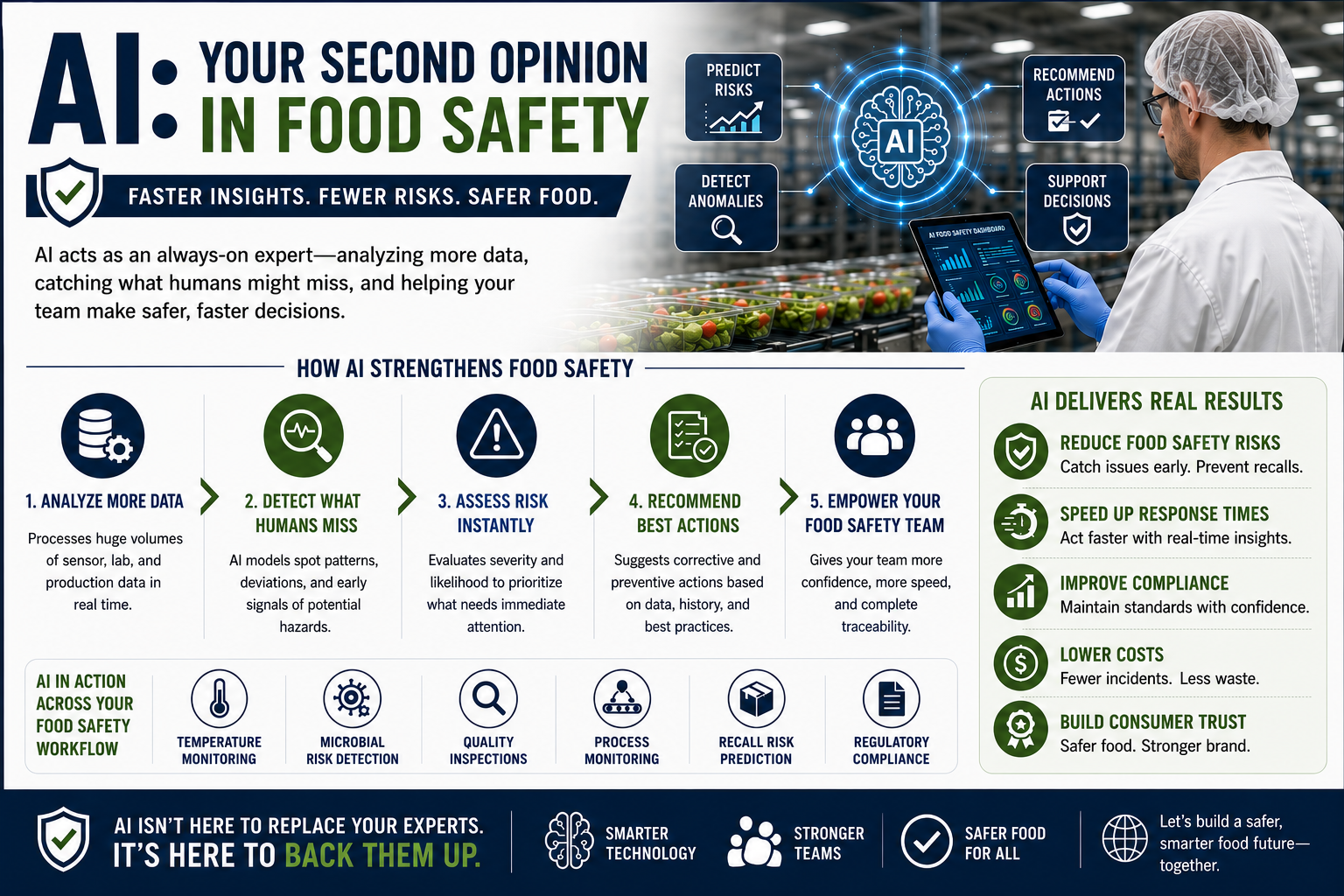
Epic Canning uses AI to validate its HACCP hazard analyses, not to replace human judgment
Perhaps the most interesting application of AI at Epic Canning involves food safety.
The company's HACCP (Hazard Analysis and Critical Control Points) program forms the backbone of its quality management system.
Developing a HACCP plan requires years of manufacturing and regulatory expertise, and Justin has no intention of letting AI replace that knowledge.
Instead, Epic Canning uses AI as a second opinion, asking it to validate the team's hazard analyses and critical control points. "We'll develop our HACCP plan ourselves," Justin says. "Then we'll ask AI to validate our conclusions."
For Justin, AI supports human judgment—it doesn't replace it, a balance that is essential in food manufacturing where quality and safety leave no room for error.
Documentation Has Become Operational Intelligence
Documentation has always been a cornerstone of food manufacturing, but Justin believes it has evolved beyond compliance to become a source of operational intelligence. "If it isn't documented, it didn't happen," he says.
At Epic Canning, supplier communications, customer requests, meeting discussions, and key operational decisions are all captured and recorded, creating a searchable knowledge base that strengthens traceability, supports better decision-making, and simplifies audit readiness.
Rather than scrambling to reconstruct events, the team can quickly retrieve records showing who made a decision, when it occurred, what information was considered, and how the conclusion was reached.
As food safety regulations continue to evolve, this level of documentation provides confidence that extends well beyond regulatory compliance.
AI's Greatest Contribution May Be Organizational Memory
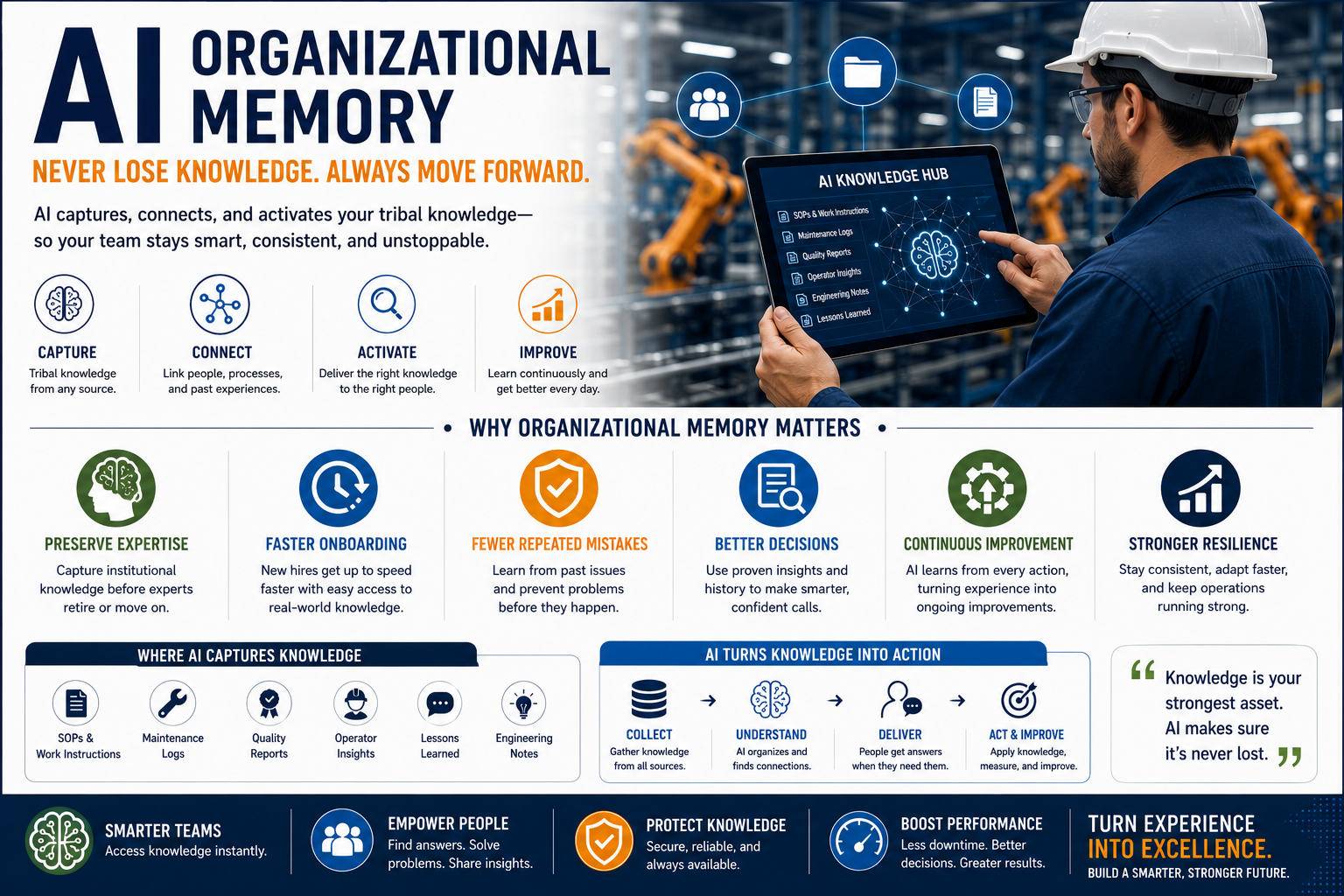
Capturing conversations and decisions helps Epic Canning preserve expertise through turnover and growth
Throughout our conversation, one theme became increasingly clear: Justin doesn't see AI as a tool for replacing people, but as a way to preserve organizational knowledge.
By capturing conversations, documenting decisions, and making information searchable, AI helps ensure valuable expertise isn't lost through retirements, employee turnover, or forgotten discussions. "We're not looking for AI to think for us," Justin says. "We're looking for it to help us think better."
For manufacturers, that shift—from automation to knowledge preservation—may prove to be AI's most valuable contribution.
Looking Ahead
Looking beyond today's manufacturing landscape, I asked Justin what he believes will define the industry's future. His answer wasn't about AI, robotics, or fully automated factories. Instead, he returned to the principles that had shaped our entire discussion: strong teams, clear communication, disciplined operations, and an unwavering commitment to quality. While Justin believes AI will play an increasingly important role in manufacturing, he emphasizes that its greatest value will come only when organizations adopt it with realistic expectations and build it on a strong operational foundation.
Rather than replacing operators or making complex decisions independently, AI should help manufacturers eliminate repetitive administrative work, organize information more effectively, validate human analysis, and preserve institutional knowledge.
"I think AI has a very strong application in manufacturing," Justin says. "The question isn't whether we'll use it. The question is how thoughtfully we'll integrate it into the way we already work."
That measured perspective reflects a broader trend emerging across the manufacturing sector.
Many organizations spent the past two years experimenting with generative AI through isolated use cases such as document generation, customer communication, and meeting summaries. The next phase will likely be far more operational, connecting AI with ERP systems, production planning, quality management, maintenance, and supply chain operations.
Even as technology advances, Justin believes manufacturers must resist viewing AI as a shortcut. Quality still depends on disciplined processes, safety on accountable teams, and operational excellence on strong leadership. Technology simply amplifies what already exists.
Companies with strong cultures, well-documented knowledge, and disciplined operations will see AI become a powerful multiplier, while those lacking these fundamentals are unlikely to realize its full potential.
Throughout our conversation, one message remained consistent: manufacturing has always been, and will continue to be, a people-driven industry. Machines improve productivity, software enhances efficiency, and AI accelerates access to information, but none of them can replace human judgment, accountability, or leadership.
Perhaps that's why this conversation felt different from so many discussions taking place across manufacturing today.
Instead of asking how AI can replace people, Justin is asking how AI can make good people even better.
For manufacturers navigating their own digital transformation journeys, Justin's message is clear: technology alone doesn't create operational excellence.
Lasting competitive advantage comes from strong leadership, disciplined processes, open communication, and a culture where quality is everyone's responsibility. AI can amplify those strengths, but it cannot replace them. As Epic Canning continues to grow, its journey serves as a reminder that while manufacturing technology will continue to evolve, the industry's greatest asset will always be its people.
Related Template