



AI investment news offers one of the clearest signals of where the artificial intelligence industry is heading. Rather than focusing on product launches, software reviews, or AI tutorials, this page tracks where governments, hyperscalers, sovereign wealth funds, and private investors are committing billions of dollars. These capital movements reveal which technologies are moving toward mainstream adoption and which sectors are likely to shape the next phase of AI innovation.
From new data centers and advanced semiconductor manufacturing to cloud infrastructure and national AI initiatives, AI investment news today provides valuable insight into the future direction of enterprise AI. Large-scale investments often determine which AI capabilities become faster, more affordable, and more widely available over time.
This page brings together the latest AI infrastructure investment news, major funding announcements, government initiatives, and strategic partnerships from around the world. Whether you are a business leader, manufacturer, investor, or technology strategist, understanding where capital is flowing can help you identify emerging opportunities, anticipate market shifts, and make better long-term AI investment decisions.
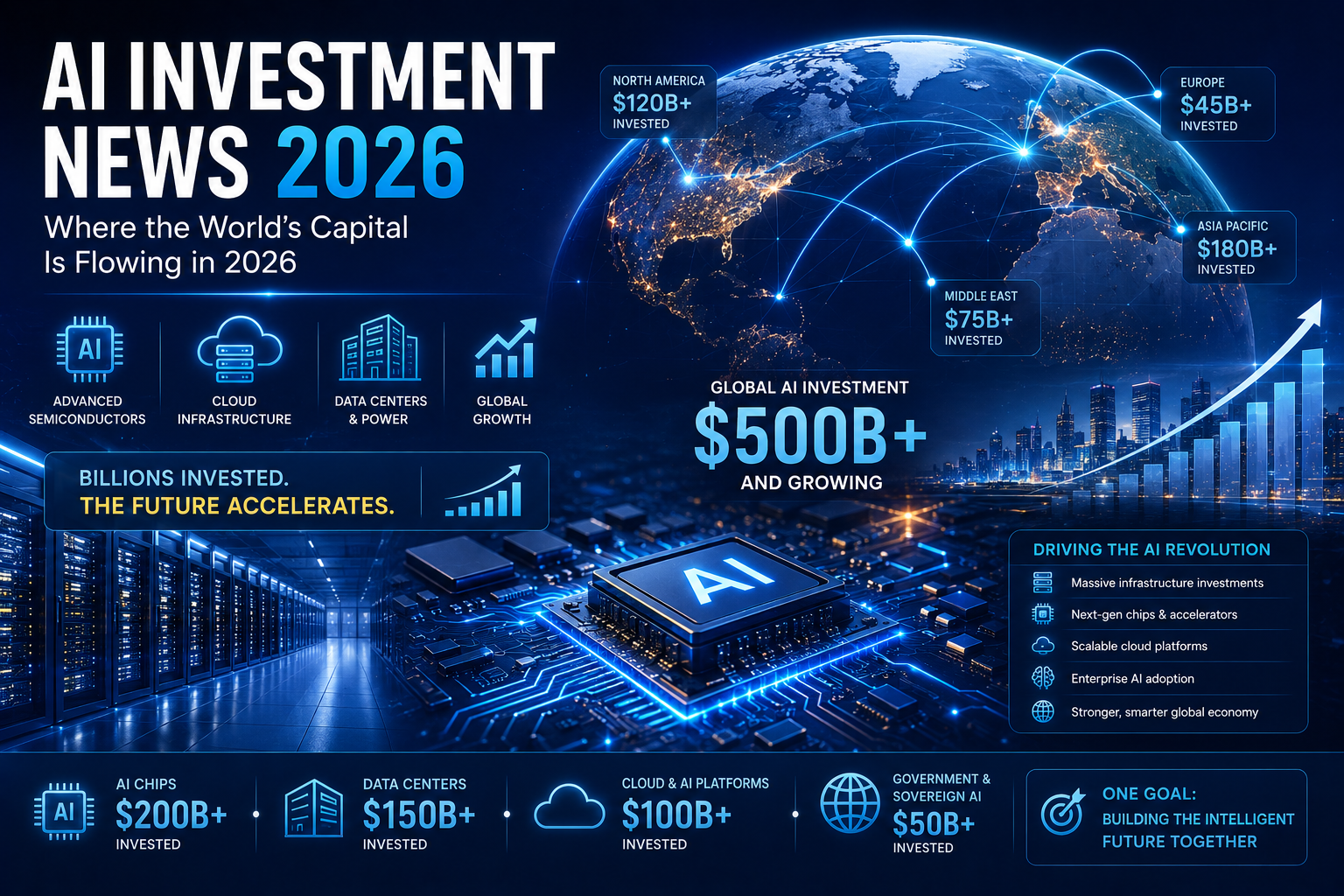
AI investment news 2026 — global capital flows across AI chips, data centers, cloud platforms, and sovereign AI
Why AI Investment News Matters for Business Leaders
Tracking AI investment news is no longer an activity for investors alone. As AI turns into a basic requirement for businesses, the sources of funds allocated to certain technologies reveal important information about whether these technologies are ready for commercialization or are going to be viable only after some time has passed.
First, financial flows are always an indicator of the technologies that are likely to become available at lower prices the soonest. With investments being pumped into AI infrastructure, foundation models, edge computing, and enterprise software, competition heats up, innovations speed up, and costs become lower with each day that passes by.
Second, AI infrastructure investments news are a clear indicator of how much quickly the AI ecosystem is developing. Big investments made by cloud vendors, semiconductor firms, and even governments helps to mitigate the risks of deployment through increasing computational capabilities, enhancing software platforms, and making enterprise AI more accessible. More competition brings not only cheaper solutions but also faster performance and additional opportunities to deploy AI technology in a business.
Third, for companies and small to medium-sized businesses, knowledge of the buildout of the AI infrastructure increases the justification of AI investments in business operations. Lower costs, advanced AI software, and the developing ecosystem of enterprise AI solutions provide an additional advantage when it comes to justification of AI investments. This is where GrayCyan's approach to AI Strategy Readiness can be applied.
AI Data Center Investment News – Q2 2026
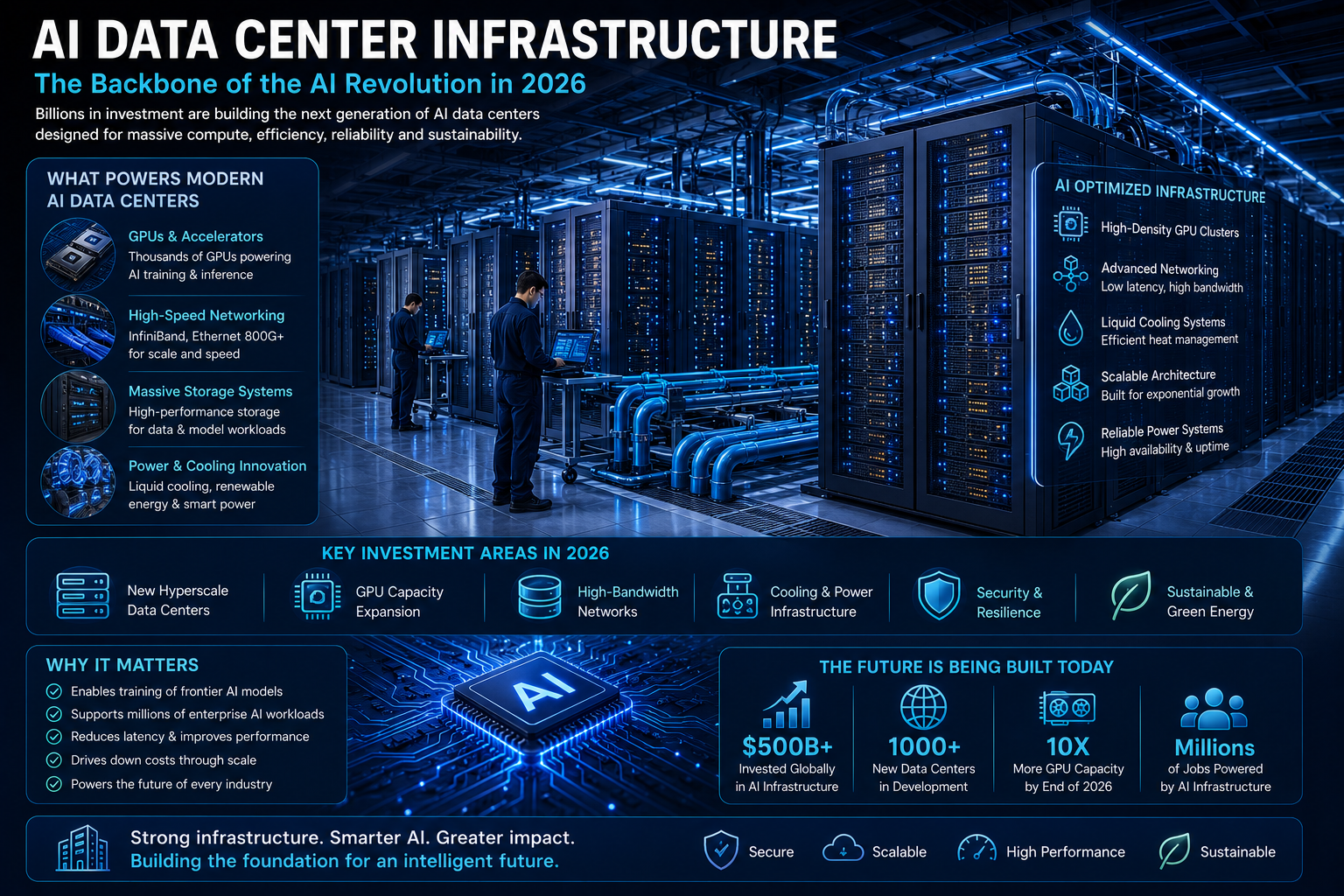
Microsoft, Meta, and Nvidia lead the AI data center investment race in Q2 2026
Microsoft's AI Data Center Investment: What $80B+ Looks Like on the Ground
Microsoft remains ahead of other firms when it comes to AI-related data center investments, as it has plans to invest over $80 billion for AI infrastructure in the financial year 2026. This is an investment in hyperscale data centers, GPU clusters, networking infrastructure, and power infrastructure to help Microsoft grow its Azure AI platform. There will be expansion in capacity in the U.S., Europe, and Asia to meet the growing enterprise demand for AI computing.
This goes beyond the construction of larger data centers. Microsoft will be growing its AI infrastructure for not only training but also serving foundation models and handling millions of enterprise AI workloads at the same time. These are investments in networking, liquid cooling, energy infrastructure, and storage systems dedicated to large-scale AI computing.
The Microsoft AI investment news today is relevant for enterprise customers in particular. With the increase in Azure's AI infrastructure capabilities, enterprises will get access to increased computing power, increased service reliability, decreased deployment difficulties, and ultimately lower infrastructure costs due to economies of scale. Enterprises including manufacturing companies, software vendors, and SMBs deploying AI solutions should see advantages from much more faster deployment of AI models, better worldwide accessibility, and lower costs of AI services. The ultimate consequence of this process will be the creation of an AI infrastructure that scales well.
Meta's AI Infrastructure Buildout: The $65B Bet Explained
Meta AI investment news is no longer limited to enhancing social media platforms and is currently one of the largest private AI infrastructures in the world. The current investment is based on previous $65 billion investments and includes continuous construction of GPU clusters, AI-specific hardware, networks, and large data centers that will be used for internal AI development as well as for new AI products in the future.
Despite the widespread focus on consumer applications from Meta, the true value of such investments is in their impact on the entire AI industry. Large infrastructure investments boost the production of semiconductors, expand cloud computing capabilities, enhance network technologies, and create competition within the industry.
Meta is also making extensive investments in research on AI for recommendation systems, generative AI, advertising, virtual reality, and smart digital assistants. While at it, Meta keeps solving issues such as those of data privacy, AI transparency, compliance with regulations, and responsible deployment.
What enterprises should learn from Meta AI investment news is not just about the competitive advantage that Meta has. Large infrastructure investments made by hyperscalers lead to a robust supply chain ecosystem and spur hardware innovations.
Nvidia's Role: From Chip Maker to AI Infrastructure Kingmaker
There is no company that has reaped the benefits of this AI infrastructure investment craze more than Nvidia. The latest Nvidia AI investment news is proof of how this company has transformed from a GPU maker into the leading technology supplier for the growing AI data center infrastructure.
Nvidia's Blackwell platform with the B200 architecture and all the innovations on the roadmap is the backbone of the massive hyperscale deployments of AI infrastructure in the likes of Microsoft, Meta, Amazon, Google, Oracle, and other sovereign AI projects. Nvidia is not spending money on data centers itself but influencing the whole AI infrastructure investment process with AI accelerators that make it possible to deploy larger foundation models and enterprise AI.
For enterprises, Nvidia's roadmap is important because AI chip innovations bring better performance of the models while reducing the price per unit of AI computing power. Every new AI chip makes it possible for cloud service providers to provide more better AI services to enterprises.
Sovereign Wealth & Government AI Investment — Q2 2026
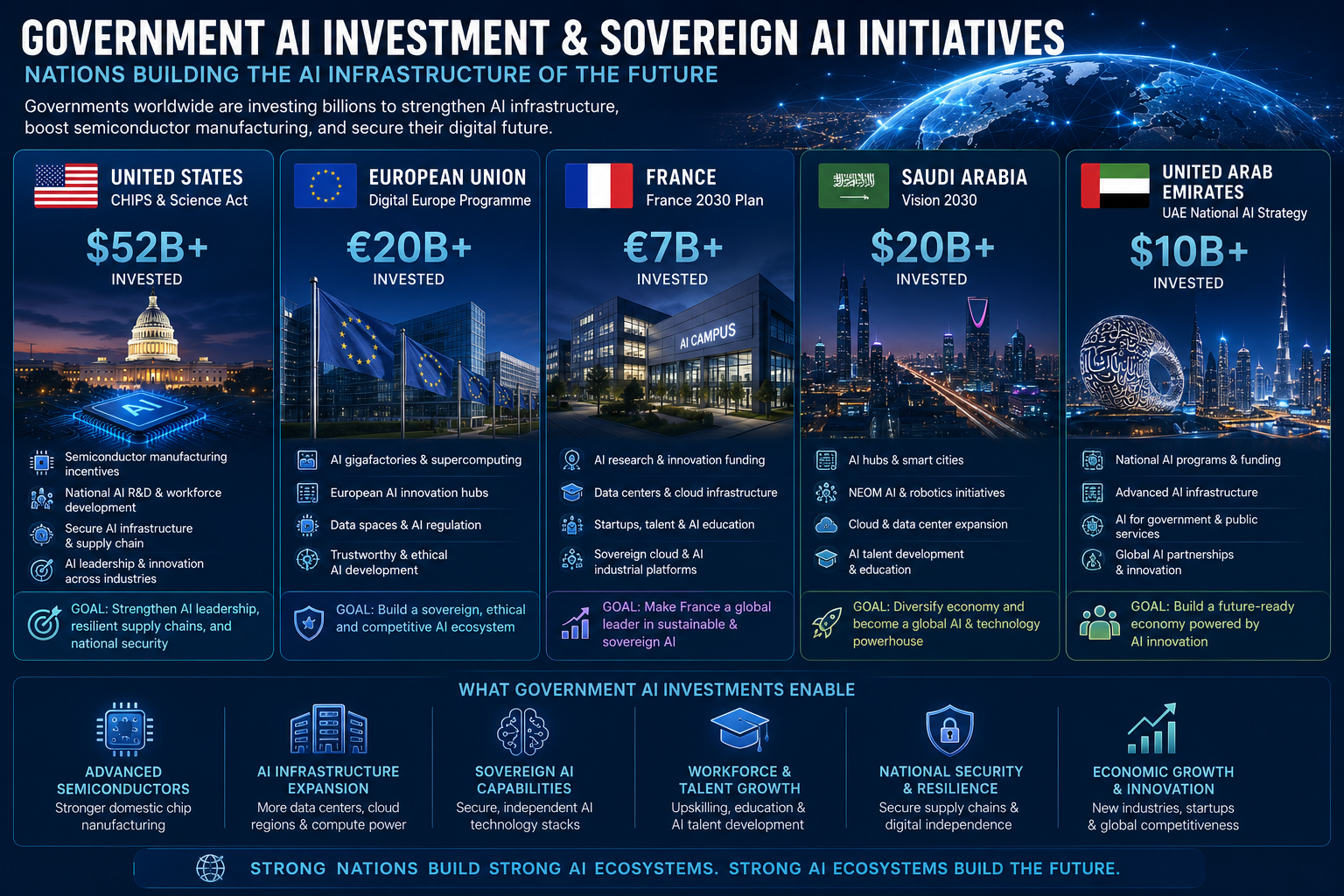
Governments and sovereign wealth funds are treating AI compute as national infrastructure
France's €109B AI Plan: Europe's Answer to the US-China Race
As part of their national AI aspirations, France has launched a €109 billion AI investment project that places it among one of the biggest technology projects in Europe, and it is a significant milestone for French AI investment news. In addition to previous commitments, Brookfield is still working on implementing their proposed AI-oriented data center network, which includes the 1GW Cambrai campus, and Bpifrance is using its long-term investments to support AI startups in France until 2029. Meanwhile, telecom company Iliad keeps investing in its AI infrastructure and cloud capacity.
In addition to infrastructure, France has decided to position itself as an AI manufacturing and research center in Europe by promoting local AI models, semiconductor relations, and sovereign computing abilities. The majority of AI infrastructure in France is supplied with electricity produced by low-carbon nuclear power plants and renewables in order to solve the increasing energy requirements of big AI data centers. This combination of investments is a European response to the increasing AI competition from America and China.
Saudi Arabia, UAE & the Gulf's $100B+ AI Infrastructure Push
The Middle East Gulf region has emerged as one of the world's fastest-growing regions in terms of AI investment, thus rendering Saudi AI investment news, UAE AI investment news, and sovereign wealth fund AI investment news crucial for multinational companies.
The country is leveraging its Public Investment Fund (PIF) to speed up investments in the fields of AI, cloud computing, semiconductor collaboration, and innovation, among others, within the context of its efforts to diversify its economy.
The United Arab Emirates is following the same strategy with the help of MGX, Mubadala, and other sovereign investment ways. All these organizations are continuing to support the development of AI infrastructure, international technology partnerships, and computing projects on a massive scale. The multibillion-dollar strategic partnership of Microsoft in the UAE is adding to the strength of the country as a regional AI center.
These investments go beyond just being about economic development because governments have started to consider the need for sovereign AI infrastructure as much as that of energy infrastructure, telecoms, and transport networks. By investing early, Gulf states want to lure in AI companies, manufacturers, researchers, and even cloud companies from around the world.
US Stargate Project: The $500B Government AI Bet
The US Stargate project is among the most notable AI infrastructure projects ever conceived, with a vision of up to $500 billion for investment into building AI data centers, advanced computing capabilities, energy infrastructure, and semiconductor capability in the next decades. This shows that the Stargate project is among the biggest AI infrastructure investment news of all, considering the fact that leadership in AI depends not only on software development but also on physical infrastructure.
To enterprise organizations, this project means that AI computing capability will continue to grow significantly in the next decades to come.
Big Tech AI Capex — What Microsoft, Meta & Google Are Spending
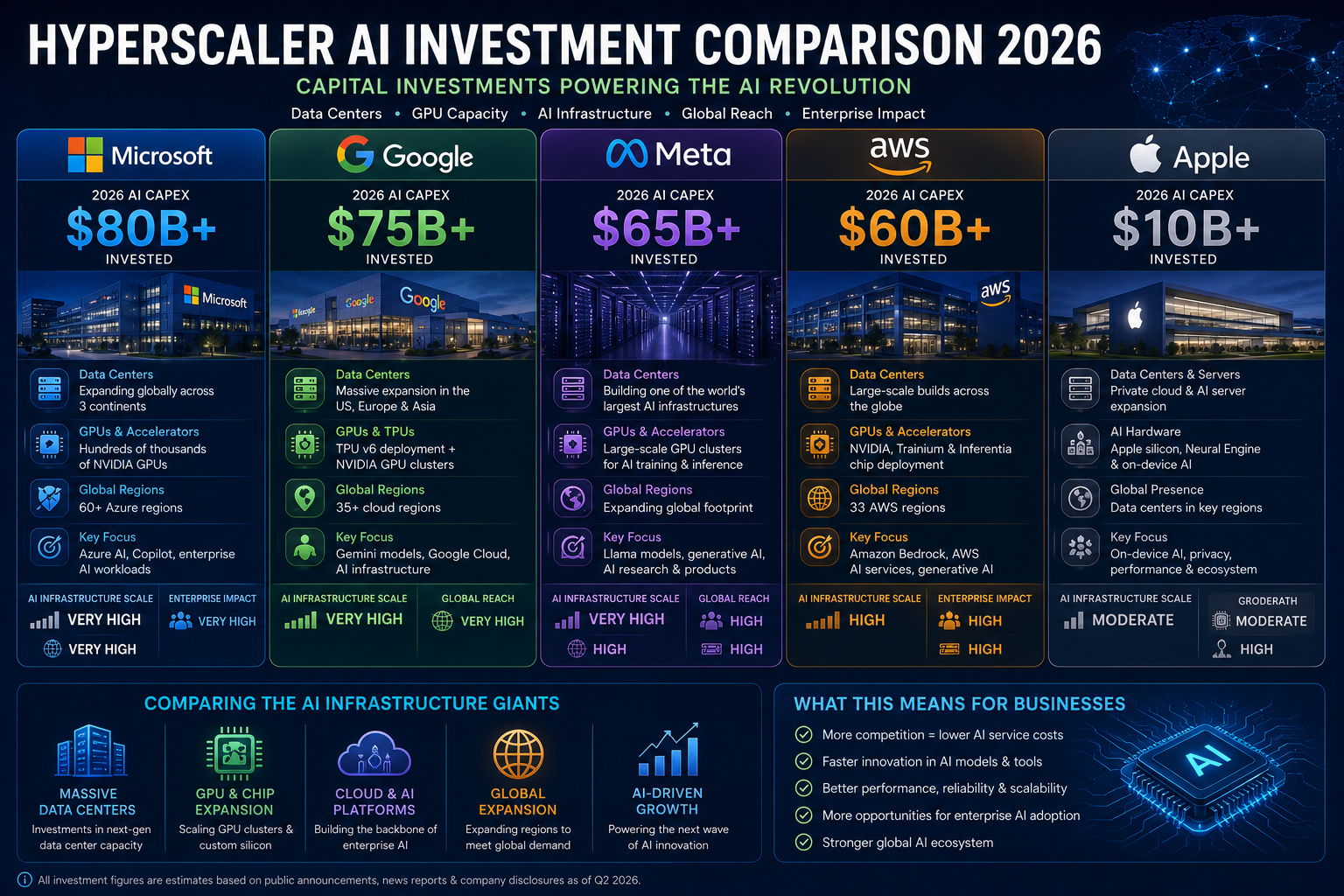
Hyperscaler AI capex comparison — Microsoft, Google, Meta, AWS, and Apple 2026 investment scorecard
Hyperscaler AI Capex Scorecard — Q2 2026
The most recent AI infrastructure investment news suggests that the hyperscalers keep investing like never before in history, considering AI infrastructure as the basis for further development instead of a technological fad. Capital investments include AI data centers, GPU clusters, AI-specific chips, networking, storage, and power infrastructure. For enterprises, these investments mean that the availability of AI becomes more higher and its performance improves along with cost reduction for its deployment. The Microsoft AI investment news is especially important as Azure is one of the largest enterprise AI platforms around the world.
| Company | Announced AI Capex | Primary Focus | Key Q2 2026 Announcement |
|---|---|---|---|
| Microsoft | $80B+ (FY2026) | Azure AI data centers, GPU clusters, global cloud expansion | Continued expansion of hyperscale AI infrastructure across North America, Europe, and Asia. |
| Meta | $65B+ | AI data centers, Llama ecosystem, custom AI hardware | Ongoing investment in large-scale GPU infrastructure supporting generative AI and recommendation systems. |
| Google (Alphabet) | $75B+ | Google Cloud AI, TPU infrastructure, Gemini ecosystem | Expanded investment in AI-ready data centers and next-generation Tensor Processing Units (TPUs). |
| Amazon AWS | $100B+* | AWS AI infrastructure, custom Trainium and Inferentia chips | Continued expansion of cloud AI capacity and enterprise AI services. (*Includes broader infrastructure spending.) |
| Apple | Multi-billion-dollar ongoing investment | Apple Intelligence, Private Cloud Compute, on-device AI | Increased investment in AI infrastructure supporting secure hybrid cloud and edge AI services. |
These numbers show that the AI infrastructure is now the biggest technology spending cycle of the decade. Instead of competing purely on the AI model front, the hyperscalers are now making huge investments in computing power, energy-efficient data centers, networking, and specialized silicon in order to make enterprise AI adoption possible.
These spending levels are a very positive development for manufacturing companies, SMBs, and enterprises. With the development of the infrastructure, AI becomes not only easier but much more affordable to use.
AI Investment Trends 2026: What the Money Is Telling Us
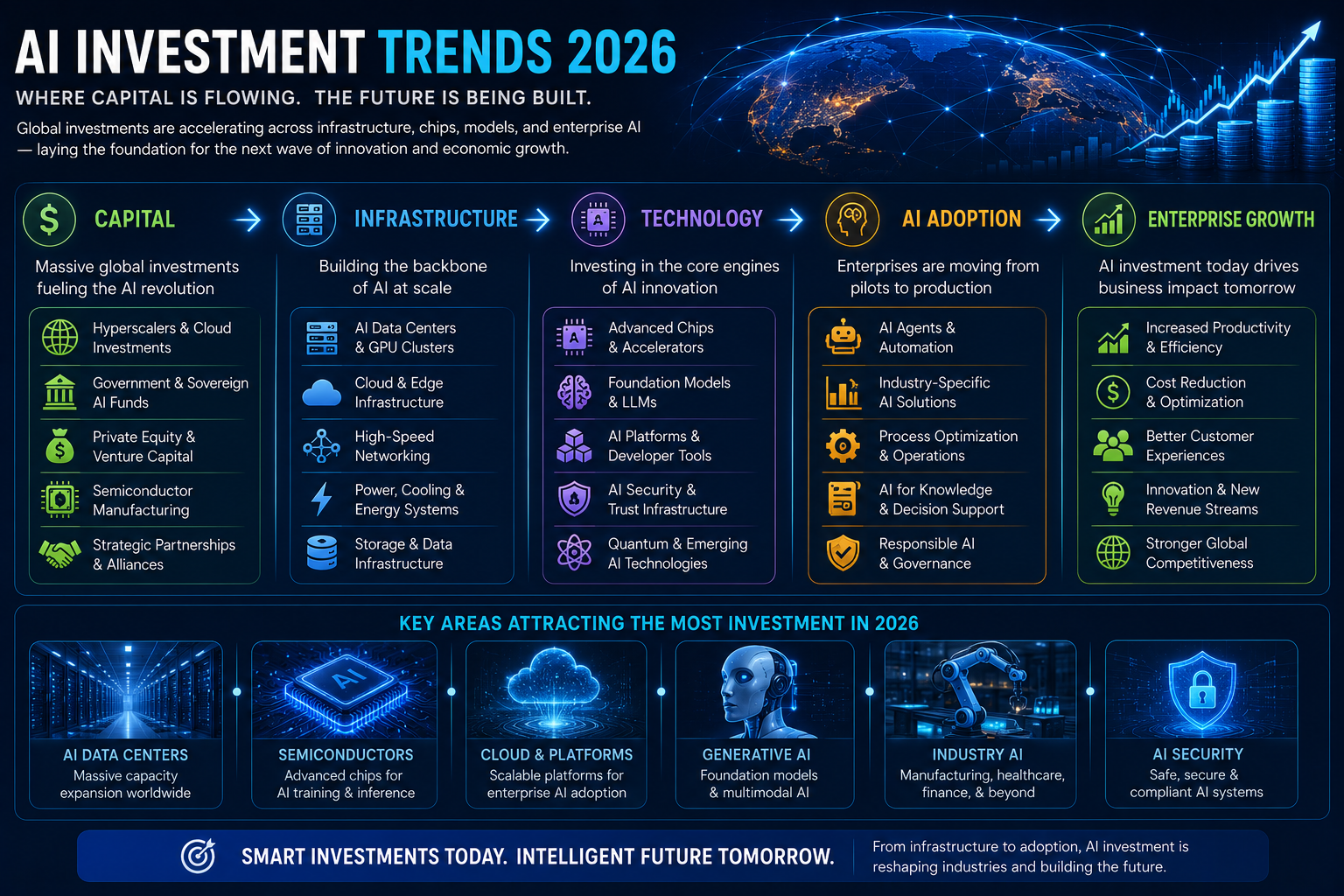
Infrastructure before applications: what the 2026 AI investment trends are signaling
The main insight to take away from the AI investment trends news 2026 is that the economy of artificial intelligence is entering a new era. While previously most of the effort was geared towards the creation of new chatbots and consumer apps, there are now significant government and tech company investments into the foundations that will be used by AI for the next ten years.
Infrastructure Before Applications
This time, the development of AI is being driven by hardware rather than software. Billions of dollars are going into building data centers, GPU clusters, networking, power supplies, and cutting-edge chip manufacturing plants to serve the needs of Artificial Intelligence. These investments make it possible to build more faster, more affordable, and more robust AI-based services that businesses will use extensively in the future.
AI Has Become a Geopolitical Priority
AI infrastructure is no longer considered only from a business perspective. Countries like the US, the European Union, France, Saudi Arabia, the UAE, China, and others have started to consider AI computational power a strategic national asset. Sovereign investments and large-scale infrastructure initiatives demonstrate an increasing awareness of how AI dominance can impact competitiveness and national security.
The Biggest Opportunity May Be for SMBs
Although billion-dollar investment announcements grab the attention of the news headlines, their effects will be seen on smaller and midmarket businesses. With increasing capacity in computing and competitive pressures, AI is now becoming cheaper and more widely available. Services that used to be only available to the largest corporations in the world are increasingly being made available to manufacturers, distributors, and growing businesses.
In terms of GrayCyan's target audience, this is a valuable trend to watch out for. With decreased costs in infrastructure, the adoption of AI for operations, knowledge management, quality control, customer support, and decision-making becomes a lot easier and more feasible. Businesses that adopt an AI strategy now would be ready to take advantage of this development in the coming years.
Case Study: Apple & Alibaba — When AI Investment Meets Geopolitics
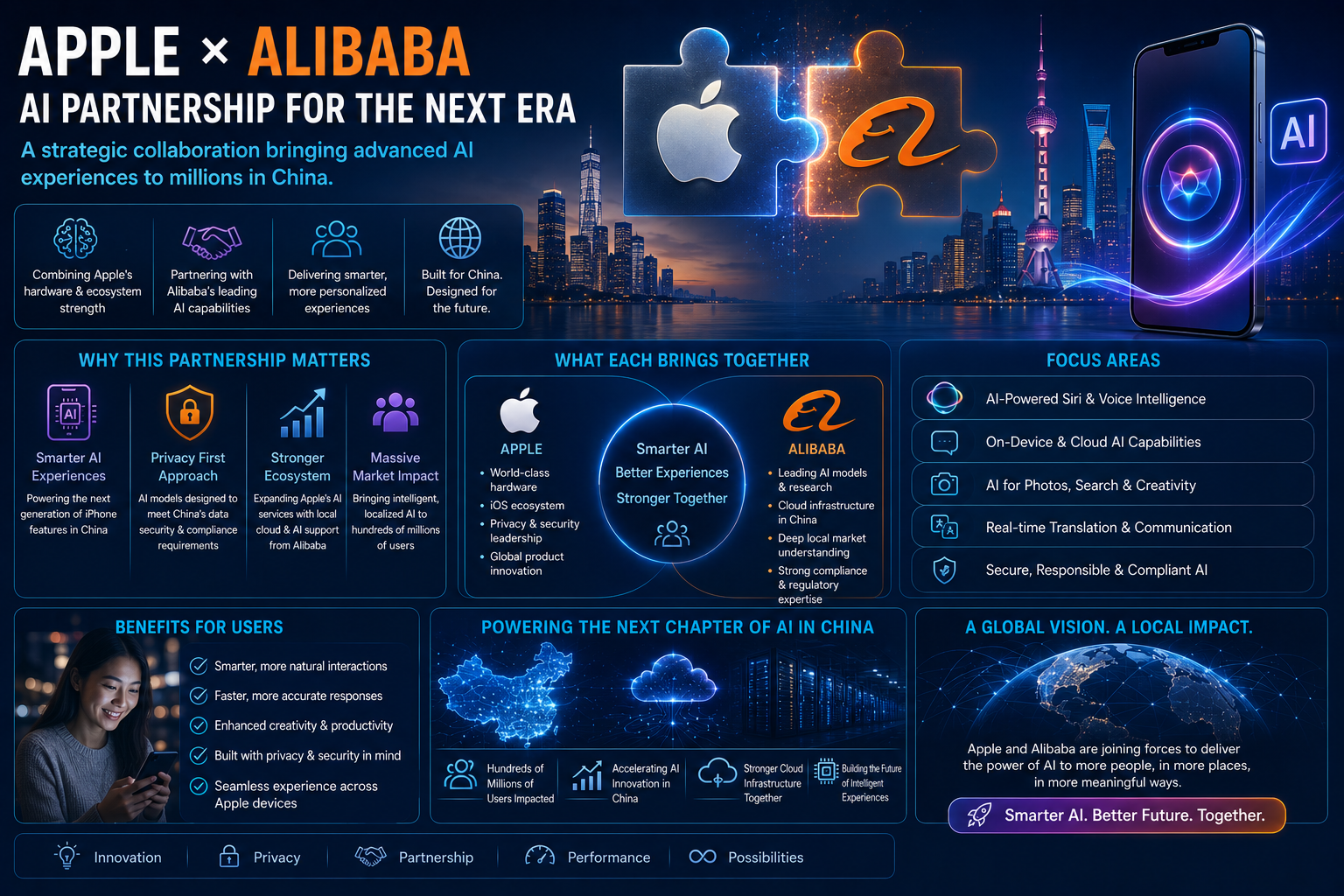
Apple's partnership with Alibaba shows how regulation shapes AI investment decisions in China
Apple's cooperation with Alibaba is one of the most evident cases of how the decision-making process in the realm of AI investment is being determined not only by technological but also by geopolitical and regulatory factors. With the tightening of governments' regulation over AI models, it becomes necessary for multinational companies to change their investment policy in order to fit into the local regulatory framework and be competitive at the same time.
Background and Context
As part of an agreement between Apple and Alibaba Group, the former is now able to provide cutting-edge AI technologies on iPhones used by Chinese customers. This partnership involves using Alibaba's large language model, Qwen, to enhance Apple Intelligence functionalities for Chinese consumers. The chairman of Alibaba, Joe Tsai, affirmed this partnership, saying, "They [Apple] want to use our AI to power their phones."
Before establishing such an AI partnership, Apple has considered other candidates, among them Baidu, ByteDance, Tencent, and DeepSeek. But the regulatory environment in China demands that all big language models be approved by the government.
Alibaba's AI Expertise
Alibaba has emerged as one of the top AI firms in China due to the swift evolution of the Qwen suite of large language models from Alibaba. The Qwen models have always performed very well in industry benchmarks for the best open AI models worldwide. As far as Apple is concerned, Alibaba can help Apple get an enterprise-ready AI solution immediately.
Strategic Implications for Apple
This collaboration would also be a response to the overall competition that the company is facing in the Chinese market. Apple has been under increasing competitive pressure from local competitors like Huawei and Xiaomi, while it has also seen an 11% fall in its revenue from the Greater China region, accounting for 15% of Apple's total revenue. Apple aims to enhance the user experience through its locally compliant AI features in iPhones.
Regulatory Considerations
The deal is an example of the role of regulation in the process of investments in AI technology. The regulations for China's AI mandate that foreign companies operating with AI should do so in partnership with licensed local firms. With this deal, Apple will be able to use Alibaba to implement its Apple Intelligence services.
Market Reaction and 2026 Update
The financial markets responded favorably to the news. The share price of Alibaba rose by more than 40% amid increasing investor confidence in its artificial intelligence (AI). In addition, further growth was seen after the confirmation of the company's cooperation with Apple. This cooperation met investors' expectations and demonstrated that Alibaba had all chances to become one of China's leading AI infrastructure players.
By 2026, both companies will continue their work of getting approved by Chinese regulators and adding more AI capabilities to Apple's products to provide them to Chinese users. Despite the fact that analysts are unsure whether the presence of AI features will help in increasing sales of iPhones, there are other important reasons for cooperation. This collaboration shows that in order to be successful in the field of AI, one should not only create the best algorithms and models but also know how to navigate the legal framework of the country and make the necessary regional partnerships.
Also in AI Investment This Quarter
Funding for AI agents continued
AI startups developing autonomous AI agents received new funding as enterprises embraced AI-powered automation of workflows. Recent AI Agent funding news confirms that the investor community is optimistic about technologies aimed at enterprise efficiency, customer service, and software development.
Open source AI funding picked up speed
Companies creating products based on large language models with an open-source approach were funded by investors to help enterprises leverage AI without reliance on proprietary AI.
AI infrastructure spending increased
The demand for GPU clusters, AI cloud services, network hardware, and energy-efficient data centers kept growing amid the expansion of AI infrastructure deployments and the emergence of foundation models.
AI software solutions for enterprises spread into various sectors
Additional investments helped build AI platforms in healthcare, finance, cybersecurity, law technology, and manufacturing, as there was still a need for efficient AI solutions that would increase efficiency and lower operational expenses.
The cross-border flow of AI investments grew stronger
Venture funds made investments in startups from Europe, Asia, and the Middle East, demonstrating that innovations in the field of AI are not limited to a particular territory anymore.
For additional information about startup investments, venture rounds, and advancements in agentic AI, be sure to check out our Agentic AI News page where we cover these topics and many more.
What This Means for Mid-Market Manufacturers — GrayCyan Perspective
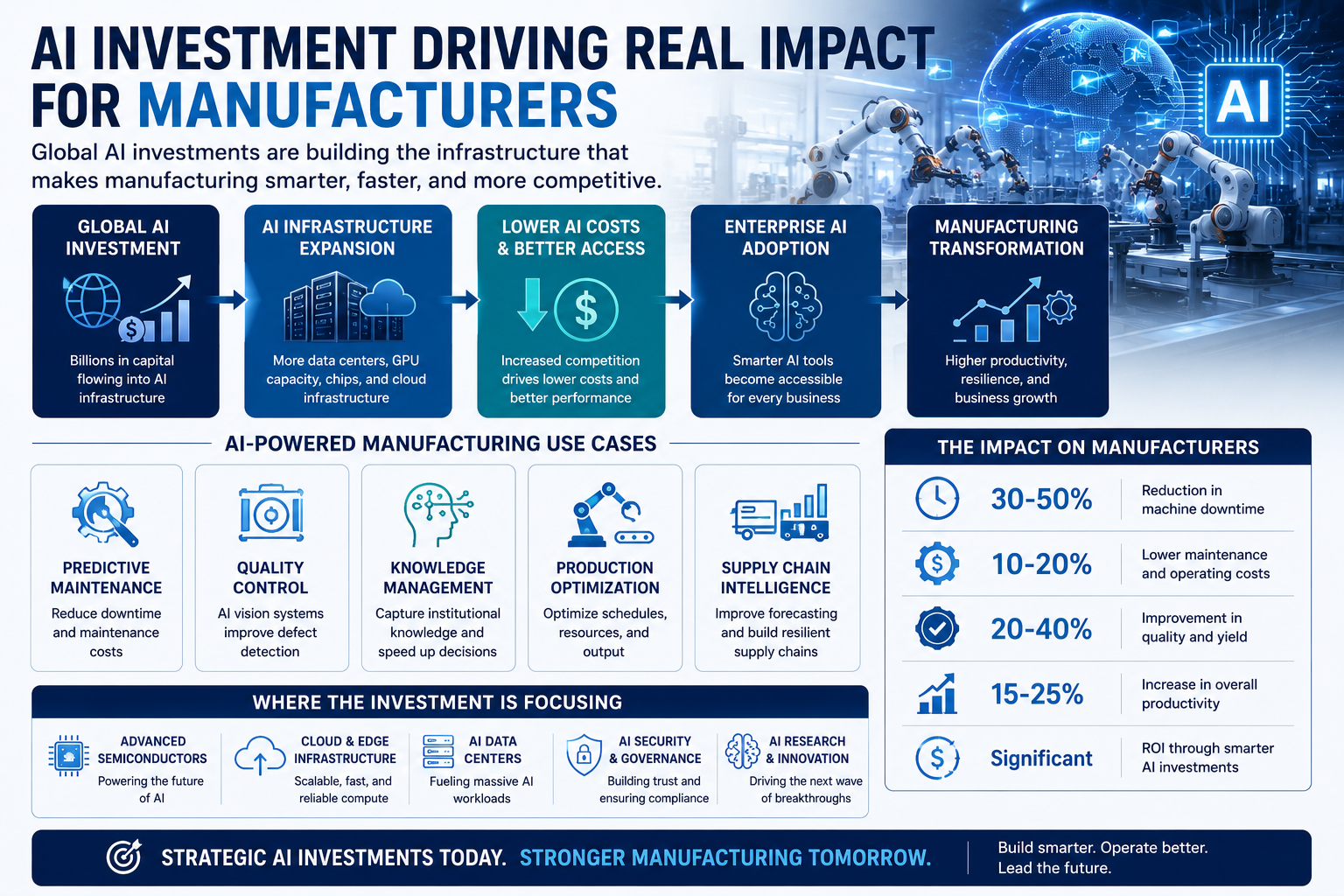
How global AI investment is translating into real productivity gains for manufacturers
The most important takeaway from today's AI investment news is that the organizations putting up hundreds of billions of dollars are not the only ones who get something out of it. As hyperscalers, governments, and semiconductor companies keep expanding global AI infrastructure, enterprise AI gets cheaper, more robust, and more available for all types of businesses.
This is what makes AI infrastructure investment news relevant for mid-market manufacturers. Cheaper computing, better cloud services, and advanced AI software are lowering the barriers to implementing technologies like predictive maintenance, product quality control, production planning, knowledge management, and AI-powered customer service. Technologies that were out of reach for small and medium-sized companies are becoming possible to implement.
But the competitive window is shrinking. In the current climate, the implementation of Artificial Intelligence can set a company apart from others by being much more productive, having more greater visibility within operations, and quicker decision-making processes. As the infrastructure matures further, it will become an expectation rather than a competitive advantage for organizations to possess such characteristics.
GrayCyan provides companies in the manufacturing sector with ways to realize how AI can deliver tangible business value now and prepare them for future enterprise capabilities of AI with AI Strategy Readiness and Predictive Intelligence solutions.
FAQs
Turn Infrastructure Investment Into Competitive Advantage
Schedule a consultation with GrayCyan to build an AI roadmap that turns today's infrastructure investments into tomorrow's competitive advantage.
Schedule a Consultation