
AI-Driven Production Scheduling: How Mid-Market Manufacturers Are Replacing Manual Order Management
Most manufacturers already have the data their production scheduling needs. What they are missing is a system that reasons with it in real time, before Monday's plan is obsolete by Monday afternoon.




A production schedule built on Monday morning is often obsolete by Monday afternoon. A material delivery slips. A machine goes down. A customer order gets revised at 2pm. The scheduler who rebuilt the plan manually every afternoon spent hours on work that, in 2026, AI can do in minutes.
The Real Problem with Manual Production Order Management
Walk into most mid-market manufacturing facilities and you find a version of the same system. There is a master schedule, usually in a spreadsheet, sometimes in an ERP that nobody fully trusts. It was accurate at some point earlier this week. Right now, three people are looking at different versions of it.
The problem is not the spreadsheet. The spreadsheet exists because it solves a real problem: it lets planners see the full picture in one place, make quick allocation decisions, and communicate status across teams without navigating five different systems. That flexibility is genuinely useful. The problem is what happens as the business scales.
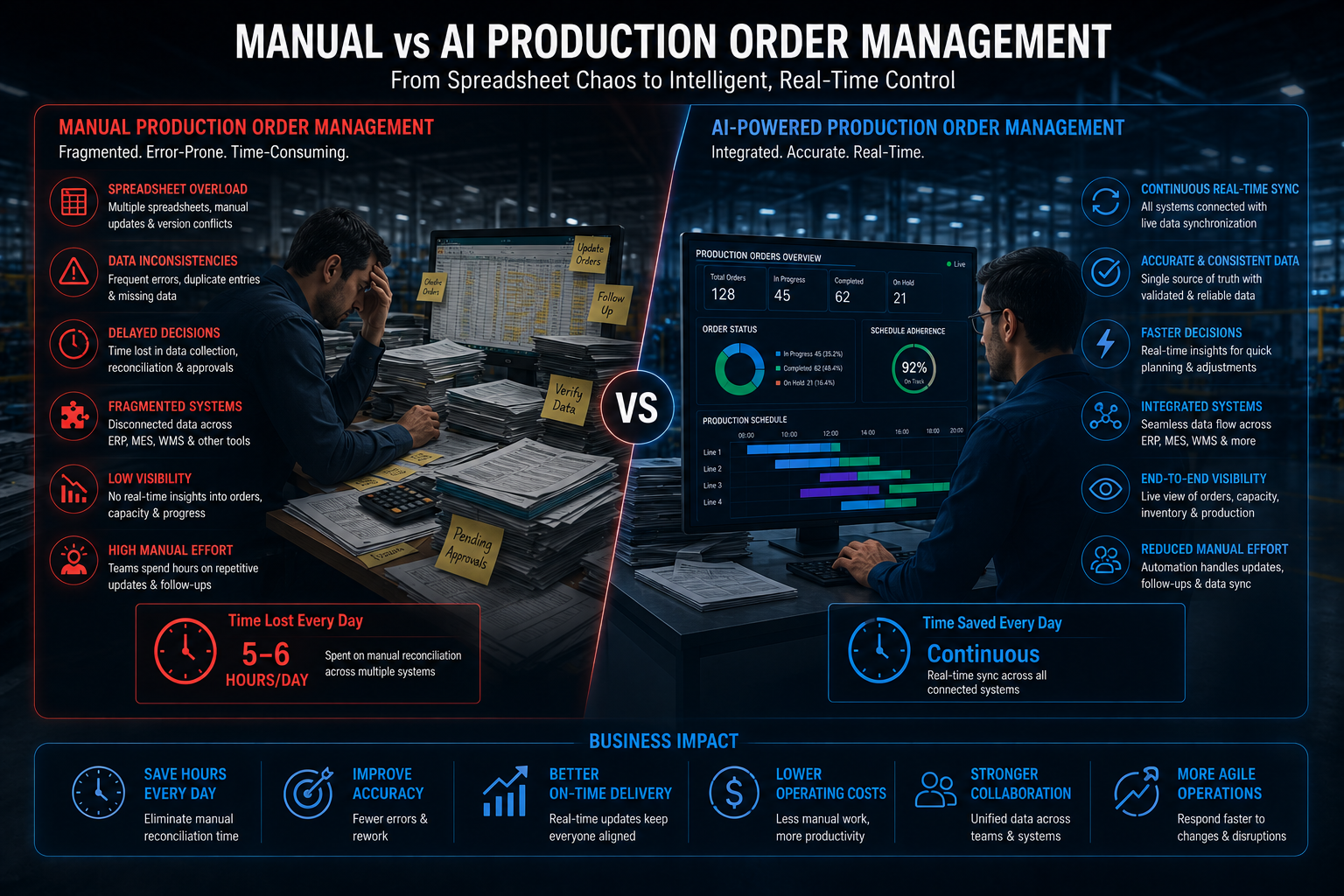
Every update requires someone to pull data from the MES, the ERP, the warehouse system, and the supplier portal, then manually reconcile them into the planning document. That takes time. It takes accuracy. And it takes the institutional knowledge of whoever built the original formula logic. When that person is out of the office, the schedule drifts.
The scheduler's job should not be building the plan. It should be reviewing the plan. The difference is significant, and AI is what creates it.
This is not a small-company problem. It shows up at manufacturers running 50-person plants and at divisions of companies with 10,000 employees. The scale changes; the underlying dynamic does not. Manual data reconciliation caps how responsive a plant can be to real-world disruption.
What AI-Driven Production Scheduling Actually Does
AI scheduling tools ingest real-time signals from ERP, MES, and warehouse systems, apply constraint rules, and propose revised schedules that reflect current conditions rather than the conditions that existed when the week's plan was built. That is the mechanism. What it changes in practice is more significant.
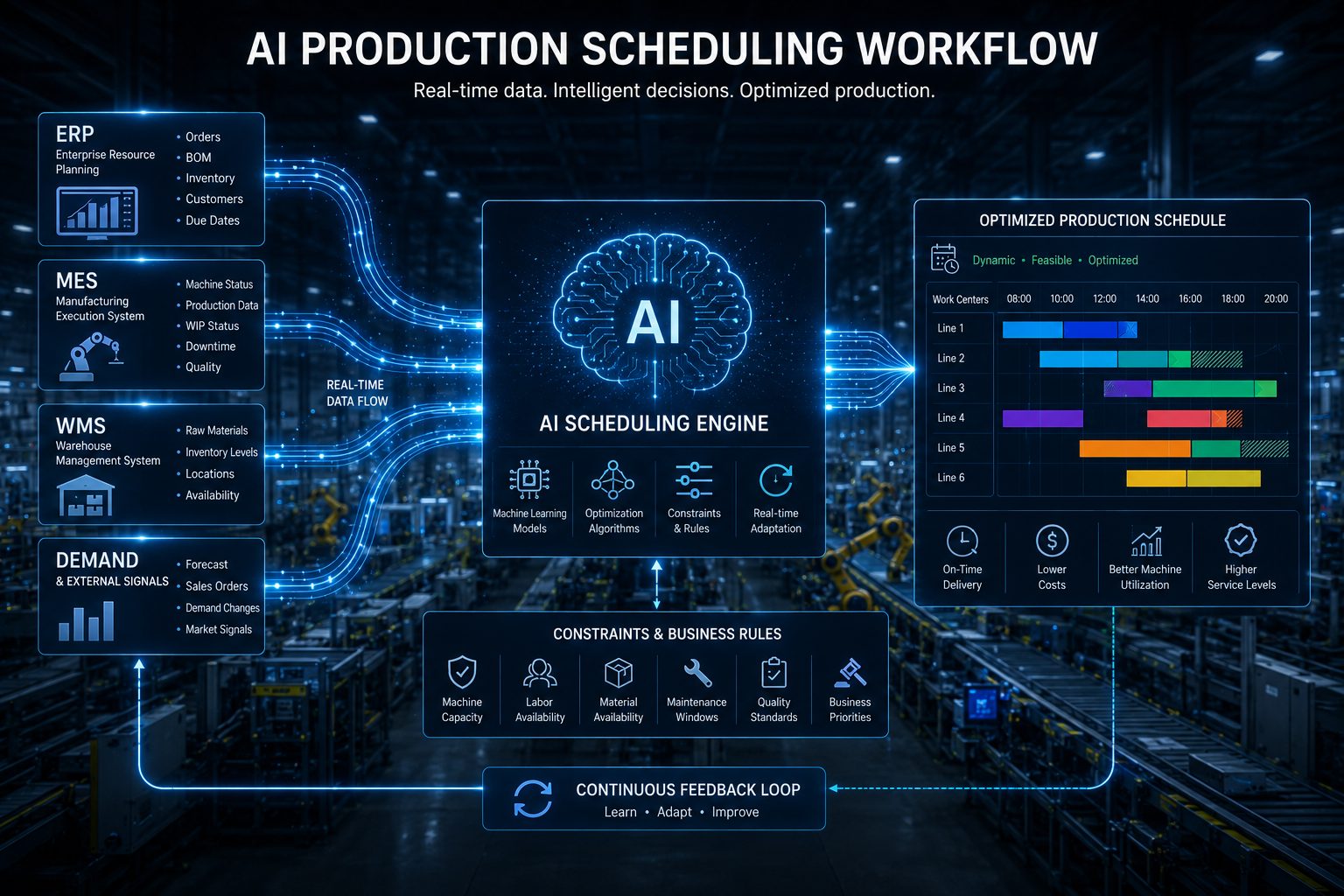
Real-Time Resequencing
When a machine goes down or a material delivery slips, AI reschedules all affected jobs immediately, not at the next planning meeting.
Constraint-Aware Planning
Changeover times, labor availability, tooling conflicts, and customer priorities are all factored in simultaneously, not approximated.
Demand Signal Integration
Customer order revisions, distributor commitments, and safety stock requirements update the schedule in real time, not at batch intervals.
The practical result shows up in the numbers. Organizations using AI scheduling report 10 to 25% improvement in on-time delivery, with variance depending on the starting baseline. Machine learning schedulers that optimize job sequencing and resource allocation across multi-product lines have lifted Overall Equipment Effectiveness by 15 to 25 percentage points in documented deployments.
What rarely gets discussed is the compounding effect. When scheduling accuracy improves, it reduces the emergency orders that inflate procurement costs. It reduces the overtime hours that erode margin. It reduces the expediting fees that nobody budgets for but everyone pays.
A GrayCyan Example: When the Sheet Became the System
This pattern appears consistently in GrayCyan client engagements. A beverage manufacturer running national distributor orders through a Google Sheet that had evolved over nearly three years provides a useful illustration. The sheet tracked distributor purchase orders, production scheduling, lot allocations, warehouse inventory, and shipping timelines. The founder described it as the only place where the real operational status of the business lived.
The structural problem was that the sheet required constant manual updates. Operations staff spent five to six hours every day copying information from their inventory system and logistics platform into the spreadsheet. When someone missed an update, the entire operational picture became inaccurate, and decisions made on that picture were wrong before they were executed.
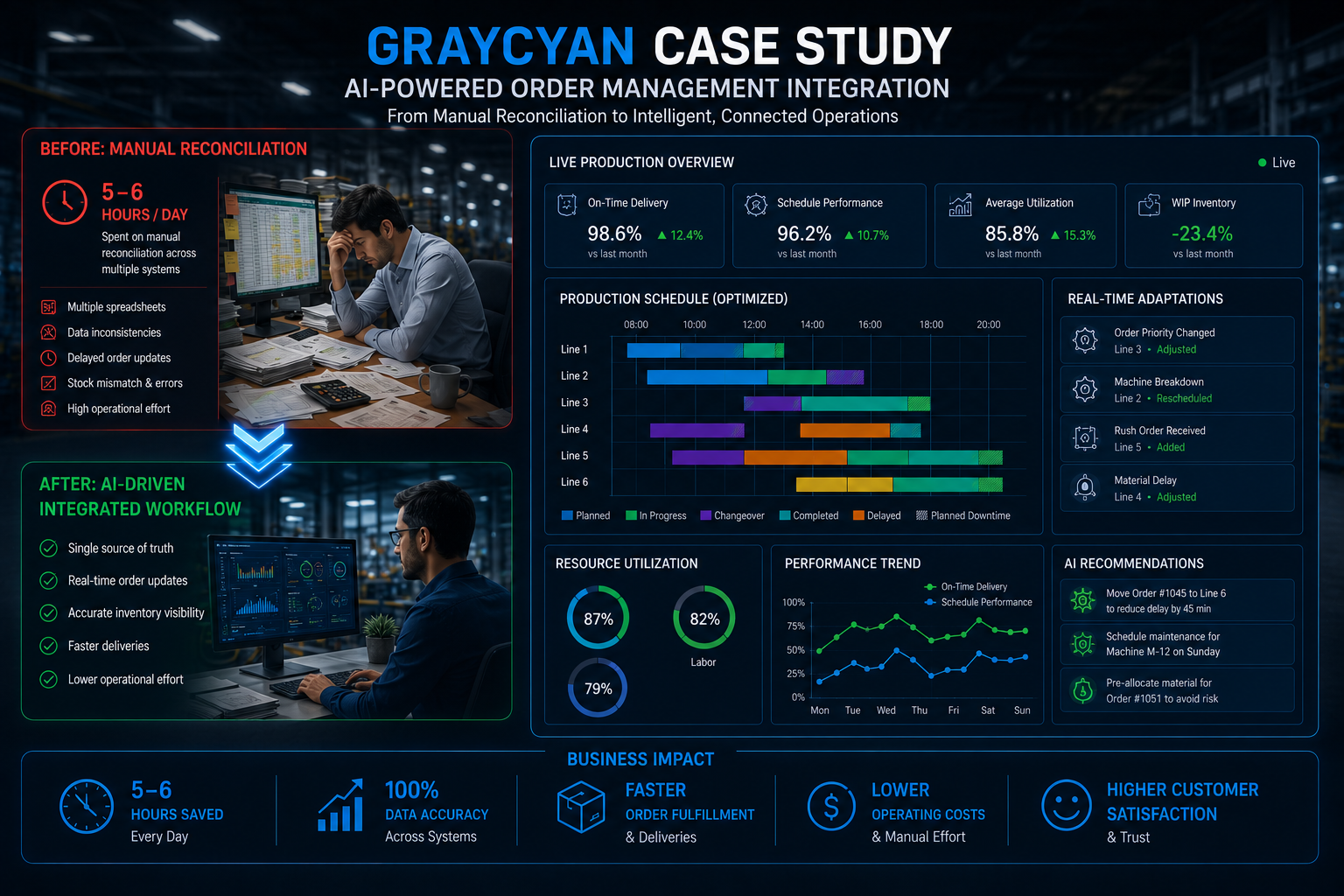
GrayCyan implemented an AI-driven integration layer connecting the sheet directly to the brand's operational systems. Production confirmations now update order status automatically. Inventory systems feed real-time stock levels into allocation calculations. Shipment confirmations update delivery timelines as they occur. The familiar interface stayed unchanged. The data behind it became live.
GrayCyan: Beverage Brand Order Management Transformation
A fast-growing beverage brand was managing national distributor orders through a spreadsheet that had become their operational command center over three years. The sheet required 5 to 6 hours of manual updates daily, reconciling data across their inventory platform, logistics system, and co-packer inputs.
GrayCyan connected the sheet to the brand's operational systems through an AI integration layer. Production confirmations, inventory levels, and shipment timelines began updating automatically. AI validation checks ensure incoming data accuracy before it appears in the planning view.
The sheet did not change. What changed was whether the data in it reflected reality. For a plant manager or operations leader, that distinction is the difference between a tool they trust and one they spend their morning second-guessing.
Why AI Scheduling Is Different from Your ERP
A common objection from manufacturing leaders is some version of: we already have scheduling in our ERP. That is usually true. It is also, for most mid-market manufacturers, not the same thing.
| Capability | Standard ERP Scheduling | AI Production Scheduling |
|---|---|---|
| Data refresh rate | Batch, often daily or weekly | Continuous, real-time |
| Constraint handling | Predefined rules, manually maintained | Dynamic, learned from operational history |
| Disruption response | Manual replan required | Automatic resequencing with human review |
| Demand signal integration | Periodic import from CRM/OMS | Live feed from order management systems |
| Planner role | Plan builder | Plan reviewer and exception handler |
| Learning over time | Static unless manually updated | Improves as it processes more production cycles |
The distinction that matters most operationally is the last one. In Deloitte's 2025 Smart Manufacturing Survey, companies deploying smart manufacturing technologies including AI for production planning reported double-digit gains in production output and employee productivity, and up to 15% more available capacity. That capacity came not from adding equipment or headcount, but from eliminating the scheduling friction that was quietly absorbing it.
Where Lot Tracking Fits the Manufacturing Picture
Production scheduling and lot tracking address different problems, but in food, beverage, and regulated manufacturing, they are tightly connected. A scheduler who knows which production run is affected by a quality hold, and which lots came from that run, responds differently than one who does not.
The practical implication: AI production scheduling systems that do not integrate with lot traceability data produce schedules that cannot account for hold events, regulatory requirements, or recall scenarios. The schedule looks clean. The operational reality is not.
Regulatory context: Under the FDA's Food Traceability Rule (FSMA 204), covered firms must provide lot-level traceability records within 24 hours during a recall or investigation. AI production scheduling connected to lot tracking data is what makes that response possible at speed, rather than through a days-long manual reconstruction.
For food and beverage manufacturers specifically, this integration between scheduling and traceability is not optional. It is the difference between a contained recall and one that expands because nobody could quickly identify which production runs were affected and where those units went.
Where Mid-Market Manufacturers Should Start
The manufacturers achieving the highest AI ROI in production scheduling share one practice: they start with a documented baseline. Not a pilot review meeting with anecdotal observations, but actual measurement of current state before any AI is deployed.
Measure the actual cost of your current scheduling process
Hours per week spent on manual updates. Frequency and cost of emergency expedites. On-time delivery rate and the gap to target. This is what you are actually solving.
Map where your data actually lives
Which systems hold the inputs your scheduler currently reconciles manually? ERP, MES, WMS, supplier portals? AI scheduling needs those data sources connected, not summarized in a spreadsheet.
Start with one product family or production line
Not the whole plant. Pick the line where scheduling errors are most expensive or most frequent. Prove the model on a contained problem before expanding it.
Keep the human review layer from day one
AI proposes the revised schedule. The planner reviews it. That review loop is not a transitional safeguard to be removed later. It is the mechanism by which the AI learns your specific constraints over time.
Measure against the baseline at 90 days
Same metrics you documented before deployment. This is what builds the internal business case for the next deployment and the one after that.
More than 40% of manufacturers will adopt AI tools for scheduling systems in the next 12 months, according to IDC's 2026 Manufacturing Industry FutureScape. The manufacturers who are already measuring their current state are the ones who will be able to demonstrate ROI when they get there.
The Data Fragmentation Problem Nobody Talks About
The practical obstacle to AI production scheduling in most mid-market manufacturing operations is not AI. It is data fragmentation.
Modern manufacturing plants typically run two technology stacks that do not communicate naturally. The operational technology layer runs the equipment: PLCs, SCADA systems, MES platforms, sensors on machines that have been running for 15 years. The information technology layer runs the business: ERP, CRM, finance systems, data warehouses. They were designed by different teams, for different purposes, with different priorities around speed, security, and reliability.
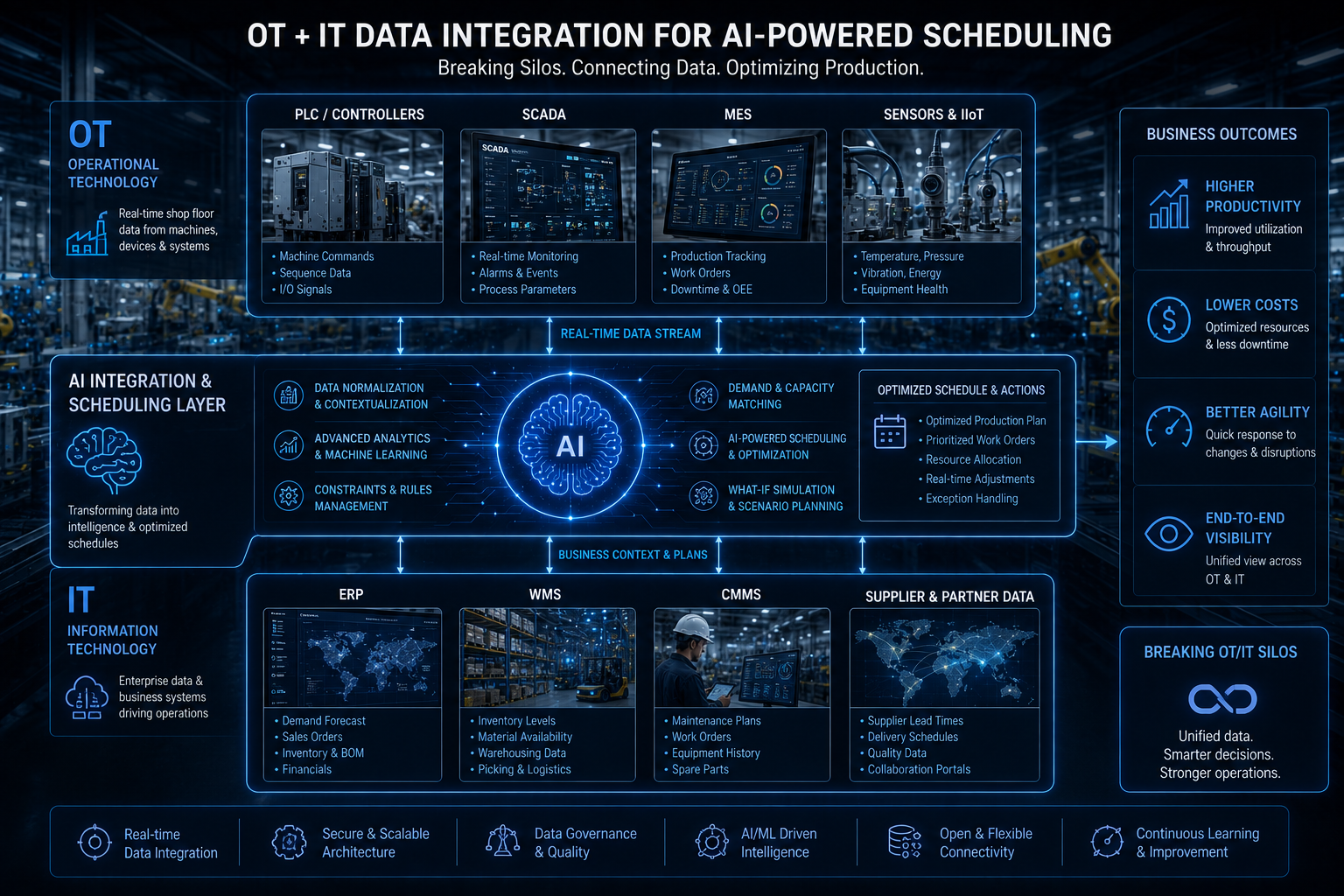
AI scheduling needs data from both layers simultaneously. A schedule that does not know the current state of the equipment it is scheduling is not a better schedule. It is a more convincing version of a wrong one.
- OT layer: PLC, SCADA, MES, sensor data, equipment status, cycle times
- IT layer: ERP orders, WMS inventory, CMMS maintenance history, supplier data
- The gap: middleware and data historians that translate between OT and IT protocols
- The risk: AI scheduling on IT data alone, blind to OT reality
- The fix: integration layer that surfaces live OT state to the scheduling model
- The timeline: longer than expected, but the prerequisite for everything else
Manufacturers consolidating onto a new ERP platform frequently find that the migration creates an unexpected opportunity. Cleaning and standardizing data for the new system produces the data foundation that AI scheduling requires. Organizations that run ERP migration and AI readiness work in parallel rather than sequentially compress the time to value significantly.
Ready to Audit Your Production Scheduling System?
GrayCyan's AI Readiness Assessment starts with your current scheduling baseline, maps the data sources your AI needs, and identifies the highest-value opportunity for your specific production environment.
Book an AI Readiness AssessmentFrequently Asked Questions