Two different questions drive people to HonestAI's AI coverage. The first: what are enterprises doing with AI agents? That's the Agentic AI News page. The second: what are the tools, protocols, and chips that make those agents possible? That's this page. MCP news, AI chip developments, multi-agent frameworks, and the LovingIs.ai case study showing what human-in-the-loop architecture actually looks like in practice. Updated quarterly.
USB
The analogy for MCP — one integration per tool, works with any compatible AI
1.7x
Blackwell B200 performance improvement over H100 predecessor
AAIF
Linux Foundation's Agentic AI Infrastructure Foundation — now stewards MCP as the open standard
What Is MCP — and Why AI Agents Cannot Scale Without It
Large language models can reason, draft, summarize, and code. What they cannot do — at least not without additional infrastructure — is act. They cannot send your email, book your meeting, query your database, or update your ERP. They can tell you how to do it. They cannot do it.
That gap is what MCP closes.
The Problem MCP Solves
Before MCP, connecting an AI assistant to an external tool required custom API integration for every combination of AI and tool. If you wanted Claude to read your Notion workspace, someone had to build a Notion-to-Claude integration. If you then switched to GPT-4, that integration did not transfer. Every AI, every tool, required its own plumbing.
Model Context Protocol, originally developed by Anthropic and now an open standard under the Linux Foundation's Agentic AI Infrastructure Foundation (AAIF), solves this with a universal protocol. Build an MCP server once for your tool, and every MCP-compatible AI can use it. The AI ecosystem analogy that lands consistently: MCP is the USB port of AI. One standard connection, works everywhere.
How MCP Works — Without the Jargon
🤖
MCP Client
The AI assistant — Claude, GPT-4o, Cursor, Windsurf, or any MCP-compatible model. It sends requests to MCP servers to access tools and data. The client decides what to do; the server provides the capability.
🔌
MCP Server
The tool or data source exposing its capabilities in the MCP standard. A Notion MCP server lets AI read and write your workspace. A GitHub MCP server gives AI access to code repositories. One server, any compatible AI.
📡
MCP Protocol
The standardized conversation layer between client and server — based on JSON-RPC 2.0. Defines how requests are made, how capabilities are discovered, and how responses are returned. Consistent across the entire ecosystem.
Best MCP Servers for Building AI Apps — Q2 2026
This table is updated quarterly as the MCP ecosystem expands. These are the most widely deployed MCP servers covering the core use cases for enterprise and developer teams:
| MCP Server |
What It Connects |
Primary Use Case |
Best For |
| Filesystem Core |
Local file system |
Read, write, and navigate files on the host machine |
Local automation, document processing |
| GitHub Core |
GitHub repositories |
Code review, PR management, issue tracking, repo search |
Development teams, code automation |
| Notion |
Notion workspaces |
Read and write pages, databases, and structured content |
Knowledge management, documentation workflows |
| Slack |
Slack channels and DMs |
Send messages, read channel history, search conversations |
Team communication automation |
| PostgreSQL |
PostgreSQL databases |
Query, read, and analyze structured database data |
Data analysis, operational reporting |
| Playwright Popular |
Web browser (automated) |
Navigate websites, fill forms, extract data, test flows |
Web automation, testing, data collection |
| Google Drive |
Google Drive files |
Read Docs, Sheets, and Drive files; organize and search |
Document-heavy workflows in Google Workspace |
| Figma Popular |
Figma design files |
Extract design specs, translate designs to code |
Design-to-development workflows |
| Stripe |
Stripe payments API |
Query transactions, manage subscriptions, generate reports |
Finance automation, payment operations |
| Supabase |
Supabase databases |
Database queries, auth management, real-time data |
Developers building on Supabase backend |
Manufacturing note: MCP servers for ERP systems (SAP, Oracle NetSuite, SYSPRO) are in active development. Once available, they will allow AI agents to query production data, update inventory records, and process supplier communications directly within your ERP — without a separate integration project for each AI system deployed.
Why MCP Was Adopted by the Linux Foundation AAIF
In late 2025, the Linux Foundation launched the Agentic AI Infrastructure Foundation (AAIF) — and MCP became its foundational standard for AI tool connectivity. This was the most significant validation event in MCP's short history. It moved MCP from "Anthropic's protocol" to "the industry's protocol."
The practical implication: any organization building AI agent infrastructure in 2026 that ignores MCP is building on a proprietary integration model that will require significant rework as MCP becomes the expected standard. This is the USB/Bluetooth moment for AI tool connectivity — early adopters build once and reuse everywhere.
AI Chip News — The Hardware Driving the Agent Era
AI agent capability is ultimately constrained by the hardware running the models. Understanding the chip landscape is not just a technical exercise — it is a procurement and infrastructure decision with multi-year consequences. Three developments define the Q2 2026 chip picture.
Nvidia's Blackwell B200 represents a significant step in AI accelerator capability and energy efficiency. Built on TSMC's 4NP process with 208 billion transistors and HBM3e memory, the chip delivers up to 1.7 times the performance of its predecessor while consuming 20% less power — a combination that directly addresses the energy cost problem scaling at hyperscaler data centers.
The inference efficiency improvement is even more dramatic. According to Jensen Huang, Nvidia CEO and founder: "Blackwell is the most potent chip for generative AI in the world. We've completely reimagined the memory subsystem and dramatically increased the chip's ability to handle the large-scale matrix operations that are central to modern AI systems." The chip's Fifth-Generation NVLink and transformer-optimized architecture make it particularly suited to the large-scale inference workloads that enterprise agentic AI deployments generate.
Patrick Moorhead, founder of Moor Insights and Strategy, noted: "Nvidia continues to execute flawlessly, and this chip will likely extend their technological lead for at least another 12-18 months. Even while their rivals are improving, Nvidia's software ecosystem remains a significant advantage."
That software ecosystem — CUDA and the associated AI libraries and frameworks — remains Nvidia's deepest competitive moat. Switching to a competitor chip is not just a hardware change. It requires porting software, retraining development teams, and accepting performance uncertainty during transition.
Why It Matters
For organizations planning AI infrastructure investment, Blackwell deployment means significantly lower inference costs per token compared to prior-generation hardware. For manufacturers running edge AI on production lines, the energy efficiency improvements translate directly to operating cost reductions at the facility level.
AMD's MI300 and MI400 series accelerators have made the most credible competitive challenge to Nvidia in enterprise AI workloads. While Nvidia maintains approximately 70-80% of the data center GPU market, AMD is winning meaningful share in specific contexts — particularly inference workloads where its price-performance ratio is more favorable than Nvidia's premium positioning.
The competitive landscape also includes custom silicon from hyperscalers: Google's TPU v5, Amazon's Trainium 2, and Microsoft's Maia — all designed specifically for their own AI workloads rather than sold to third parties. Intel's Gaudi processors, acquired through the Habana Labs purchase, continue to make incremental progress but have not achieved significant market traction.
Startups like Cerebras Systems (wafer-scale technology) and SambaNova Systems (reconfigurable dataflow architecture) represent alternative architectural bets that have found niche applications but have not challenged the Nvidia/AMD duopoly in volume deployments.
Why It Matters
The AMD competitive pressure is gradually reducing Nvidia's pricing power at scale. Organizations procuring AI infrastructure in 2026 have more negotiating leverage than they did in 2023-2024 when Nvidia GPU availability was constrained. For manufacturers evaluating on-premise AI deployment, a competitive chip market means more infrastructure options at lower cost.
For manufacturers deploying AI on production lines, the relevant chip market is not hyperscaler GPUs — it is edge AI processors designed for embedded and industrial deployment. Three categories are active in 2026:
- Nvidia Jetson series — the dominant platform for embedded AI, used widely in computer vision quality control, robotic guidance, and intelligent manufacturing equipment
- Intel Neural Processing Units (NPU) — integrated into Intel's recent processor generations, enabling AI inference without a dedicated accelerator card
- Specialized industrial AI SoCs — purpose-built for specific manufacturing tasks (predictive maintenance sensor analysis, real-time defect detection) where standard GPU architecture is over-specified
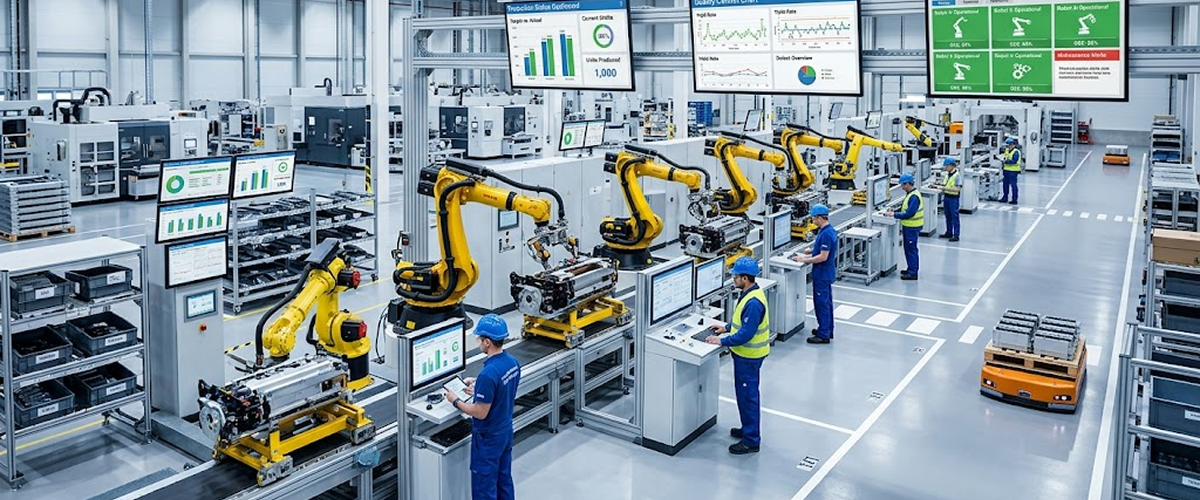
The defining characteristic of edge AI deployment in manufacturing is latency. Cloud AI inference involves a network round-trip that typically adds 50-200ms to every inference call. For quality control decisions on a production line running at speed, 200ms is too slow. Edge AI chips running optimized models (ONNX, TensorRT quantized) achieve sub-10ms inference latency on the production floor.
Why It Matters for Manufacturers
The combination of low latency, no cloud dependency, and no sensitive production data leaving the facility makes edge AI chips the natural infrastructure choice for production-floor AI deployments. The infrastructure cost has dropped significantly as the Jetson ecosystem has matured — what required a custom hardware project in 2022 is now a standard deployment with established tooling.
The agentic AI tool market has matured from a collection of experimental projects to a structured landscape of production-ready options. Two categories define the current moment: purpose-built agentic platforms targeting specific workflows, and general-purpose frameworks that developers use to build custom agents.
Manus AI, developed by Butterfly Effect, launched in early 2025 with a simple but compelling premise: most AI tools respond to prompts. Manus acts on goals. It understands what you need, creates a plan, and executes tasks autonomously — connecting to email, calendar, documents, and APIs to complete work rather than just describe it.
At launch, Manus offered tiered pricing starting at $39/month with an advanced $199 option (enabling five simultaneous tasks and more computation credits), built on Anthropic's Claude model family. The platform positioned itself as a direct competitor to task-based AI assistants from OpenAI and Google, with a particular focus on professional and business workflows.
The core capability that distinguishes Manus from standard LLM interfaces: it maintains context across a multi-step workflow rather than treating each interaction as independent. Ask Manus to research three competitor products and produce a comparison report — it does not answer once and stop. It searches, reads, synthesizes, formats, and delivers.
Why It Matters
Manus represents the commercial direction of agentic AI — tools that handle complete workflows rather than individual tasks. For manufacturers evaluating agentic AI for procurement, quality documentation, or supplier communication workflows, the Manus model (plan, execute, deliver) is the architectural pattern that is generating real operational value.
The agentic AI tool market has stratified into four categories that serve different buyer profiles:
AI coding agents: Cursor and Windsurf lead for developers building with AI assistance. Both support MCP, enabling them to connect to databases, APIs, and documentation sources during development. Devin from Cognition represents the more autonomous end — capable of completing entire development tasks end-to-end.
AI research and analysis agents: OpenAI Deep Research and Perplexity Deep Research are the mature options for information synthesis tasks. Both handle multi-source research across hours of autonomous operation, delivering structured reports rather than individual answers.
AI workflow automation agents: n8n and Make (formerly Integromat) have added AI agent capabilities to their existing automation platforms. These are the practical options for manufacturing operations teams who want to connect AI to existing ERP and operational systems without a development project.
Enterprise-embedded agents: Salesforce Agentforce, ServiceNow AI agents, and Microsoft Copilot Agents operate within their respective platforms. For organizations already running on these platforms, these are the path of least resistance to production agentic AI deployment.
Why It Matters
The right agentic tool choice depends entirely on the workflow being automated and the existing systems in your organization. For custom manufacturing and B2B operational deployments — particularly those requiring ERP integration, HITL oversight, and data sovereignty — off-the-shelf platforms often require significant customization. This is where specialist deployment partners become relevant.
Case Study — How GrayCyan Built LovingIs.ai Using HITL Architecture
LovingIs.ai is on a mission to teach AI what love actually means — not as sentiment analysis, but as a foundational principle applied to every AI output. Founded by entrepreneur Jen Loving, the project set out to build a compassionate AI layer that works across existing models (GPT, Claude, Gemini), ensuring every response embodies genuine empathy rather than generic positivity.
"This experience has been better than I even anticipated. When I first saw the product, I had tears in my eyes because it was more than I imagined it would be."
— Jen Loving, Founder, LovingIs.ai
The Challenge — Teaching AI What Love Is
The technical challenge was real: how do you encode something as culturally, philosophically, and emotionally complex as love into an AI system that operates across different contexts, languages, and cultural frameworks? Jen's team had approached other developers who treated it as a standard build. The "why" behind the technology was not their concern.
When GrayCyan's Nish connected with Jen, the approach was different. Before writing a single line of code, the GrayCyan team participated in ten 90-minute sessions exploring love from cultural, philosophical, and ethical perspectives. The goal was not to define love in a database — it was to understand it well enough to build a principled filter that would hold across contexts.
The HITL Difference — What the Strawberry Test Showed
The most memorable demonstration of GrayCyan's HITL architecture came from a simple test. The team asked both ChatGPT and GrayCyan's AI system the same question: "How many R's are in the word strawberry?"
ChatGPT answered incorrectly — confidently, coherently, and wrong. GrayCyan's system answered correctly, and delivered the answer in a genuinely engaging tone that made the response not just accurate but enjoyable to read.
The difference was not a better model. It was architecture. The combination of structured intelligence and human review — the human-in-the-loop layer — catches what the model alone misses. The "loving layer" that GrayCyan built does not replace the underlying LLM. It filters and validates outputs against a principled standard before they reach the user.
- Launched Valentine's Day 2025 — a private beta that attracted hundreds of enthusiastic early users
- Works across GPT, Claude, and Gemini — the loving layer operates as a universal filter, not model-specific
- GrayCyan's design team (led by Shruti) created a logo symbolizing love and safety — a visual identity that may become a recognizable marker for ethically-built AI
- 10 x 90-minute immersion sessions before any development work — the product's quality traced directly to this foundation work
Jen Loving's words reflect the outcome: "I would 100% recommend GrayCyan to anyone building an AI or tech product that needs to be deeply aligned with their vision."
The Principle Behind the Case Study
HITL is not a constraint on AI capability. It is the architecture that makes AI capability trustworthy. The organizations achieving the highest AI ROI are not deploying the most autonomous systems — they are deploying systems where AI speed and scale are combined with human judgment at the right intervention points. LovingIs.ai demonstrates this in an emotionally-charged context. The same principle applies to quality control, procurement, and production scheduling in manufacturing.
Multi-Agent AI Frameworks — What's New This Quarter
A single AI agent handles a single workflow thread. Multi-agent systems coordinate multiple agents — each with specialized capabilities — to complete complex, multi-part tasks that no single agent could handle alone. The orchestration layer connecting these agents is one of the most actively developing areas of the AI infrastructure stack.
LangGraph (LangChain) has become the production choice for complex multi-agent workflows requiring fine-grained control over agent interactions. Its graph-based architecture makes it well-suited to manufacturing workflows where the sequence of operations matters — quality check before packaging, approval before procurement, inspection before shipment.
CrewAI takes a higher-level approach, enabling teams to define agent roles (researcher, writer, quality reviewer) and let the framework manage coordination. It is faster to prototype with and has growing enterprise adoption for content generation and research workflows.
AutoGen (Microsoft) focuses on conversational multi-agent patterns where agents communicate with each other in natural language to solve problems. Microsoft's enterprise backing means it integrates well with Azure AI services and the Microsoft 365 ecosystem.
OpenAI Agents SDK, launched in 2025, provides a first-party option for GPT-based multi-agent systems with built-in handoff patterns between agents and native tool calling.
Why It Matters for Operations Teams
Multi-agent orchestration is the technology that makes complex operational automation possible. A single AI agent can handle one process step. A multi-agent system can handle the entire workflow — from detecting the anomaly, to identifying the root cause, to drafting the corrective action, to routing it for approval — with human checkpoints at every decision that matters.
Also in AI Tools This Quarter
- OpenAI Agents SDK gained broader enterprise availability — enables building GPT-based agents with native handoff, tool calling, and streaming. See Agentic AI News for enterprise deployment coverage.
- Azure OpenAI Service expanded regional availability — new data residency options for European manufacturers. For investment and infrastructure scale, see AI Investment News.
- n8n MCP integration — the open-source workflow automation platform added native MCP support, enabling MCP-connected AI agents within n8n workflows without custom API code.
- Claude Desktop MCP support — Anthropic's desktop Claude app now natively supports MCP server connections, enabling direct local file system, database, and tool access from the Claude interface.
- AI chip export controls updated — US restrictions on AI chip exports to China continue to evolve. For broader geopolitical AI coverage, see AI Market Developments.
What GrayCyan Builds With These Tools
The tools covered in this roundup are the components GrayCyan uses to build AI systems for manufacturers and B2B operators. MCP provides the connectivity layer — GrayCyan's deployments connect AI agents to clients' ERP, WMS, and production systems through MCP and direct integrations. Edge AI chips provide the hardware layer for production-floor deployments where cloud latency is unacceptable. Multi-agent frameworks provide the orchestration layer for complex operational workflows.
Every GrayCyan deployment also implements the HITL principle demonstrated in the LovingIs.ai case study: AI handles volume and speed, humans retain judgment and override at the decision points that matter. The strawberry test result — GrayCyan correct, standard model wrong — is not a party trick. It is what happens when AI capability is combined with principled architecture rather than deployed raw.
🔌
Ready to Connect AI to Your Operations?
GrayCyan builds agentic AI systems for manufacturers and B2B operators — connecting AI to your existing ERP, WMS, and production systems with HITL oversight and data sovereignty built in from day one. Start with an AI Readiness Assessment.
Frequently Asked Questions
What is MCP in AI?
▾
Model Context Protocol (MCP) is an open standard that connects AI assistants to external tools, databases, and services. Originally developed by Anthropic and now maintained by the Linux Foundation's Agentic AI Infrastructure Foundation (AAIF), it works like a USB port for AI — build one MCP server for a tool, and every MCP-compatible AI can use it. Without MCP, every combination of AI model and external tool requires a custom integration.
What are the best MCP servers for building AI apps?
▾
Updated quarterly — see the full table above. The most widely deployed core MCP servers: Filesystem (local file access), GitHub (code repositories), Notion (knowledge management), Slack (team communications), PostgreSQL (database queries), Playwright (browser automation), Google Drive (document access), Figma (design files), Stripe (payment data), and Supabase (backend databases). The ecosystem has over 1,000 community-maintained servers covering most enterprise tools.
What is the latest AI chip news?
▾
Updated quarterly — see AI Chips section above. Current landscape: Nvidia Blackwell B200 is the production standard for enterprise AI training and inference, offering 1.7x performance improvement and 20x inference efficiency over prior generation. AMD MI300/MI400 is gaining share in price-sensitive inference workloads. Edge AI chips (Nvidia Jetson, Intel NPU) are the hardware of choice for manufacturing production-floor deployments requiring sub-10ms inference latency.
How do AI agents use MCP?
▾
An AI agent uses MCP to connect to external tools without custom API coding for each combination. The agent (Claude, GPT-4o, Cursor) acts as the MCP client — it discovers what capabilities an MCP server exposes, then sends structured requests to use those capabilities. For example, an agent with access to a GitHub MCP server can read repository code, create pull requests, and search issues — treating the entire codebase as accessible context for its reasoning.
What is agentic AI infrastructure?
▾
Agentic AI infrastructure is the technology stack that enables AI agents to function in production: MCP for tool connectivity, vector databases for persistent memory (Chroma, Qdrant, Weaviate), orchestration frameworks for multi-step planning (LangGraph, CrewAI, AutoGen), model serving infrastructure (cloud or on-premise), and human-in-the-loop controls for oversight and override. Without this infrastructure, an AI model can answer questions — it cannot complete workflows.