Lot Tracking Reinvented: How AI-Powered Food Traceability Software Is Solving the Industry's Oldest Data Problem
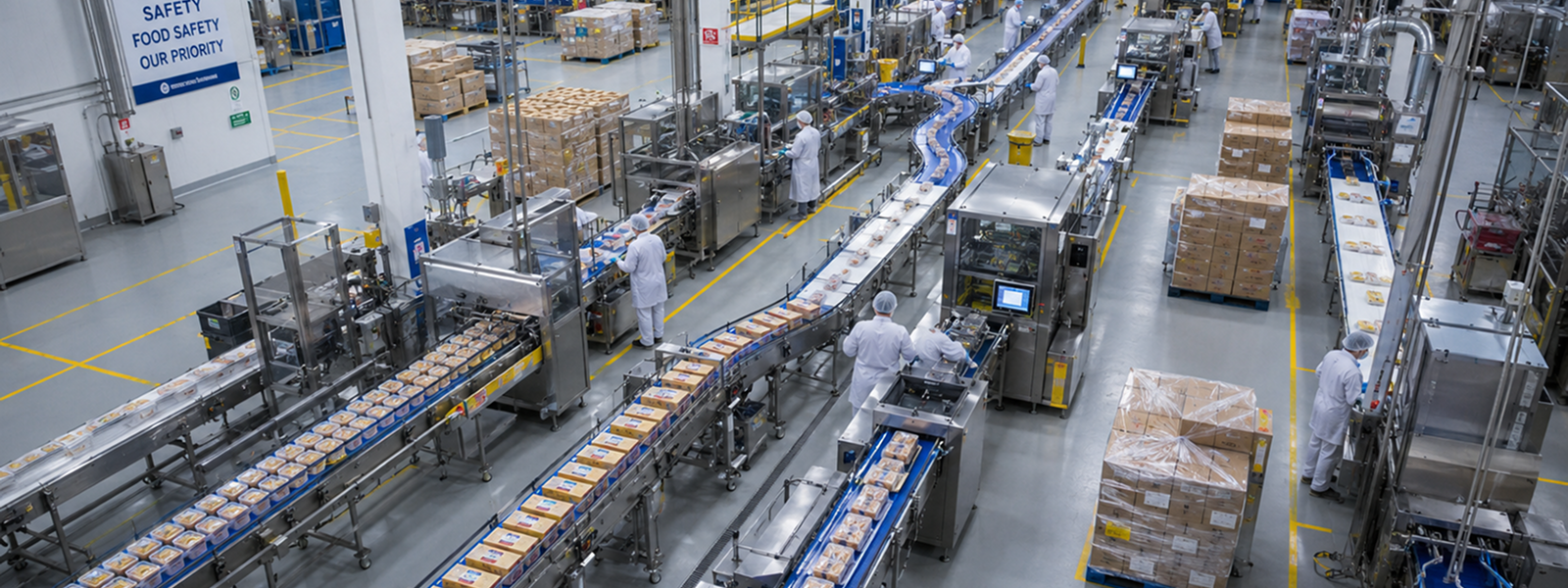
Food manufacturers face a crisis hiding in their data. A single contaminated lot — traced hours too late — can cost Mn in recalls, destroy brand trust built over decades, and trigger FDA enforcement action. AI-powered lot tracking and batch tracking software is changing that equation permanently.




Every food manufacturer knows the drill: a contamination event surfaces, regulators call, and the race begins. Teams scramble across spreadsheets, paper logs, and disconnected ERP modules trying to answer the most basic question in food safety — which lots are affected, and where did they go? In most facilities today, that answer still takes days. With AI-powered food traceability software, it takes minutes.
This article covers everything manufacturers, food processors, and supply chain operators need to know about modern lot tracking — from what it is and why it matters, to how AI is solving the traceability problems that legacy systems have failed to fix for decades. We also cover FSMA 204 compliance requirements, food recall management, and how GrayCyan's AI approach delivers real traceability that holds up under regulatory scrutiny.
What Is Lot Tracking in Food Manufacturing?
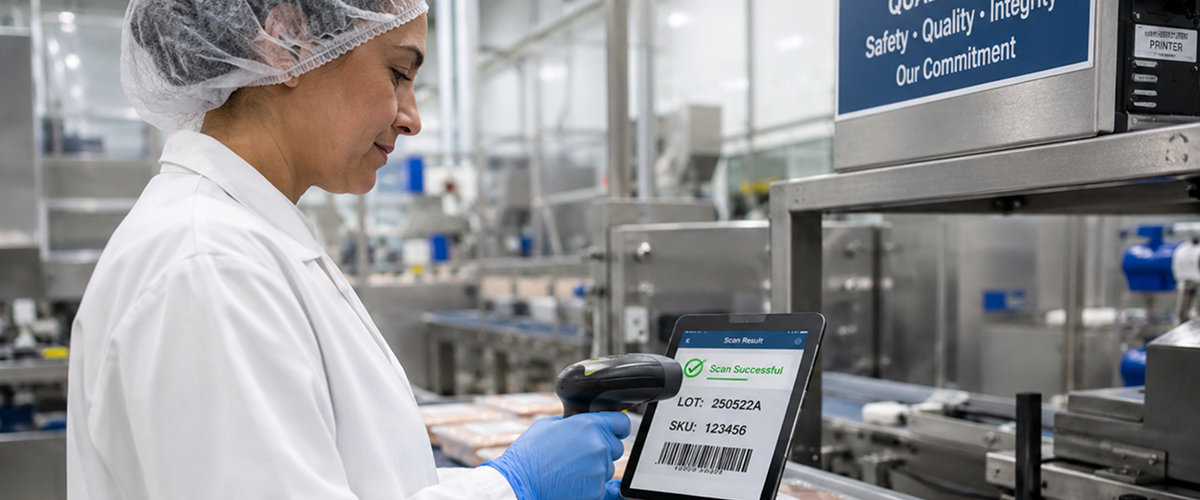
Lot tracking — also called lot number tracking or batch tracking — is the process of recording and following the movement of a specific group of products or ingredients through every stage of production, processing, storage, and distribution.
In food manufacturing, a "lot" typically refers to a batch of product produced under the same conditions, from the same ingredients, within a defined time window. Every lot receives a unique identifier — a lot number — that links it to its raw material sources, production records, quality test results, and shipment destinations.
When traceability works correctly, any food product on any shelf can be traced backward to every ingredient lot it contains, and forward to every customer location it reached. This is the foundation of food safety, regulatory compliance, and recall management.
Traceability Forward
From raw ingredient lot to finished product — tracking where every batch went: which production run, which finished goods, which customer shipments.
Traceability Backward
From a finished product or recalled item back to every raw material lot it contained — identifying contamination sources precisely and quickly.
Lot Number Tracking
Maintaining a live, auditable record of every lot's status, location, quantity, and quality test results — accessible instantly for compliance and recall response.
The Real Cost of Poor Food Traceability
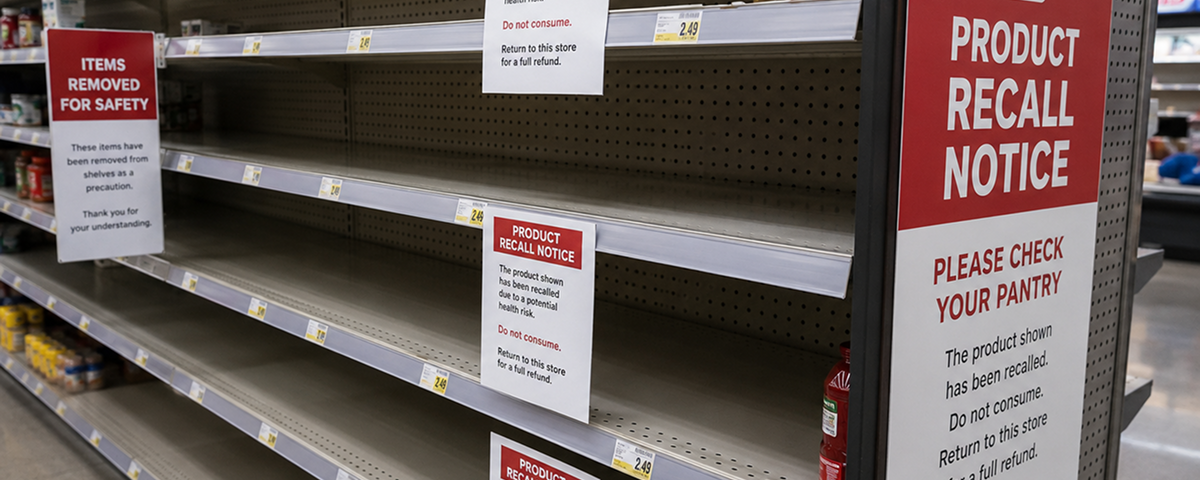
Poor lot tracking is not just a compliance risk — it is a business risk that shows up directly on the balance sheet. When a contamination event occurs and a manufacturer cannot quickly identify the exact affected lots, the default response is a broad recall: pull everything that might be affected. That scope expansion is where the real cost lives.
The hidden multiplier: When a food manufacturer cannot pinpoint the exact affected lots within hours, regulators and legal counsel default to the broadest possible recall scope. Every additional lot recalled unnecessarily costs real money — product destruction, logistics, retailer chargebacks, and brand damage that compounds long after the event.
Why Traditional Lot Tracking Systems Fail
Most food manufacturers are running lot tracking on systems built for a different era — spreadsheets layered on top of ERP modules that were never designed for real-time traceability. The symptoms are familiar:
- Lot records split across multiple systems with no automated reconciliation
- Manual data entry creating gaps, typos, and timestamp errors
- Paper-based production logs that are not digitized in real time
- No single view connecting raw material receipts to finished goods to outbound shipments
- Recall simulations that take days rather than the hours regulators expect
- Inability to trace sub-ingredients and sub-components across multi-tier supplier networks
How AI Reinvents Lot Tracking
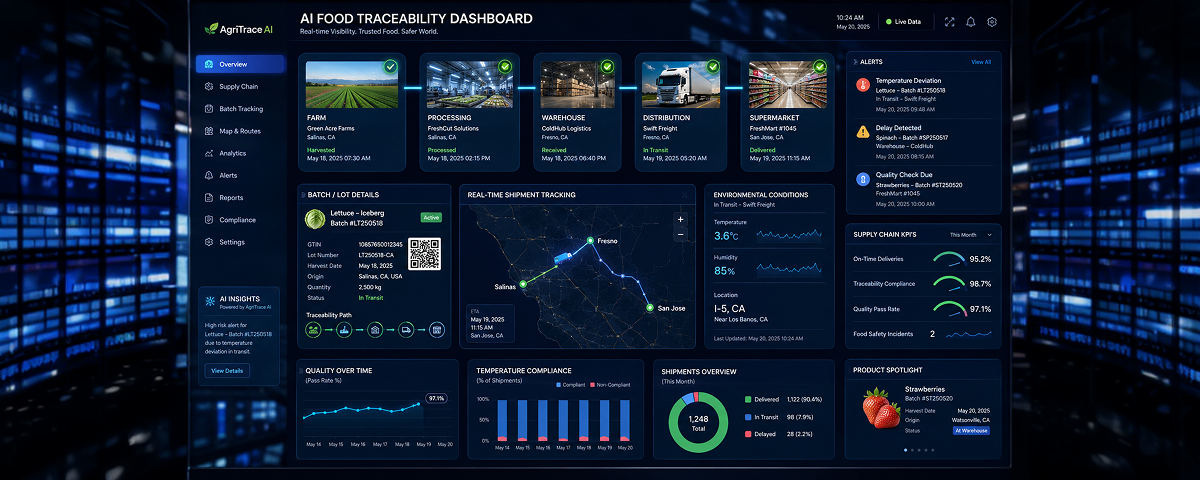
AI-powered lot tracking does not just digitize the existing manual process — it fundamentally changes how traceability data is created, connected, and queried. Instead of relying on humans to enter lot information at each stage, AI-enabled systems capture data automatically, validate it in real time, detect anomalies immediately, and make the entire lot history queryable in seconds.
"A recall that takes 7 days to scope under a manual system takes 7 minutes under an AI traceability platform. That difference is not just operational — it is the difference between a contained event and a brand-defining crisis."
— HonestAI Magazine · Food & ManufacturingWhat AI Adds to Lot Tracking That Legacy Systems Cannot
Automatic lot record creation from production data — no manual entry
Real-time linkage between ingredient lots and finished product lots
Anomaly detection — flags missing records, duplicate lot numbers, gaps in chain of custody
Live location tracking — where every lot is at every moment across the supply chain
Instant lot trace — forward and backward — in seconds instead of days
Auto-generated compliance reports — FSMA 204, HACCP, audit-ready documentation
What Food Traceability Software Actually Does
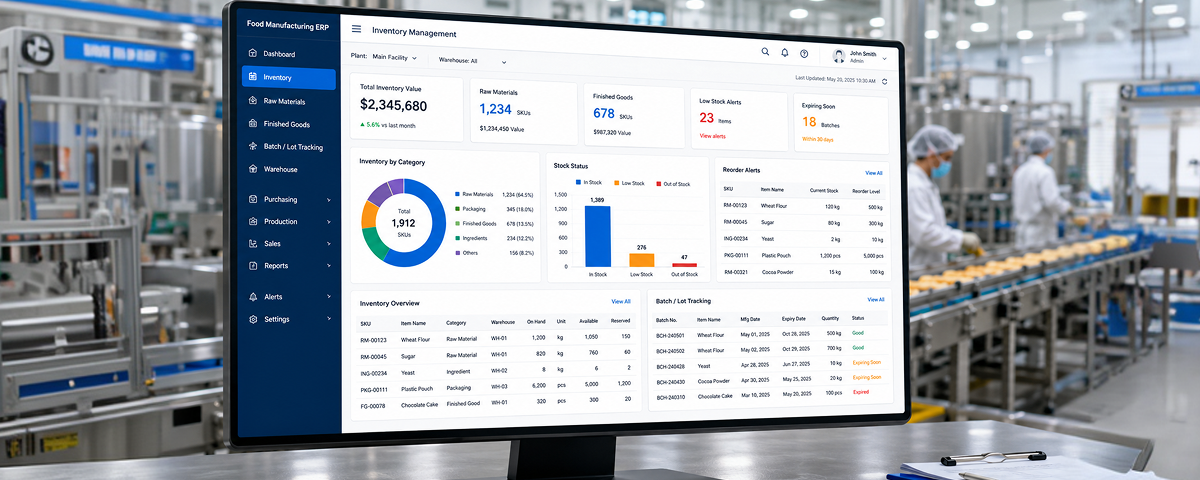
Food traceability software is a purpose-built platform that creates, maintains, and makes queryable a complete, auditable record of every ingredient, lot, and finished product that moves through a food manufacturing operation. The best food traceability systems do this automatically — capturing data from production equipment, ERP systems, WMS platforms, and supplier records without depending on manual input at each stage.
Unlike a generic inventory management system, food traceability software is designed around the specific requirements of the food industry: lot-level granularity, multi-tier supplier tracing, regulatory compliance documentation, and recall simulation capability. It answers questions that no spreadsheet can answer quickly enough when a recall event is live.
Core Capabilities of Modern Food Traceability Software
Ingredient Receipt & Lot Assignment
Every incoming ingredient is automatically assigned a lot record linking supplier name, supplier lot number, Certificate of Analysis, receipt date, and storage location — creating the first link in the traceability chain at the moment of receipt.
Production Lot Creation & Linkage
When production begins, the system automatically creates a finished product lot record and links it to every ingredient lot consumed in that production run — establishing a permanent, auditable forward and backward trace in real time.
Quality Hold & Release Management
Lots can be placed on hold automatically when quality tests fail or when a supplier alert is received — preventing non-conforming product from advancing through production without manual intervention at every step.
Outbound Shipment Tracking
Every outbound shipment is linked to the finished product lots it contains — recording which customer, which distribution centre, which date. This creates the forward trace that makes targeted recalls possible.
Recall Simulation & Audit Trail
Regulators and auditors can request a recall simulation at any time. AI traceability software executes the full forward and backward trace in seconds — producing a complete, exportable audit trail that satisfies FDA, FSMA 204, and retailer requirements.
Batch Tracking Software: What It Is and How It Differs
Batch tracking software focuses specifically on production batches — the groups of finished product created in a single production run. While lot tracking covers the full supply chain journey of ingredients and finished goods, batch tracking software zooms into the production stage: which ingredients went into this batch, what production parameters were applied, what quality results were recorded, and what finished product lots came out.
In practice, the best batch tracking software and food traceability software are increasingly the same system — or deeply integrated. AI-powered platforms handle both simultaneously: capturing batch data during production while automatically linking it to the broader lot traceability record that extends to suppliers upstream and customers downstream.
| Capability | Traditional Batch Tracking | AI-Powered Batch Tracking Software |
|---|---|---|
| Data Capture | Manual entry by production staff at end of shift | Automatic capture from equipment, sensors, and ERP in real time |
| Lot Linkage | Manual cross-referencing across spreadsheets | Automatic linkage — ingredient lots to finished product lots instantly |
| Error Detection | Errors discovered at audit — weeks later | Anomalies flagged in real time — missing records, mismatched quantities |
| Recall Trace | Days of manual investigation | Full forward and backward trace in seconds |
| Compliance Reports | Manual compilation — hours per audit | Auto-generated, audit-ready, exportable instantly |
| Quality Hold | Depends on human communication across shifts | Automatic hold placement with alerts to relevant teams |
FDA Food Traceability Requirements: FSMA 204 Explained
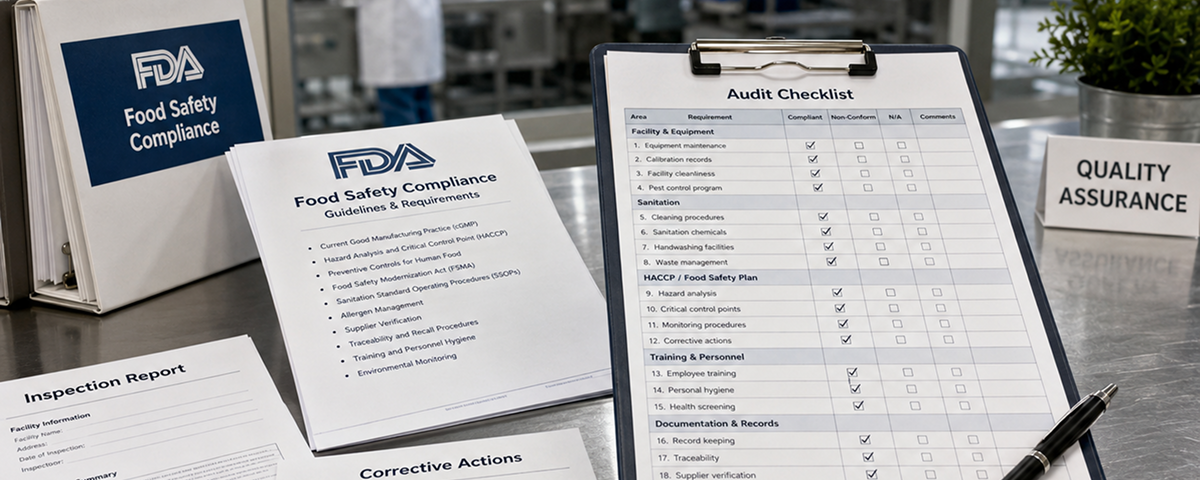
The FDA Food Safety Modernization Act's FSMA 204 rule — the Food Traceability Rule — establishes new record-keeping requirements for manufacturers, processors, and distributors of high-risk foods. It is the most significant update to FDA food traceability requirements in decades, and it has direct implications for lot tracking and batch tracking systems across the food supply chain.
Key FSMA 204 requirement: Covered entities must maintain traceability records and be able to provide the FDA with key data elements (KDEs) at each critical tracking event (CTE) within 24 hours of a request — in a sortable, spreadsheet-format. Manual systems that take days to compile this information are not compliant.
What FSMA 204 Requires — Key Data Elements (KDEs)
Ingredient Receipt Records
Traceability lot code, quantity and unit of measure, location description where received, date received, and reference document type/number for every incoming ingredient lot covered under FSMA 204.
Production & Processing Records
New traceability lot code for finished product, location of transformation, date of transformation, and the traceability lot codes of every input food used in the transformation — linking ingredients to finished goods.
Outbound Shipment Records
Traceability lot code, quantity, location shipped from, location shipped to, date shipped, and reference document for every outbound shipment of covered foods — creating the forward trace chain.
Rapid Response Capability
The ability to provide all required KDEs to the FDA within 24 hours of a request, in sortable electronic format. Manual lot tracking systems that take days to compile this data do not meet this standard.
AI-powered food traceability software maintains all required KDEs automatically at every CTE — creating a continuously updated, audit-ready record that satisfies FDA food traceability requirements without requiring manual compilation when a request arrives.
Food Recall Management Software: Speed Is Everything
When a food recall event begins, every hour matters. The faster a manufacturer can identify the exact lots affected, the smaller the recall scope — and the lower the financial, operational, and reputational damage. Food recall management software powered by AI transforms recall response from a multi-day investigation into an operation that completes in minutes.
What AI-Powered Recall Management Does Differently
- Instant lot scope identification: AI traces forward and backward through the full lot history in seconds — identifying exactly which finished product lots contain the affected ingredient, with no manual cross-referencing required
- Customer shipment mapping: Automatically generates a complete list of every customer, retailer, and distribution centre that received affected lots — with quantities, dates, and contact records
- Unaffected lot confirmation: Precisely identifies which lots are not affected — enabling manufacturers to exclude product from the recall scope that would have been included under a manual, conservative recall
- Regulatory documentation generation: Produces FDA-formatted recall notification documentation automatically — including all KDEs required under FSMA 204 — ready to submit within hours, not days
- Real-time recall status tracking: Monitors acknowledgement and return status from each customer location — providing a live dashboard of recall completion across the distribution network
What Faster Lot Tracing Means in a Recall Event
Scenario: Contaminated Ingredient Lot Identified
A supplier notifies a food manufacturer that an ingredient lot shipped 3 weeks ago may be contaminated. The manufacturer must immediately determine: which of our finished product lots contains this ingredient? Where did those finished products go? Who has them now?
| Action | Manual Lot Tracking System | AI Food Traceability Software |
|---|---|---|
| Identify affected finished product lots | 2–3 days of manual cross-referencing | Seconds — automatic forward trace |
| Map customer shipments | Hours of ERP queries and spreadsheet work | Instant — complete shipment map generated automatically |
| Confirm unaffected lots | Rarely done — too risky to exclude without certainty | Precise — AI confirms which lots are definitively safe |
| FDA documentation | Manual compilation — 1–2 days | Auto-generated — ready to submit in hours |
| Recall scope | Broad — includes product that may not be affected | Precise — limited to confirmed affected lots only |
Food Supply Chain Traceability: Beyond the Factory Floor
Food supply chain traceability extends lot tracking beyond the four walls of a single manufacturing facility — connecting raw material suppliers, co-manufacturers, distributors, retailers, and logistics providers into a single, queryable traceability record. This is where the real complexity of modern food traceability lives, and where AI-powered systems deliver the greatest advantage over legacy approaches.
A finished food product may contain dozens of ingredients sourced from multiple suppliers across multiple countries. Each ingredient arrives with its own lot number from its supplier. Once in the facility, it may be blended with other ingredients, processed through multiple production steps, and combined into a finished product that is then shipped to hundreds of customer locations. A traceability system that does not capture and connect every link in this chain is not truly traceable — it is partially traceable, which is almost as dangerous as not being traceable at all.
What End-to-End Food Supply Chain Traceability Covers
Supplier Lot Records
Every ingredient arrives with a supplier lot number, Certificate of Analysis, and origin records — automatically ingested and linked to your internal lot system at receipt.
Multi-Step Production
AI tracks ingredient lots through every transformation step — blending, cooking, packaging — maintaining the lot linkage chain even as products change form across production stages.
Distribution Network
Finished product lots are tracked to every distribution centre, retailer, and end customer — creating the forward trace that enables targeted recalls and regulatory response.
How GrayCyan Delivers AI-Powered Food Traceability
GrayCyan AI Solutions builds food traceability systems that integrate directly into the ERP, WMS, and production systems food manufacturers already use — without requiring a platform replacement or a multi-year implementation. The approach is designed specifically for the operational reality of food manufacturing: complex ingredient networks, multi-shift production, strict regulatory requirements, and the need for traceability data that holds up under FDA scrutiny.
- ERP & WMS integration: Connects to SAP, Oracle NetSuite, Microsoft Dynamics, and purpose-built food ERP systems — capturing lot data automatically without manual re-entry
- Automatic KDE capture: Every FSMA 204 Key Data Element is recorded at every Critical Tracking Event without requiring staff to manually compile compliance records
- Instant recall simulation: Full forward and backward lot trace in seconds — meeting the FDA's 24-hour response requirement with margin to spare
- Human-in-the-loop quality holds: AI flags anomalies and places automatic holds, but humans retain override control — every AI decision includes a transparent reasoning trail
- Audit-ready documentation: Compliance reports, recall documentation, and traceability records are auto-generated in formats acceptable to FDA, GFSI, and major retailer audit programmes
- Supplier lot ingestion: Supplier certificates of analysis and lot records are automatically ingested and linked — extending traceability upstream without requiring suppliers to change their systems
Start AI Readiness Assessment with GrayCyan AI Solutions and see exactly where your traceability gaps are.
Book a Call →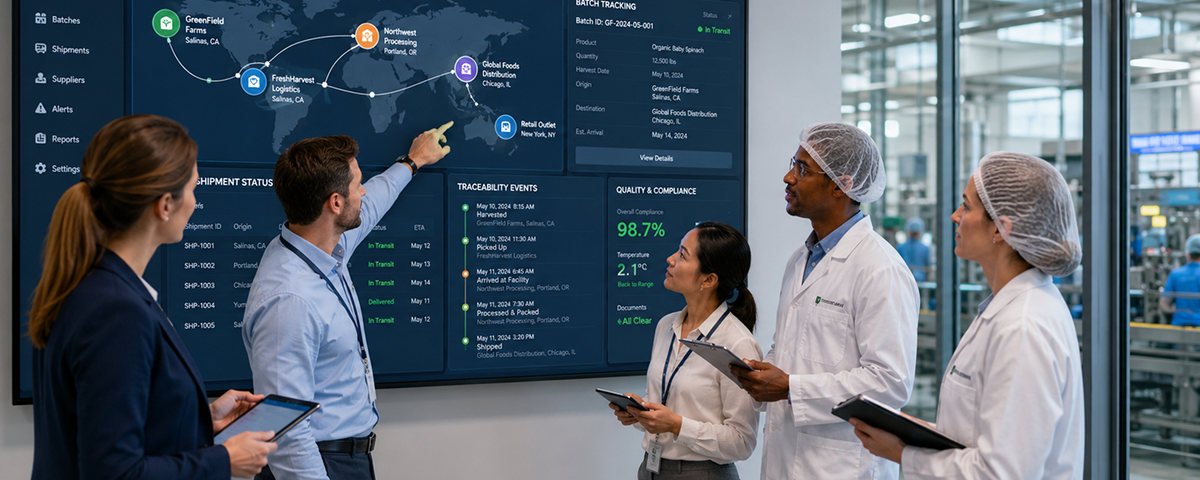
Frequently Asked Questions
What is food traceability software? ▾
Food traceability software is a platform that creates and maintains a complete, auditable record of every ingredient lot, production batch, and finished product that moves through a food manufacturing operation. It enables forward and backward tracing — from raw ingredient supplier to end customer — and generates the compliance documentation required by the FDA, FSMA 204, and retailer audit programmes. AI-powered food traceability software does this automatically, capturing data from ERP, WMS, and production systems without manual entry at each stage.
What is lot tracking software and how does it work? ▾
Lot tracking software assigns a unique lot number to every group of ingredients or finished products and maintains a live record of that lot's movement through production, storage, and distribution. Modern AI-powered lot tracking software captures this data automatically — linking ingredient lots to finished product lots in real time — and makes the complete lot history queryable in seconds. This enables instant recall simulation, compliance reporting, and quality hold management without manual investigation.
What are the FDA food traceability requirements under FSMA 204? ▾
FSMA 204 — the FDA Food Traceability Rule — requires covered food manufacturers, processors, and distributors to maintain Key Data Elements (KDEs) at every Critical Tracking Event (CTE): receiving, transformation (production), and shipping. Covered entities must be able to provide all required KDEs to the FDA within 24 hours of a request, in sortable electronic format. The rule covers high-risk foods including leafy greens, fresh fruits and vegetables, shell eggs, nut butters, finfish, crustaceans, and ready-to-eat deli salads.
What is batch tracking software? ▾
Batch tracking software focuses on production batches — recording which ingredients went into each batch, what production parameters were applied, what quality test results were recorded, and what finished product lots resulted. In modern food manufacturing, batch tracking software and food traceability software are increasingly the same platform: AI systems that capture batch data automatically during production while linking it to the broader traceability record that connects supplier ingredients to end customers.
How does AI improve food supply chain traceability? ▾
AI improves food supply chain traceability in four key ways: it captures lot data automatically without manual entry, it detects anomalies and gaps in the traceability record in real time, it executes forward and backward lot traces in seconds rather than days, and it generates compliance documentation automatically. The result is a traceability system that is faster, more accurate, and audit-ready at all times — rather than one that only produces accurate records when staff have time to compile them manually.
How does food recall management software reduce recall costs? ▾
Food recall management software reduces recall costs by identifying the exact affected lots quickly and precisely — limiting the recall scope to only the product that is actually affected. Under manual traceability systems, recalls are scoped broadly because manufacturers cannot quickly determine which lots are safe to exclude. AI-powered recall management software completes the full lot trace in seconds, identifies unaffected lots with certainty, and generates FDA-formatted recall documentation automatically — reducing scope, response time, and regulatory risk simultaneously.