




AI infrastructure is the foundation of every successful AI initiative. The strongest AI strategies don't begin with models—they begin with the infrastructure that supports them. Whether you're a CTO, operations leader, or manufacturer evaluating AI deployment, understanding the AI infrastructure landscape is essential for building scalable, secure, and reliable AI systems. This guide explains the core components of modern AI infrastructure, compares cloud, on-premises, and hybrid architectures, explores governance and agentic AI, and addresses manufacturing-specific deployment challenges. By the end, you'll understand how to build AI-ready infrastructure, choose the right architecture, control costs, and create a foundation that supports long-term AI success rather than short-term experimentation.
What Is AI Infrastructure — and Why Getting It Right Matters
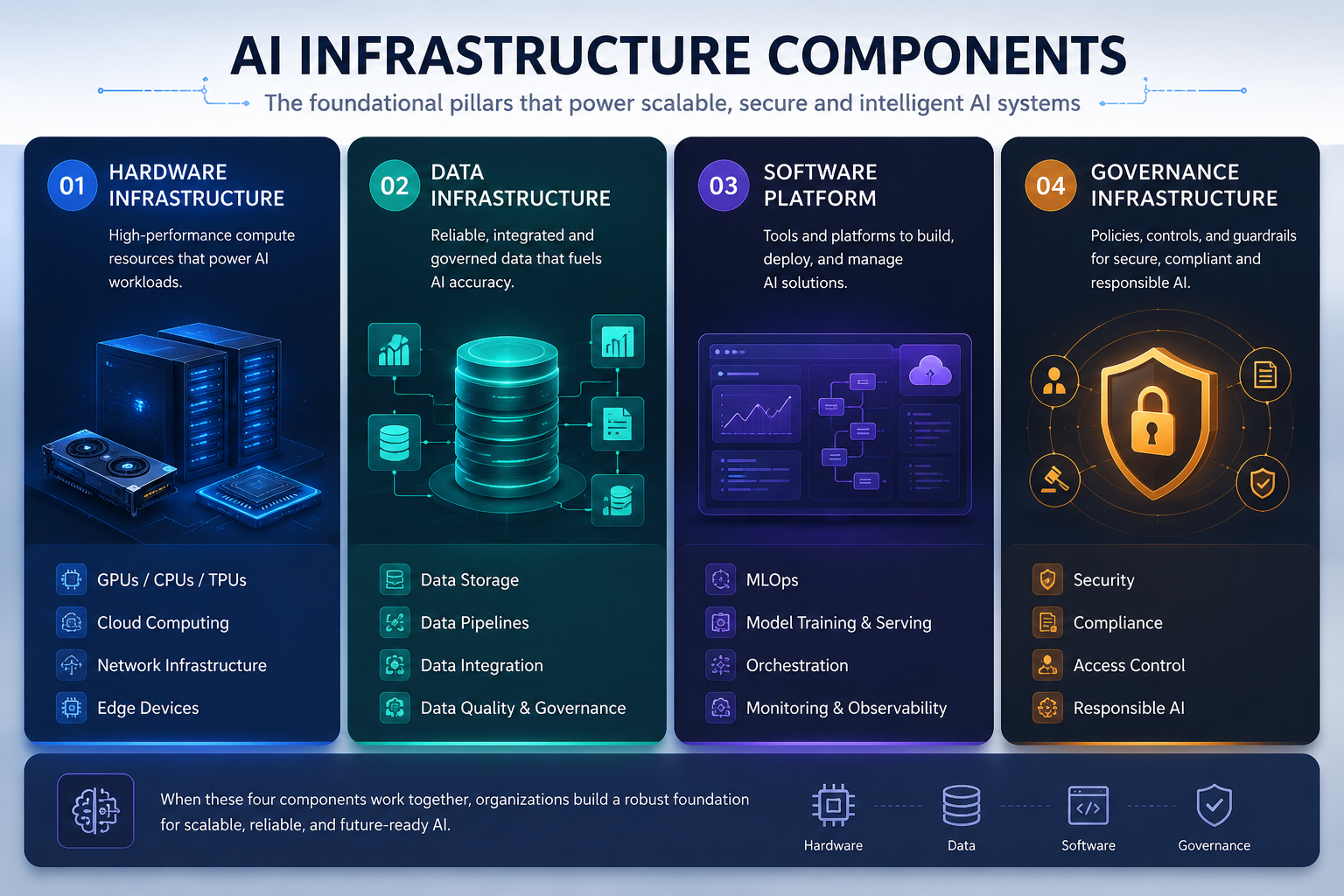
The four foundational pillars that power scalable, secure, and intelligent AI systems
It is important to understand what is AI infrastructure before deploying artificial intelligence systems. Simply put, AI infrastructure definition can be taken as a technological stack that allows companies to develop, deploy, and manage AI solutions. Four main elements make up AI infrastructure:
- Hardware resources like GPUs, CPUs, cloud computing, and network infrastructure;
- Data infrastructure like data storage, data pipeline, data integration, and data quality;
- software platform for developing and managing AI applications, MLOps, model serving, orchestration, and monitoring;
- Governance infrastructure related to security, compliance, access control, and responsible AI.
The combination of these components guarantees scalability and reliability of AI systems.
The choice of infrastructure at early stages of development plays a crucial role in the successful deployment of AI systems. Properly designed infrastructure ensures rapid deployment, cost-effectiveness, scalability, and consistent performance of models. Improper architecture leads to technical debt that prevents further innovation and becomes increasingly costly to fix.
There are three common infrastructure issues that organizations have.
- Organizations purchase advanced models without having proper data that is easily manageable and clean.
- Organizations create infrastructures meant for demo purposes rather than those that are meant for production.
- Organizations wait until there is an issue of security, compliance, and monitoring before they can govern their infrastructure.
Creating a proper infrastructure at the beginning will help organizations create confidence in AI implementation, adjust their business, and gain sustainable value rather than rebuilding their infrastructure again and again.
AI-Ready Infrastructure Starts with Data — Not Models

High-quality, connected, and governed data is the foundation of every successful AI system
Many companies start AI projects by selecting models rather than ensuring that their data is ready. But for an organization to succeed with AI, the company should lay the right data foundation. AI-friendly infrastructure is based on correct, integrated, and governed data that the AI system can rely on. Before implementing the models, the company should have its data ready for each step.
Data Quality Over Data Volume
Most companies think that AI is about gathering an enormous amount of information. It is more about having quality data than having plenty of data. AI works perfectly well with data that is consistent, complete, current, and contextualized.
- Consistency refers to the use of the same fields, names, and formats in all of the business systems.
- Completeness means that all significant records have all the necessary information to make a model effective.
- Currency implies that data relates to current operations and not the previous business state.
- Context implies all the metadata regarding a field, its origin, and interpretation.
Think of an example of a manufacturing company that uses three different generations of ERP systems. One of them defines the product as "AX-100", another one calls it "AX100", and the old-fashioned database uses the name "AX_100". Even though they mean the same item, AI sees these products as distinct from each other. This information has to be prepared, standardized, and validated prior to the training process. High-quality data allows AI to work much more effectively for prediction and decision-making.
Connected Pipelines — Eliminating the Silo Problem
Information related to business processes is commonly stored by manufacturers using ERP systems, WMS, QMS, spreadsheet databases, Internet of Things, and operator reports. Inconsistency of these separate databases hinders AI from discovering dependencies between various business processes.
The advanced AI data infrastructure links these sources via automated pipelines for continuous acquisition, standardization, validation, and synchronization of data. This way, rather than performing analysis on the basis of isolated datasets, AI gets a holistic picture of business operations covering procurement, production, stock, quality control, logistics, and customer service.
Using linked sources, AI is able to discover relationships that are hard to find out based on separate databases. For instance, there can be consistent correlations between suppliers' delayed deliveries and quality defects several weeks ahead or maintenance planning and production outputs and stocks. Linking data sources creates an intelligence layer for enterprises from scattered business data, which makes AI provide more accurate forecasts and more better cross-functional decisions.
Accessible but Accountable — The Governance Layer
Accessible data is not about giving everyone unlimited access to data. Good governance dictates who gets to access what kind of data, why they get it, and everything else gets documented. Governance is not about management; rather, it forms the bedrock of explainable and trusted AI.
With AI ready infrastructure, governance determines the permissions, security, audits, compliance policies, and data ownership within an enterprise. Any piece of data used for any form of training or inference can be traced back to its source of origin, thus ensuring that everyone knows where the data comes from.
Whenever an AI system advises on production scheduling, supplier selection, or potential machine failure, it is imperative for an enterprise to know what data formed the basis of that advice. This is what governance achieves in the context of a secure and compliant environment.
Cloud vs On-Premises vs Hybrid: How to Choose Your AI Architecture

Choosing the right architecture for your business needs, data strategy, and long-term AI goals
Selecting the correct architecture for your AI solution is perhaps one of the most critical infrastructural decisions that an organization will have to take. The choice of architecture will determine the speed of deployment of the AI solution, the security of data management, and the cost and scalability of the AI solution.
Cloud AI Infrastructure — Agility at Scale
The cloud AI architecture gives companies access to computing power on demand without the need for hardware investments. This architecture allows companies to develop, test, and run their AI infrastructure as a service easily by scaling up or down depending on the workload. Numerous firms usually start their journey with Azure AI infrastructure, AWS Bedrock, and Google Vertex AI since they simplify deployment.
What it is
- AI infrastructure hosted and managed by cloud service providers.
- Resources scale automatically based on workload requirements.
- Delivered as AI infrastructure as a service, eliminating hardware management.
Who it is right for
- Organizations starting AI initiatives.
- Teams requiring rapid experimentation and deployment.
- Businesses with moderate data sensitivity.
- Companies lacking dedicated infrastructure teams.
Cost implications
- Minimal upfront capital investment.
- Pay only for compute, storage, and inference usage.
- Ongoing token-based and inference costs can increase significantly as AI adoption expands.
Latency and performance
- Excellent scalability for variable workloads.
- High availability through global cloud regions.
- Performance depends on internet connectivity and cloud location.
Where it wins
- Fast proof-of-concept development.
- Global collaboration across distributed teams.
- Rapid scaling for growing AI applications.
- Organizations seeking modern Azure AI infrastructure without managing physical servers.
On-Premises AI Infrastructure — Control and Sovereignty
AI infrastructure built in-house is the setup where all the AI workloads will be run from the company's data center or internal environment. Instead of depending on cloud vendors for computing, firms can own the compute resources themselves. This setup gives more control over the data as well as predictable performance.
What it is
- AI models are operated through local infrastructure.
- The GPU server could contain the NVIDIA H100 or A100 GPUs or smaller configurations for enterprise GPUs.
- For local model hosting, you could use technologies such as Ollama, vLLM, or Hugging Face TGI.
- Vector stores such as Chroma, Qdrant, or Weaviate reside within the company environment.
Who it is right for
- Manufacturers managing proprietary production data.
- Organizations with stringent compliance or data residency requirements.
- Businesses that perform high-volume AI inference workloads.
- Organizations requiring full control over their AI infrastructure.
Cost implications
- Higher upfront investment in servers, networking, cooling, and maintenance.
- Lower long-term operational costs for continuous AI inference compared to cloud token pricing.
- Three-year total cost of ownership often becomes more favorable for large-scale deployments.
Latency and performance
- Extremely low latency.
- No internet dependency.
- Consistent performance for production systems.
Where it wins
- Intellectual Property Protection.
- Secret Manufacturing Units.
- Large-scale inference with existing workloads.
- When businesses are looking for ways to deploy their own AI model locally, your Local LLM News is one resource to consider.
Hybrid and Edge Architecture — The Best of Both
Hybrid AI is a combination of centralized architecture and decentralized edge deployment. Unlike centralized AI, where all workloads run in one place, hybrid AI allows for training and managing models in one place while deploying AI near the source of operations. This approach is becoming prevalent in manufacturing.
What it is
- Centralized model development and governance.
- Local deployment on production equipment or factory systems.
- Edge devices perform real-time inference while central infrastructure manages updates.
Who it is right for
- Manufacturers operating multiple production facilities.
- Organizations requiring real-time operational decisions.
- Businesses needing centralized AI governance with local execution.
- Companies adopting industrial AI at enterprise scale.
Cost implications
- Moderate infrastructure investment.
- Lower communication costs by processing data locally.
- Reduces cloud inference expenses while maintaining centralized management.
Latency and performance
- Extremely low latency for production-floor applications.
- Local inference continues even during network interruptions.
- Central infrastructure handles training and model improvements.
Where it wins
- Predictive maintenance.
- Visual quality inspection.
- Industrial automation.
- Smart factories requiring immediate decision-making.
For most companies operating in an industrial setting, this becomes the best AI inference infrastructure recommendations as far as AI is concerned due to its blend of central governance and local responsiveness. This is also the manner in which GrayCyan usually implements its models.
Choosing the Right Architecture — A Decision Framework
The selection of the right architecture needs to be driven by the business needs of an organization and not by technology fads. There are certain considerations like AI infrastructure cost that can help an organization choose the right infrastructure for its AI implementation.
| Decision Factor | Cloud | On-Premises | Hybrid |
|---|---|---|---|
| Data sensitivity | Low to moderate | High | High |
| Inference volume | Low to moderate | High | Moderate to high |
| Internal AI expertise | Limited | Experienced IT teams | Moderate to advanced |
| Latency requirements | Moderate | Very low | Sub-100ms edge performance |
Cloud platforms may be ideal for companies that require fast implementation and little infrastructure management. For companies with highly classified information or those with massive inference tasks, the use of on-premises infrastructure is likely to yield more value over time. For firms trying to balance production demands with AI governance, a hybrid approach is generally optimal.
Agentic AI Infrastructure: The Stack That Makes Agents Actually Work
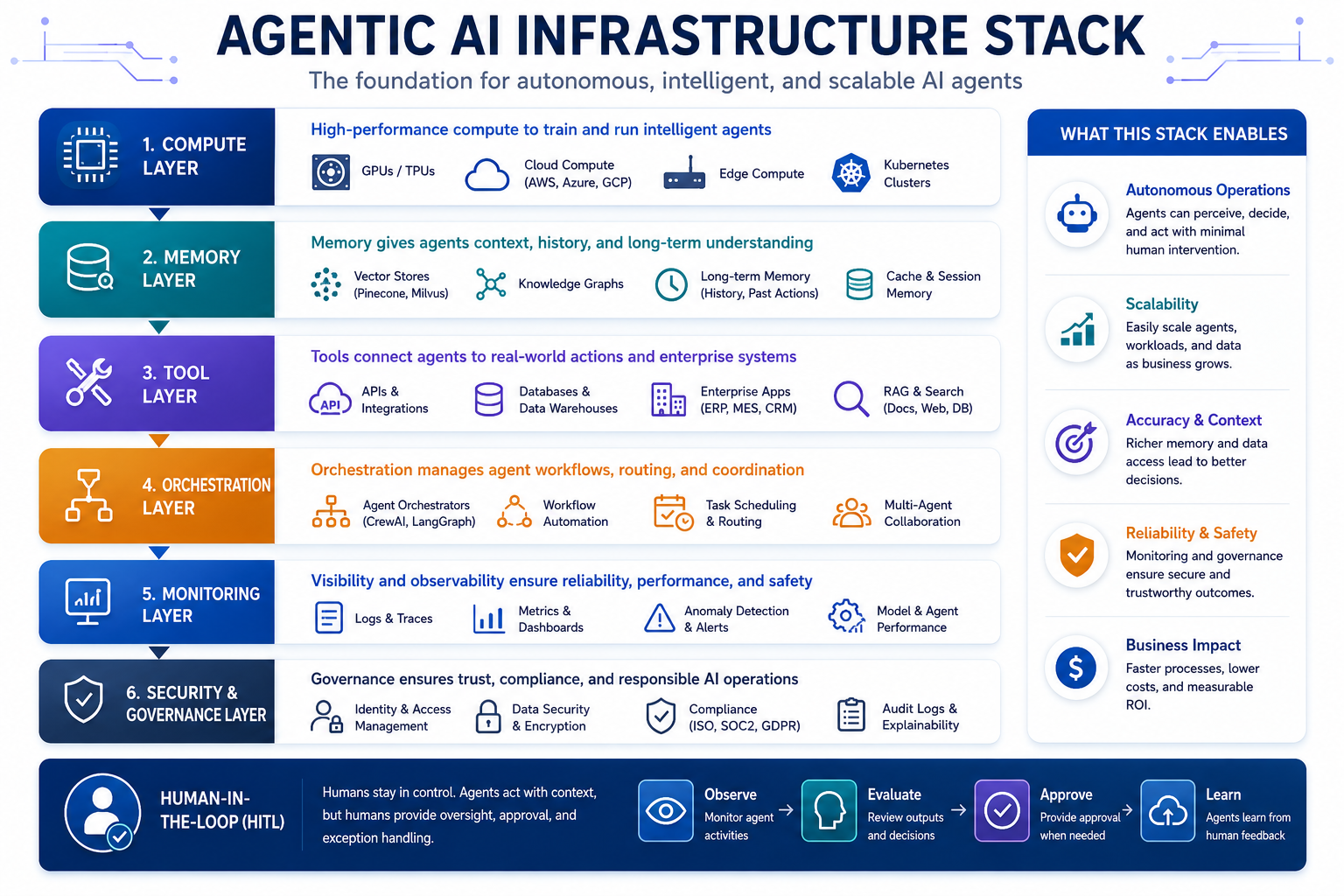
The foundation for autonomous, intelligent, and scalable AI agents
Agentic AI Infrastructure need much more than just a powerful language model. Whereas other types of AI systems merely react to prompts, agents will plan actions, communicate with software, make decisions, and carry out processes on their own. Such a change implies a new infrastructure. A successful infrastructure for agentic AI consists of compute, memory, orchestration, tools integration, monitoring, and governance all in one place. Without such layers, AI agents become unreliable and hard to deploy in a production setting.
Why Standard AI Infrastructure Is Not Enough for Agents
The traditional architecture for AI is a very basic system where the user prompts a command, the model provides a response, and the process ends there. The difference with agentic AI infrastructure lies in the ability of the agents to perform workflows that comprise several steps rather than single-point interactions. Therefore, agents need persistence for maintaining the context, access to APIs, files, databases, and environments to run the code, as well as orchestration that makes several actions possible automatically. Moreover, monitoring needs to shift its focus from the outputs of the models to the completion of the workflow, tools used, decision paths taken, and business results achieved.
AI Agent Infrastructure Stack
A modern AI agent infrastructure stack consists of five connected layers working together.
Compute Layer
Runs model inference using cloud-hosted or local LLMs.
Memory Layer
Combines short-term context with long-term vector databases supporting Retrieval-Augmented Generation (RAG).
Tool Layer
Connects agents to APIs, enterprise applications, web search, file systems, and code interpreters so they can perform business actions instead of simply generating text.
Orchestration Layer
Frameworks such as LangChain, LangGraph, CrewAI, and AutoGen coordinate multi-step reasoning, task delegation, retries, and workflow execution across multiple agents.
Monitoring Layer
Captures execution paths, tooling use, workflow results, audit trails, and human interactions. This level of visibility facilitates constant optimization while ensuring reliability, transparency, and governance.
Combined, all these levels enable converting individual artificial intelligence models into enterprise automation platforms able to handle sophisticated workflow processes.
HITL Architecture — Why Human-in-the-Loop Is Infrastructure, Not an Afterthought
Well-designed AI agent infrastructure considers Human-in-the-Loop (HITL) as an intrinsic architectural building block, not an added feature. Infrastructure for HITL involves confidence level thresholds to instigate reviews, action approval queues, override capabilities, and comprehensive audit logs capturing all decisions made. Such control measures are particularly crucial in regulated environments where AI suggestions influence financial, operations, or compliance implications. Inclusion of HITL within the infrastructure at design time enhances transparency, accountability, and trust, along with enabling future changes like those required by the EU AI Act. Businesses adopting enterprise AI must balance automation with governance by incorporating HITL in their systems' architecture. To learn about other good governance practices, please visit the AI Governance News page on the GrayCyan website.
AI Infrastructure Companies and Platforms: Who Builds What

The technology stack powering modern AI systems — chips, cloud, ML platforms, data, models, and orchestration
Picking among top AI infrastructure companies 2026 can be a difficult task, as each organization has its own specialization within the AI landscape. Some are specialized in providing cloud computing services, some develop GPUs, while others offer orchestration and deployment frameworks. Being aware of the categories allows organizations to pick the appropriate providers depending on the maturity level of the company, workloads, and business objectives. It is not about finding a one-stop-shop AI infrastructure companies but combining different providers for an effective solution implementation.
Comparing AI infrastructure providers by category, specialization, and use case
| Category | Key Players | What They Provide |
|---|---|---|
| Hyperscale Cloud | AWS, Azure AI, Google Cloud | Managed model hosting, GPU compute, MLOps services, storage, security, and global infrastructure. Azure AI offers native access to OpenAI models and enterprise AI services. |
| Specialized AI Cloud | CoreWeave, Lambda Labs, Vast.ai | GPU-optimized cloud infrastructure built specifically for AI workloads. These AI infrastructure startups often provide lower-cost GPU compute than hyperscale providers for training and inference. |
| Hardware Vendors | NVIDIA, AMD, Intel | AI accelerators, GPUs, networking hardware, and processors powering enterprise AI infrastructure. NVIDIA H100 and A100 GPU clusters remain the industry standard for large-scale AI training. |
| MLOps & Orchestration | Weights & Biases, MLflow, Kubeflow | Experiment tracking, model versioning, deployment pipelines, monitoring, collaboration, and lifecycle management for production machine learning systems. |
| Agentic Platforms | LangChain, CrewAI, AutoGen | Frameworks for building multi-agent workflows, tool integrations, memory management, orchestration, and automation. These platforms form an important layer of modern generative AI infrastructure. |
| Applied AI Consultants | GrayCyan | End-to-end AI strategy, infrastructure design, implementation, integration, governance, and deployment tailored to manufacturing and B2B workflows. GrayCyan acts as a systems integrator rather than a software platform. |
Finding the proper AI infrastructure strategy usually does not mean picking one provider at all. In most cases, organizations use combinations of cloud solutions, hardware, orchestration, and even partners to build an architecture corresponding to their needs. Start-ups will find more value in cloud services and managed platforms, whereas mature businesses tend to implement hybrid infrastructures with help from experienced deployment partners. Knowing the advantages of each group will enable companies to build an ecosystem for AI rather than just an isolated solution.
Governance, Privacy and Compliance: Building AI Infrastructure That Earns Trust
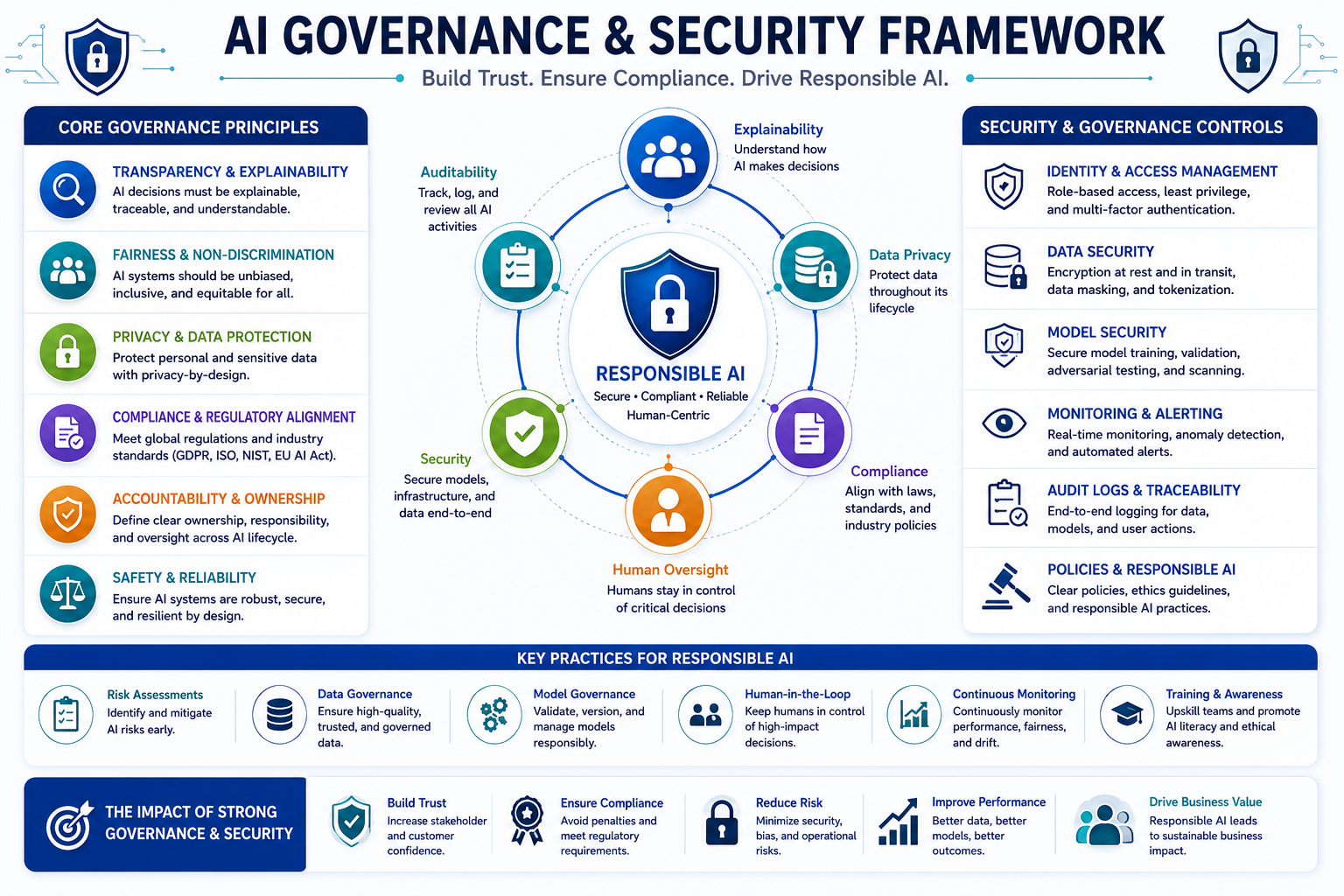
The reliability of the AI infrastructure will have to rely on effective governance alone. Trust cannot be established through the performance of the model alone. Transparency, privacy, and compliance should be an integral part of the architecture right from the start instead of including these elements after implementing the system.
Transparency — Explainability Built Into the Stack
Explainability is not a reporting component added after the deployment of the AI; it is an infrastructure component. The reasoning process of each recommendation needs to be transparent, making it easy for anyone to trace and understand how the conclusion was made. An infrastructure system needs to be able to generate auditable logs, keep comprehensive records of all inputs and outputs of the models, and include confidence scores with the recommendations. This makes it much more easier for people to trust the systems and also for debugging if any unforeseen outcomes happen. There are many different technologies that help with explainability, like SHAP, LIME, and custom logging systems.
Privacy-by-Design — Data Governance at the Architecture Level
Privacy is something that needs to be built into the AI infrastructure security itself rather than enforced using manual methods. In the case of privacy-by-design, data minimization forms the starting point where AI-based solutions would only have access to data necessary to carry out certain business operations. In any training pipeline, it is recommended to keep sensitive data anonymous wherever feasible while ensuring that access controls are in place at the time of inference based on the roles involved. It is important to ensure data residency in cases where an organization works across regulated domains or different geographies.
Compliance as Continuous Infrastructure
GDPR, EU AI Act, HIPAA, ITAR, and ISO regulations should be considered infrastructural necessities and not audits. The compliance infrastructure of AI-ready companies includes automated compliance monitoring, regular model evaluations, documented versioning, compliance enforcement, and audit logging. These qualities help organizations detect any compliance problems at an early stage while providing full traceability of model building and operation. Integrating compliance into the company's infrastructure from the start will eliminate the need for costly retrofits in the case of changes in the regulatory landscape and increases in AI usage. Compliance integration into the infrastructure enables more robust operations and lowers risks related to regulations and establishes a trustworthy AI system.
AI Infrastructure Cost and ROI: What to Expect at Each Stage
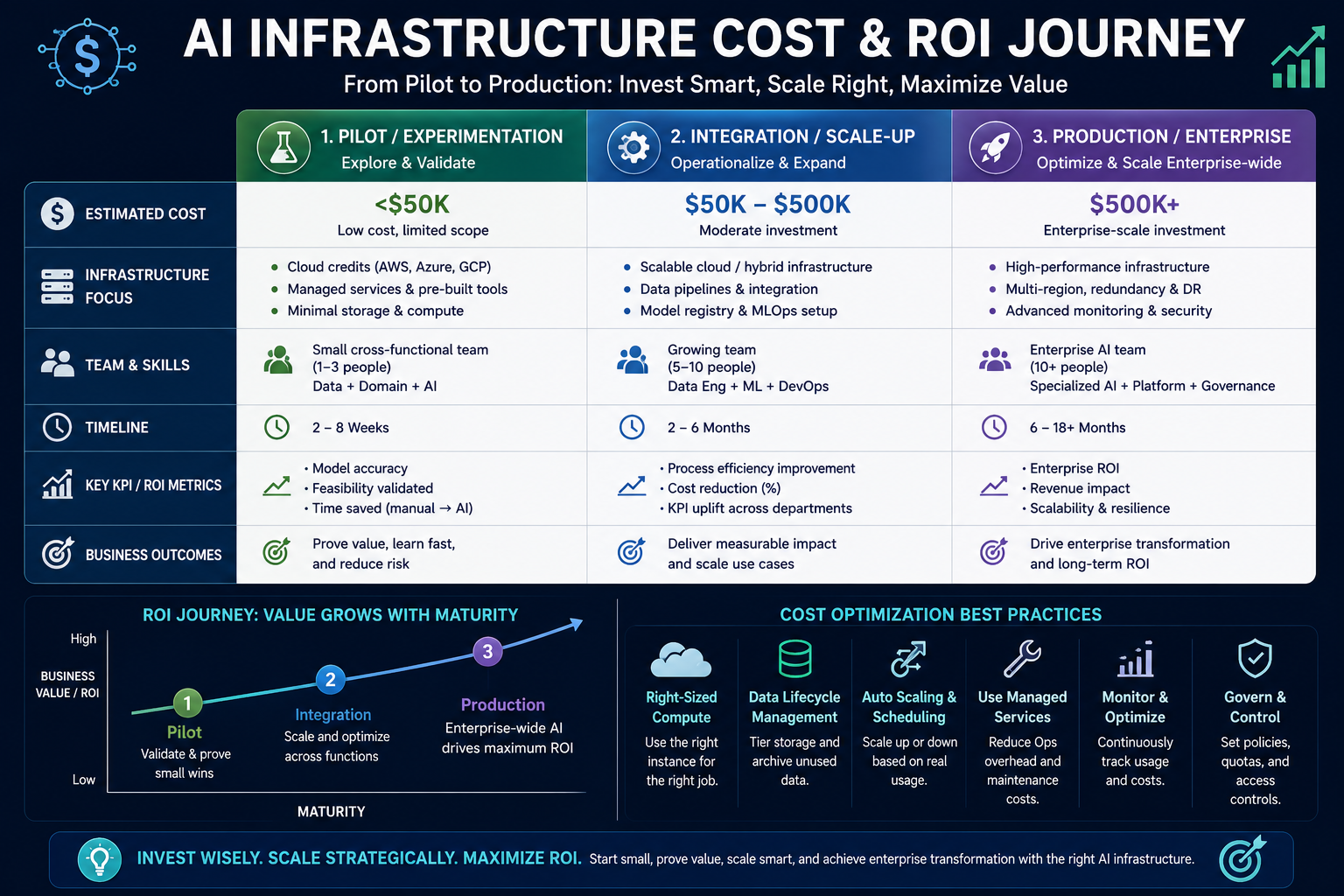
From pilot to production: invest smart, scale right, maximize value
Knowledge of AI infrastructure cost will allow an organization to estimate costs accurately, making plans accordingly to avoid surprises. The cost of AI infrastructure increases as projects grow from pilot phases to full-scale adoption. It is not sufficient to only consider model creation but rather also other aspects of AI.
The Three Cost Stages of AI Infrastructure
Most organizations progress through three stages of AI investment.
AI deployment in cloud-based infrastructure makes it possible to test AI use cases at a very small initial cost. The emphasis is on the practical testing of business issues through available data.
Integration of ERP, data pipelines, MLOps platforms, governance, and workflow automation are all part of this stage. Many organizations often underappreciate the cost associated with AI infrastructure at this point because it might take more time to connect the various enterprise systems than building the models themselves.
Enterprise implementation needs specialized computing resources, monitoring systems, security, model management, and optimization. Cloud or on-premises infrastructure needs to facilitate reliable and scalable AI operations within the business.
Where AI Infrastructure ROI Actually Comes From
The best payoff on your investment in AI technology will come from optimizing your processes instead of implementing complex machine learning models. Successful companies track how many hours are saved, decreased errors, better decisions made, increased productivity, and overall efficiency. Having metrics for baseline performance prior to implementation makes it much easier to measure improvements.
This is what GrayCyan does by starting every project with an AI Readiness Scorecard that analyzes the existing process flow, discovers inefficiencies, and estimates possible gains before any development work starts. To learn more about measuring the value of AI implementation, refer to our AI ROI guide.
AI Infrastructure for Manufacturers — Unique Challenges and the Right Approach
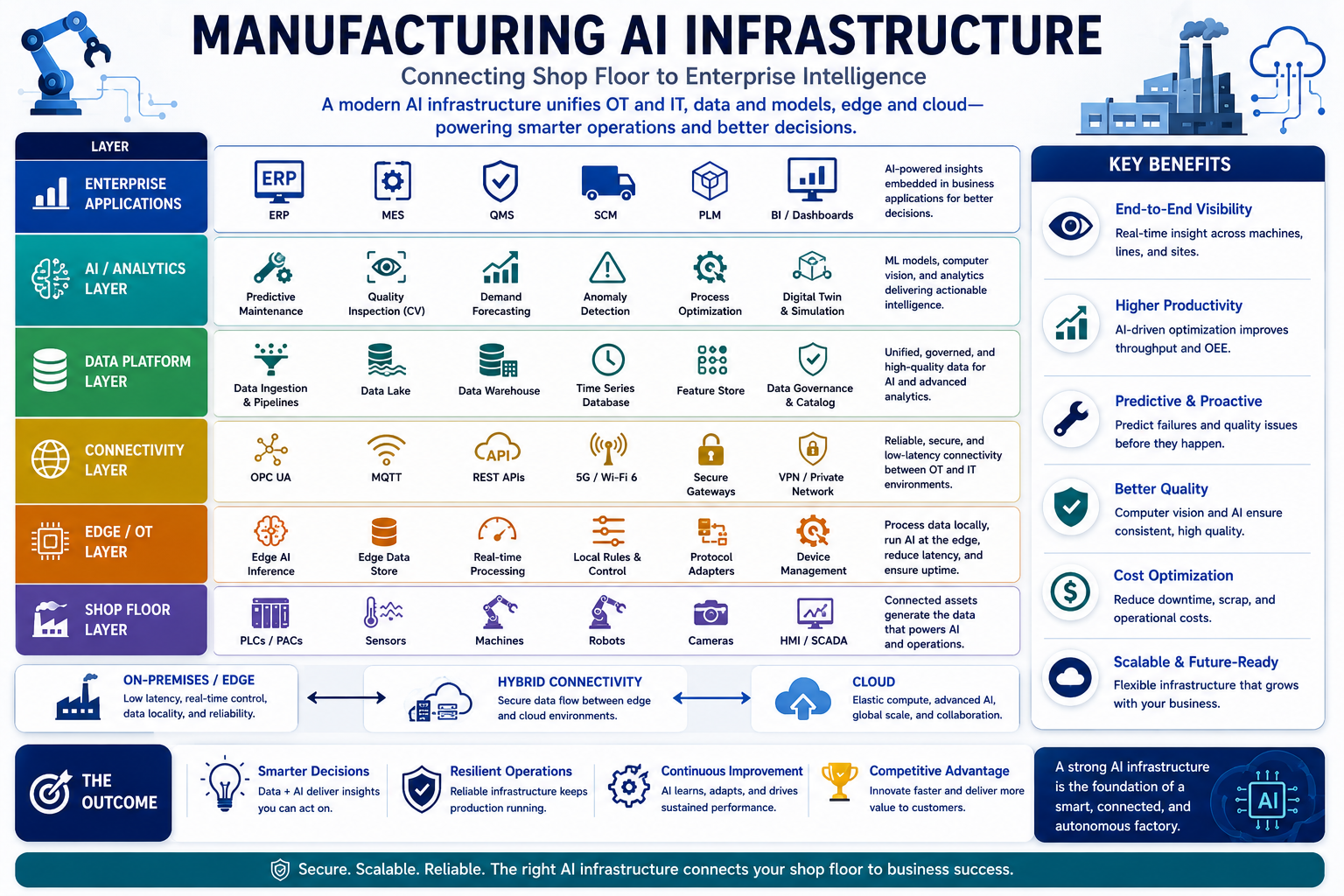
A modern AI infrastructure unifies OT and IT, data and models, edge and cloud
In the context of manufacturing in AI data infrastructure , there is a specific set of infrastructure issues associated with AI that stands out distinctly from typical AI applications within an enterprise. The manufacturing system needs to be available all the time, safeguard intellectual property rights, and make timely decisions without causing any interference to the process.
The OT/IT Convergence Problem — Why Standard AI Infrastructure Fails in Plants
The typical AI solutions provided by most enterprises are based on an IT infrastructure which includes cloud access, standard application program interface (APIs), and databases. Manufacturing work differently. In manufacturing, production depends on operational technology (OT), including PLCs, SCADA systems, MES, and QMS. These systems were made for reliability and safety instead of AI integration. They mostly depend on some industrial protocols such as OPC-UA, Modbus, and MQTT and have been developed with machinery that will last for many years. Thus, before any model delivers value, there is a need to connect the legacy operational systems to the IT infrastructure of the enterprise. For manufacturers, the biggest infrastructure problem is not computing power, but ensuring connectivity without disruptions to production technology.
Data Architecture for Manufacturing AI — What Is Different
Manufacturing data is distinct from traditional business data, necessitating specific AI data infrastructure. Manufacturing data is predominantly time-series data collected through manufacturing processes, sensors, and inspection equipment rather than static business documents. Databases like InfluxDB and TimescaleDB are more appropriate for these applications compared to traditional relational databases.
Another characteristic of manufacturing is the importance of full lot and batch traceability. Every product should be traceable to its raw material lots, machine configurations, actions taken by operators, and results of inspections. Without this context, AI advice becomes meaningless in regulated manufacturing businesses where all production decisions need to be explainable.
The next issue is that manufacturing data tends to be siloed. Production scheduling data can be stored in ERP systems like SAP, Oracle NetSuite, or SYSPRO, maintenance data lives in CMMS systems, quality data in QMS systems, and supplier data in spreadsheet documents. The proper AI infrastructure integrates these isolated systems into one data ecosystem, allowing AI to discover connections between production, quality, maintenance, purchasing, and logistics processes.
On-Premise vs Cloud for Manufacturers — The Data Sovereignty Reality
Manufacturers must comply with more strict deployment criteria compared to many other industries. Processing, quality requirements, and manufacturing processes can all be considered intellectual property that is not always feasible to store in the cloud environment. Unreliable connections could also occur in factories where cloud-only inference cannot be used in a production environment. Food manufacturing, aerospace, automotive, and pharmaceutical industries have regulatory requirements that increase the need for control and governance of their data. For this reason, many manufacturers use hybrid deployments, using local inference and local storage of production data combined with cloud model training and lifecycle management. Those who want to consider local deployments can refer to our Local LLM News page at GrayCyan.
Edge AI on the Production Floor — Infrastructure Requirements
AI use cases like visual inspection and predictive maintenance on the manufacturing floor need decisions to be made within milliseconds. Roundtrips from the cloud do not guarantee that performance. Therefore, AI infrastructure for the factory floor is based on edge computing devices like NVIDIA Jetson, Intel NUC, or industrial PCs placed near the production line. ONNX or TensorRT-optimized models run local inference while distributed model updates are orchestrated through central management of the system. This combination reduces latency and secures sensitive production data while allowing the system to operate without network access. The same strategy can be applied to warehouse automation and logistics. Find out more in GrayCyan's Smart Warehousing AI guide.
How GrayCyan Helps Manufacturers Build AI Infrastructure That Lasts

End-to-end AI infrastructure that powers autonomous, intelligent, and data-driven manufacturing
GrayCyan enables companies to develop their AI infrastructure to ensure future success rather than one-off pilots demos. The first step of any project is an AI Readiness Assessment, which assesses the quality of data, integration, and governance before model selection. HITL architecture is a part of all solutions provided by approval, audit, and confidence threshold mechanisms. GrayCyan also integrates ERP, WMS, CRM, and MES systems to create a holistic AI ecosystem. Flexible on-premise and hybrid deployments can be used for secure and robust AI implementations in critical manufacturing facilities. Get more details about AI Strategy Readiness, Agentic AI Systems, and RAG AI for Manufacturing or take your AI Readiness Assessment now!
FAQs
Build AI Infrastructure That Lasts
Schedule a consultation with GrayCyan to assess your data, architecture, and governance readiness before you invest in your next AI initiative.
Schedule a Consultation