The Overloaded Supervisor Problem: How AI Is Changing Manufacturing Workforce Management
The most overloaded person in most manufacturing plants is not the one running the line. It is the supervisor trying to manage it. Shift coverage gaps, operator skill gaps nobody has documented, and HR paperwork that eats hours every week. AI workforce management in manufacturing is addressing all three, though not in the way most vendors describe it.




There is a version of this in almost every manufacturing plant. A supervisor walks in at 5:45 a.m., before the shift starts, and the first twenty minutes go to finding out what happened overnight, who called out, which machine is flagged, and whether the parts for the 7 a.m. run are actually staged. By the time the line starts, the supervisor has already spent the most focused hour of the day on logistics that should have been automatic.
AI workforce management in manufacturing is not primarily a technology story. It is an attention story. The question is not what software can do; it is what consumes a supervisor's decision-making capacity before they have had a chance to actually manage the floor. The applications worth examining reduce cognitive load in ways that free up the people who understand the operation to spend more time using that understanding.
Reducing What the Supervisor Has to Hold in Their Head
Walk into most plants and the supervisor's morning is structured around information retrieval, not decision-making. WIP status from the previous shift. Quality flags from overnight. Attendance gaps. Machine anomalies. Overdue approvals. Freight timing. None of this requires the supervisor's judgment. It requires their attention. And attention spent on gathering information is attention not spent on the floor.
AI copilot systems for manufacturing supervisors change this by converting the information-gathering work into a structured briefing. Instead of pulling status from five different systems, the supervisor opens a single summarized view: what changed overnight, what needs a decision now, and what can wait. The judgment is still theirs. The retrieval is not.
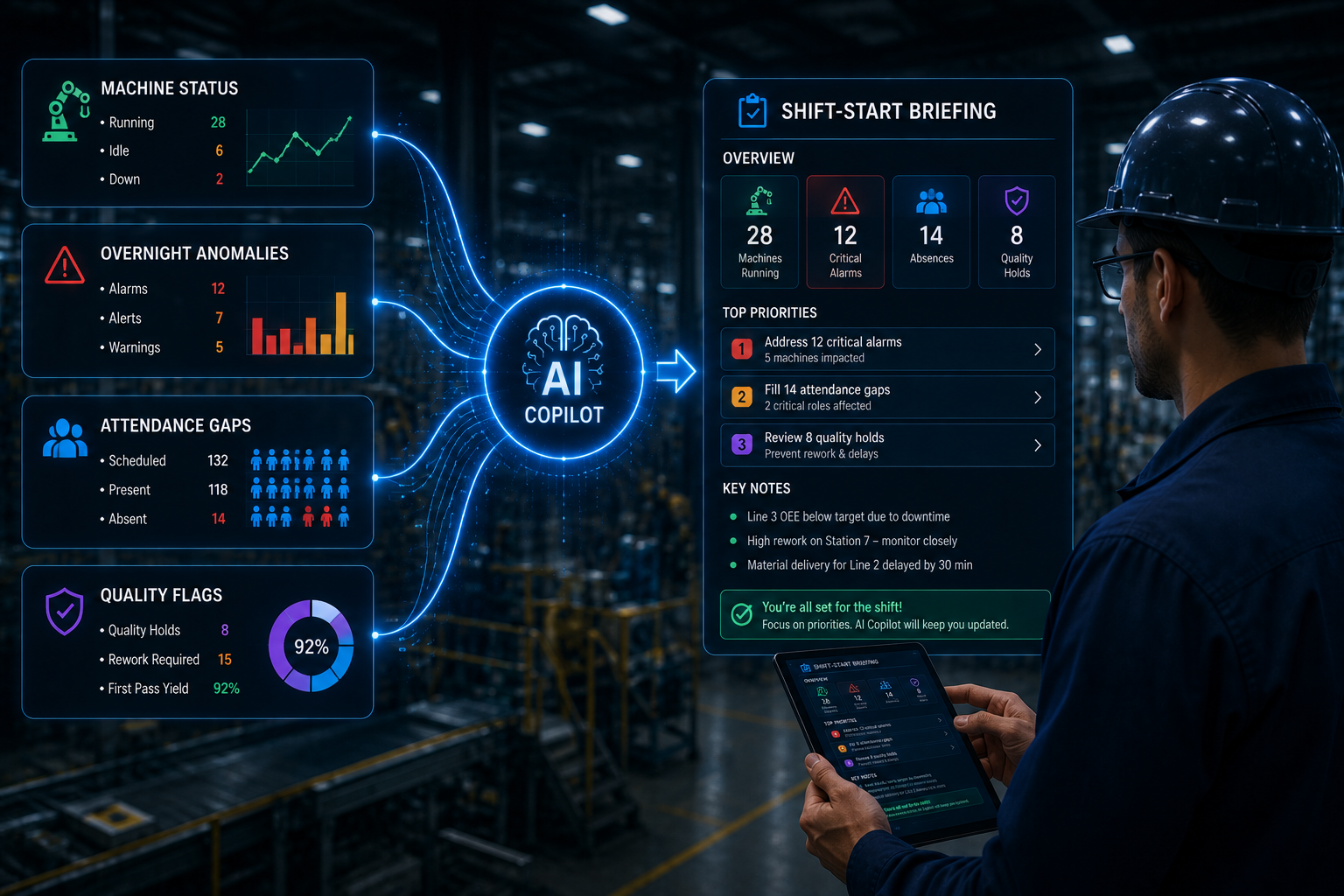
Siemens has deployed AI copilots across several manufacturing plants to handle shift-start briefing preparation. The system summarizes machine status, flags overnight anomalies, and surfaces priority actions before the shift leader begins their walkthrough. The briefing that previously required manual compilation from multiple systems is generated automatically.
The practical effect is that supervisors arrive at the floor with the context they need, rather than spending the first part of their shift building it. Planning accuracy improved and the amount of reactive firefighting on those lines decreased.
✓ Reduced supervisor task load in shift-start preparationToyota's North American plants use digital assistants to compile daily production exceptions, covering what diverged from plan, where the gaps are, and which issues require team leader attention. Team leaders use this output to prioritize floor time rather than spending the first portion of the shift reconstructing the picture manually.
The difference is not that decisions get made automatically. The difference is that the person who needs to make decisions has accurate, current information to make them from, rather than working from memory or a shift-end summary that is already hours old.
✓ Team leaders spend more time on the floor, less time on status reconstructionSkill Gaps: The Problem Nobody Has Documented
In most manufacturing plants, skill gap tracking works like this: an operator makes the same error three times, a supervisor notices, and a conversation happens. The training that follows is either generic or depends on whether anyone remembers to schedule it. There is no system watching for the pattern before it reaches three errors. There is no one tracking whether the training worked.
This is not because plant leaders do not care about operator development. It is because the data needed to identify skill gaps at the individual level is distributed across shift logs, quality records, and supervisor observations that rarely get aggregated. A scan entered in the wrong field on Tuesday, a QC note saved to the wrong batch on Thursday, a part attribute incorrectly flagged on Friday: each of these looks like a one-off event. Together they are a pattern that points to a specific gap for a specific operator.
AI-driven training analysis reads the error patterns in routine production data and identifies skill gaps before they become quality escapes. The output is not a generic training recommendation. It is a specific flag: this operator, this process step, this error type, this frequency over the past 30 days.
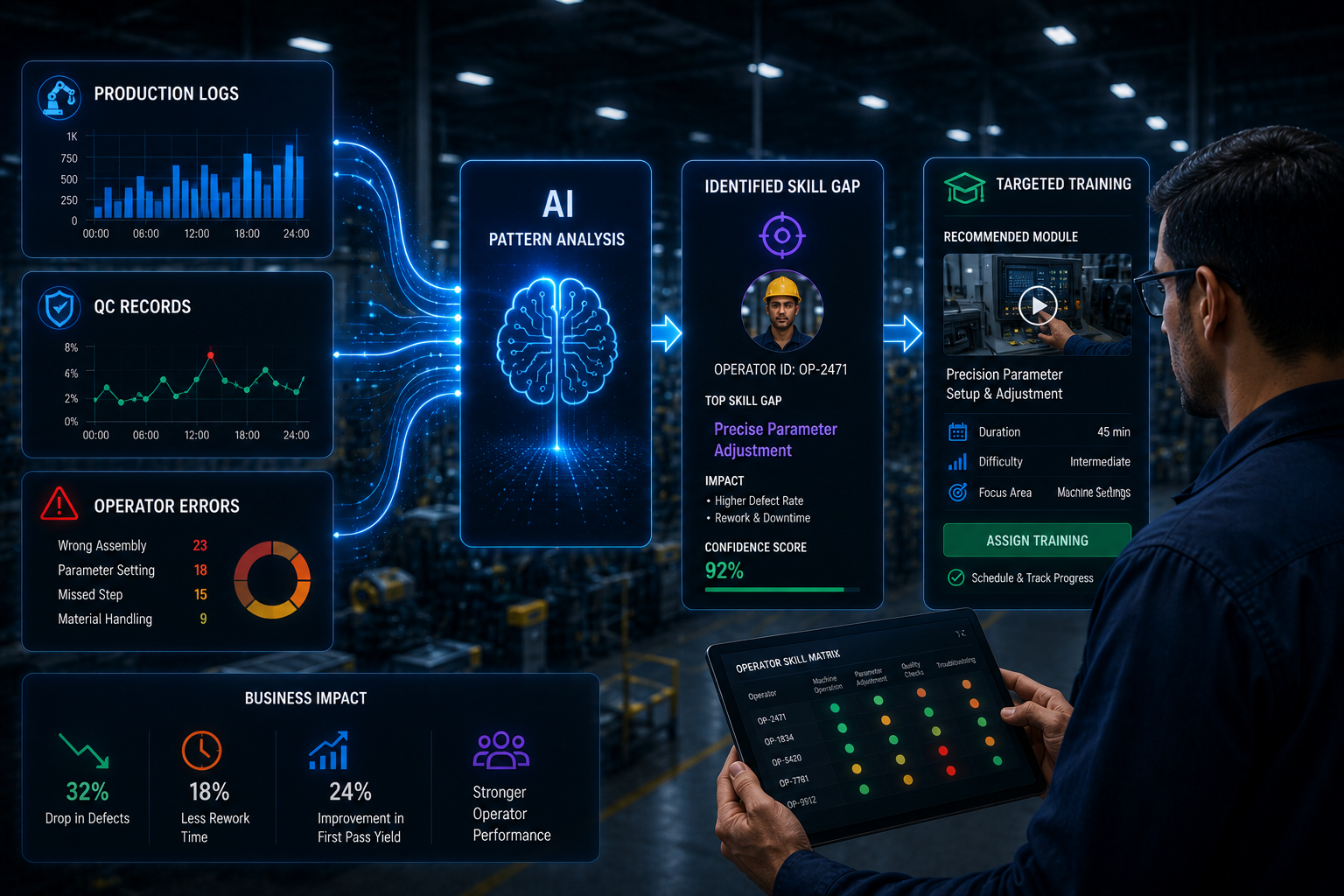
GE Appliances uses AI-driven training analysis to identify skill gaps at the individual operator level on assembly lines. Rather than waiting for a quality escape or a supervisor observation to trigger a training conversation, the system continuously monitors production data and surfaces patterns that indicate specific capability gaps.
The result is that training interventions happen earlier, they target the right operator, and they address the right process step. First-time quality rates improved and rework volumes declined. The training function shifted from reactive to anticipatory. That is a fundamentally different posture for a quality-critical operation.
✓ Improved first-time quality, reduced rework through targeted operator trainingFoxconn deployed AI-based process monitoring across key production steps to detect operator errors in real time and guide targeted upskilling before errors compound. The system tracks error patterns by operator, process step, and shift, then flags recurring issues for training intervention rather than supervisor discretion.
The difference from conventional quality monitoring is specificity. Traditional monitoring catches defects. AI-driven monitoring identifies the human factor behind the defect pattern and points to where training should go, not just that quality fell short.
✓ Reduced recurring errors at key production steps through AI-guided upskillingShift Scheduling: The $3.8-Hour Overtime Problem
US manufacturing workers averaged 3.8 hours of overtime per week in January 2026, according to BLS data. Some of that overtime is demand-driven and unavoidable. A meaningful portion of it is schedule-driven: shifts built on last week's pattern rather than this week's reality, gaps that surface at 6 a.m. when it is too late to fill them efficiently, and skill-to-task mismatches that require a more experienced operator to cover for a less-experienced one.
Most plants still build schedules the way they did twenty years ago: a supervisor or HR coordinator works through a spreadsheet, manually balancing attendance history, skill credentials, and seniority rules. The schedule that comes out reflects what the coordinator could hold in their head simultaneously, not what an optimization engine could produce by considering all variables at once.
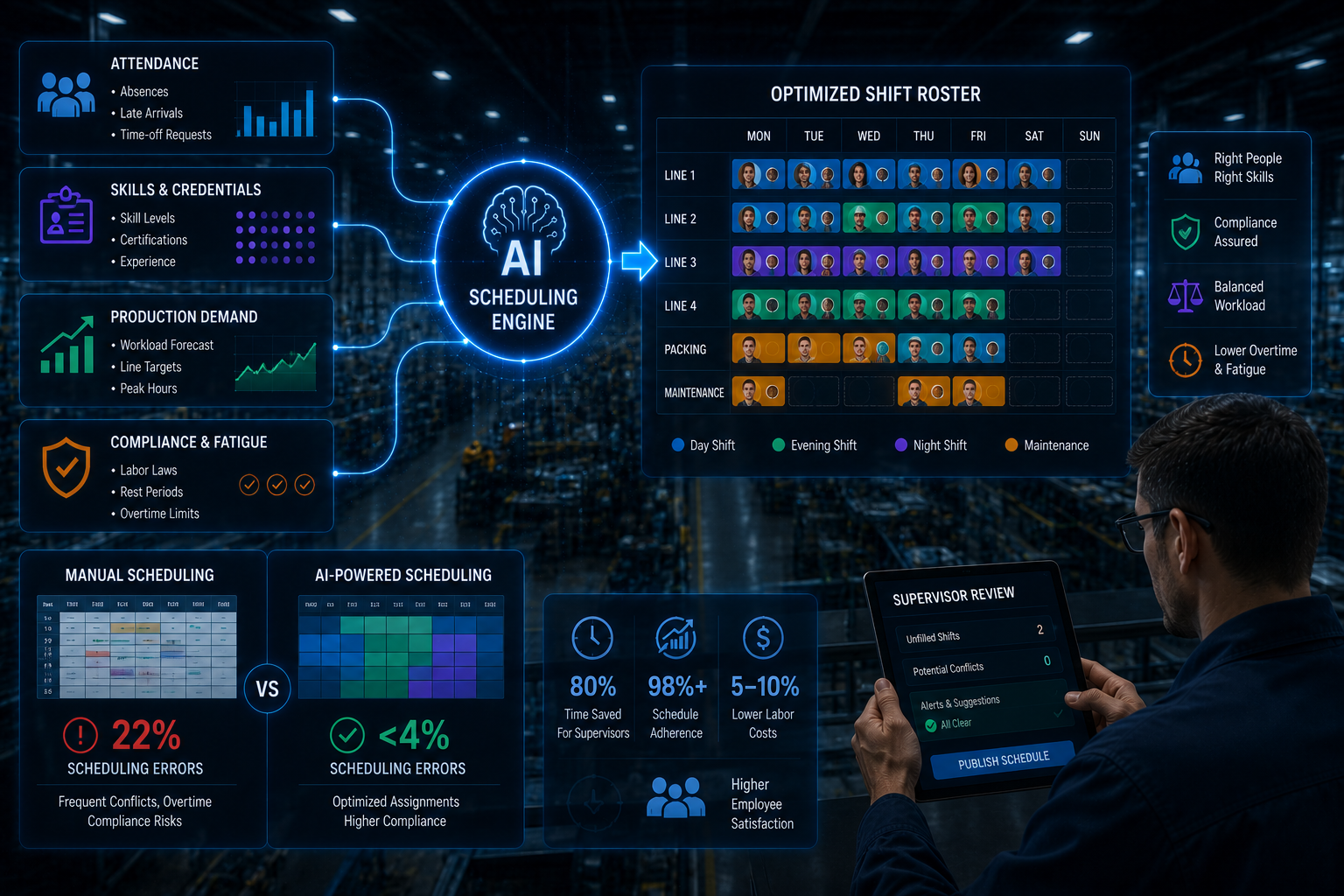
AI shift scheduling changes the logic of how rosters are built. Instead of starting from a template and patching it manually, the system ingests current attendance patterns, operator skill credentials, predicted demand for the shift, and fatigue data where available, then generates an optimized schedule that balances all of them. Organizations deploying AI scheduling in complex shift environments have reduced scheduling error rates from an average of 22 percent to below 4 percent within the first six months (Deloitte 2025).
| Variable | Manual Scheduling Approach | AI Scheduling Approach |
|---|---|---|
| Skill matching | Supervisor knows who can do what, but tracking is informal | Credential database queried automatically; correct skill assigned to each task requirement |
| Attendance forecasting | Based on recent history and intuition | Pattern-based prediction flags high-absence-risk shifts before they occur |
| Overtime management | Reacted to after the gap appears | Predicted and balanced before the schedule is finalized |
| Compliance | Manual check against labor rules, frequently missed | Automatically enforced at schedule generation |
| Schedule revision | Coordinator rebuilds manually when conditions change | AI proposes revised schedule; coordinator reviews |
The practical effect for the plant is not just scheduling accuracy. It is that the coordinator or supervisor who was spending three to four hours building and patching the weekly schedule is now spending forty-five minutes reviewing and approving a system-generated one. Those recovered hours do not disappear. They get applied to floor management.
HR Documentation: The Self-Service Gap in Manufacturing Plants
This is the workforce management problem that receives the least attention in manufacturing literature, probably because it does not show up in OEE reports. Every week, somewhere between five and fifteen percent of HR staff time in a mid-market manufacturing plant goes to answering questions that already have a documented answer. An operator wants to know how to submit a PTO request. A team lead needs to find the forklift certification renewal process. A new hire cannot locate their onboarding checklist.
None of these questions require human judgment. They require document retrieval. But if the documents are scattered across a shared drive, a printed binder in a break room, and an email chain from 2023, retrieval becomes a task that someone has to help with rather than something an employee can do themselves.
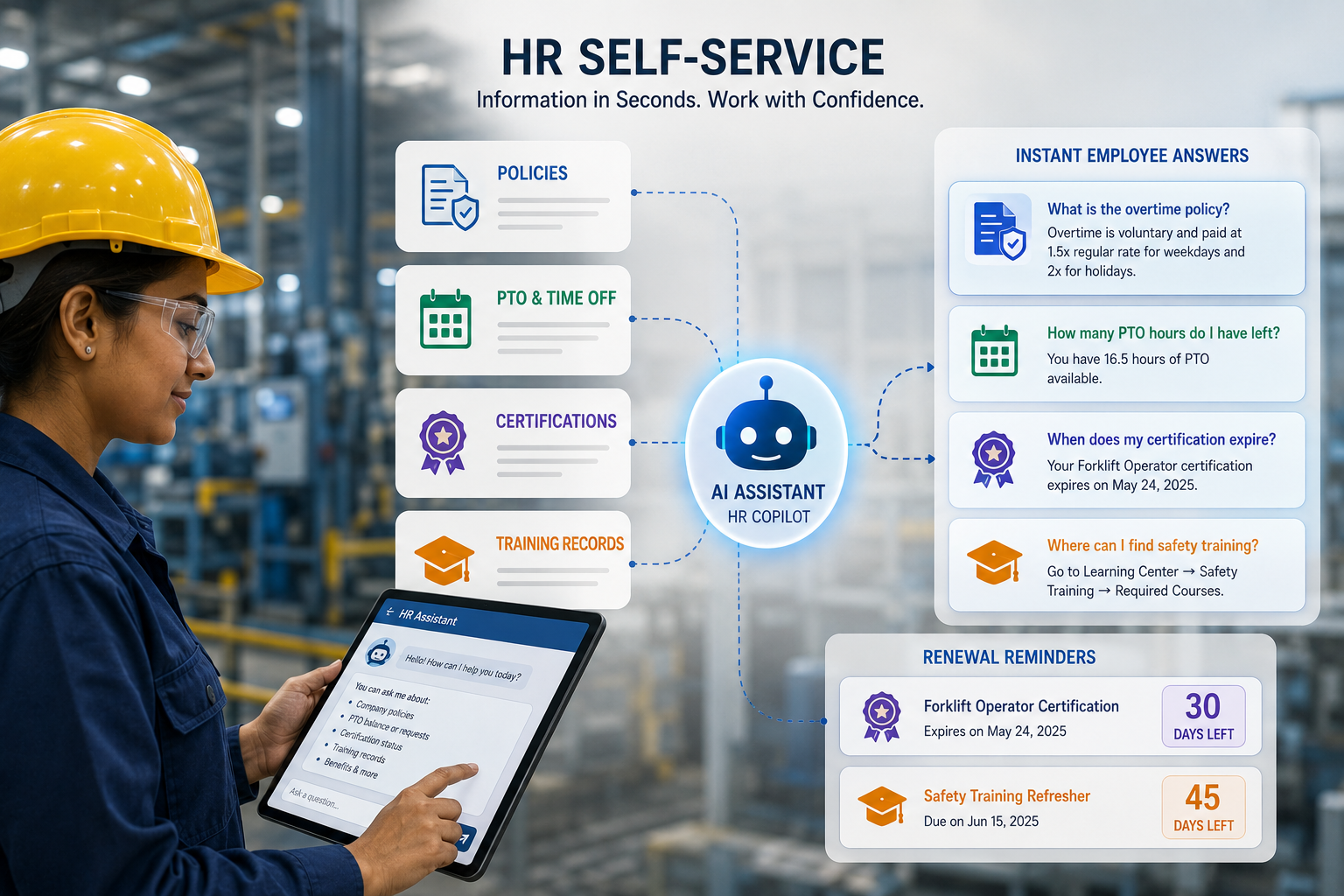
AI-indexed HR documentation systems organize every document, establish a searchable index, and surface the right answer to an employee query without routing through a coordinator. The platforms used most frequently in manufacturing at scale are Workday and Rippling, both of which have moved beyond static document storage to machine-learning-assisted search and automated workflow triggering.

The manufacturing-specific version of this problem: Safety certifications, equipment licenses, and compliance training records are not just HR documents in a manufacturing plant. They are production-floor dependencies. An operator whose forklift certification lapsed cannot be scheduled on a certain task. An AI-indexed system that tracks certification expiry dates and triggers renewal reminders is solving a scheduling problem as much as an HR documentation problem.
What Holds Most Plants Back
The gap between the 55 percent of managers who want AI scheduling and the 11 percent who use it is not primarily a technology problem. The barriers are more mundane and more addressable than most vendors acknowledge.
The first barrier is data quality. AI workforce management systems are only as good as the data they ingest. A skill credential database with 40 percent stale records will produce schedules that flag the wrong people for the wrong tasks. An attendance system with manual entry gaps cannot predict no-shows accurately. Before deploying AI scheduling, most plants need to spend time on the data that feeds it, which is unglamorous work that tends to get deprioritized in favor of the software conversation.
The second barrier is the change management question nobody is asking clearly. Supervisors who have been building schedules manually for years have legitimate concerns about what AI scheduling means for their role. If the rollout is managed as "the system now does your job," the resistance that follows is predictable. If it is managed as "the system handles the mechanical parts so you can spend more time on the judgment parts," the adoption rate is different. The distinction is not just messaging. It changes what the implementation actually looks like on the floor.
The third barrier is the integration layer. AI workforce management does not work in isolation from the plant's other systems. A scheduling tool that cannot read current skill credentials from the HR system will produce schedules that require manual correction. A training recommendation engine that cannot access quality records cannot identify skill gaps. The integrations take longer than the AI configuration itself and tend to be underestimated in every implementation timeline.
Ready to Map Your Workforce AI Opportunities?
GrayCyan's AI Readiness Assessment identifies the highest-value starting points for AI workforce management in your plant, maps the data connections required, and builds a prioritized roadmap before any implementation begins.
Book an AI Readiness AssessmentFrequently Asked Questions