Designing the Factory Before You Build It: How AI Is Transforming Manufacturing Facility Planning
Most manufacturers still find out whether a factory layout works by building it, running it, and discovering the problems. BMW now builds the factory twice: once in simulation, once in steel. What used to take weeks of physical modification and testing can be simulated virtually before a single machine is placed. The tools making this possible are reaching mid-market manufacturers faster than most realize.



There is a standard way a mid-market manufacturer handles a factory reconfiguration: clear the floor over a weekend, move the machines, run the new layout on Monday, and discover the material flow problem that the planning meeting missed. The problem costs a week of reduced throughput to fix, and nobody is quite sure why it did not show up in the spreadsheet. AI-powered factory simulation changes this sequence. The problem shows up in the model, not the production run.
The tools making this possible span a range of sophistication. At the enterprise end, BMW is running complete digital twins of over 30 global production sites on NVIDIA Omniverse. At the mid-market end, simulation platforms are increasingly accessible to plants that cannot deploy at BMW's scale but face the same fundamental challenge: every factory layout decision carries a cost, and most of those costs are only visible after the layout is locked in.
The Digital Twin Factory: Building It Twice
A factory digital twin is a virtual replica of a production environment, accurate enough to simulate real production behavior. Not a floor plan. Not a 3D model for visualization. A live simulation that reflects the actual flow of materials, the movement of people and equipment, the timing of production cycles, and the bottlenecks that emerge when any of those variables change.
The practical value is in the "what if" question. What if the new stamping press goes here instead of there? What if the inbound dock shifts to the north wall? What if a second AGV is added to this route? In a physical factory, each of these questions requires a physical test. In a digital twin, they run in minutes and cost nothing except compute time.
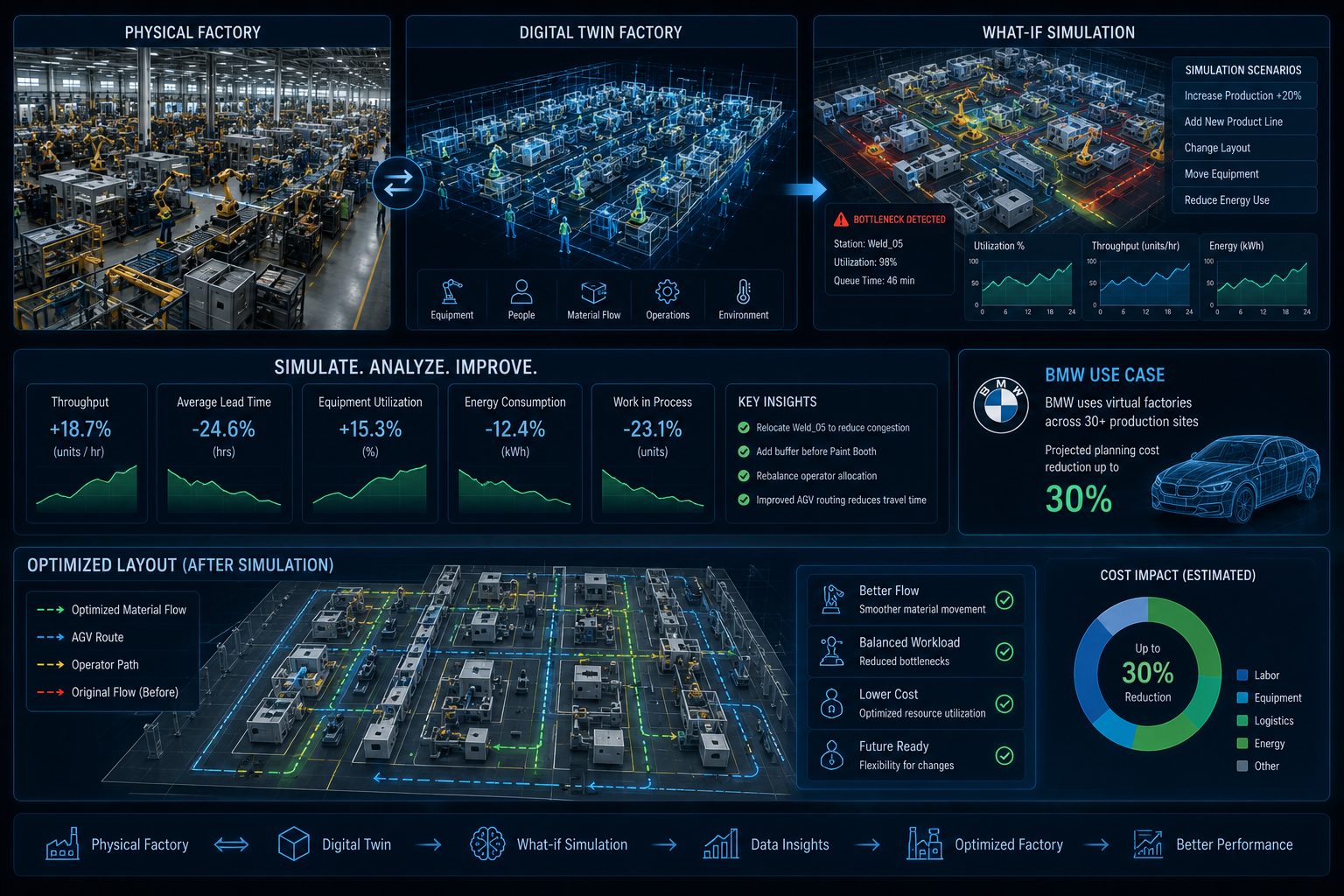
BMW Group has scaled its Virtual Factory across more than 30 production sites globally, built on NVIDIA Omniverse and OpenUSD. These digital twins are powered by an industrial 3D metaverse, allowing real-time simulations for optimizing factory layouts, robotics, and logistics systems. What previously required several weeks of real-world modification and testing can now be precisely simulated before any physical change is made.
BMW is integrating more than 40 new or updated vehicles into its global production network through 2027, all first planned virtually. The company projects up to 30 percent reduction in production planning costs from this approach. At BMW's Debrecen facility in Hungary, the plant was designed virtually from inception. A central control unit monitors incoming components, coordinates logistics, and tracks production flow in real time.
"The virtual simulation allows managers to plan the production process in greater detail than was previously possible," said Markus Grüneisl, head of production strategy at BMW. Machine learning algorithms simulate robots performing complex manoeuvres to find the most efficient process before physical deployment.
✓ Up to 30% planning cost reduction projected ✓ Weeks of physical testing replaced by simulation ✓ 40+ vehicles first integrated virtually before productionSiemens and NVIDIA have previewed an industrial technology stack that uses AI to simulate hundreds of potential factory layouts before any physical configuration is finalized. The tool enables engineers to quickly simulate different layouts within an existing facility, helping them identify the most efficient configuration and accelerate the path to increasing production.
A semiconductor manufacturer needing to set up a new production line in an existing facility can use this system to test layout configurations virtually before committing to a single approach. The engineering time spent on layout decisions moves from months to days, and the layouts that emerge from simulation are typically more efficient than those produced through manual planning against a static floor plan.
✓ Hundreds of layouts evaluated before physical commitment ✓ Reduced engineering time on facility configuration decisionsWhat AI Factory Simulation Actually Optimizes
Factory simulation tools address four distinct optimization problems, each of which carries a different cost when handled by trial and error rather than simulation:
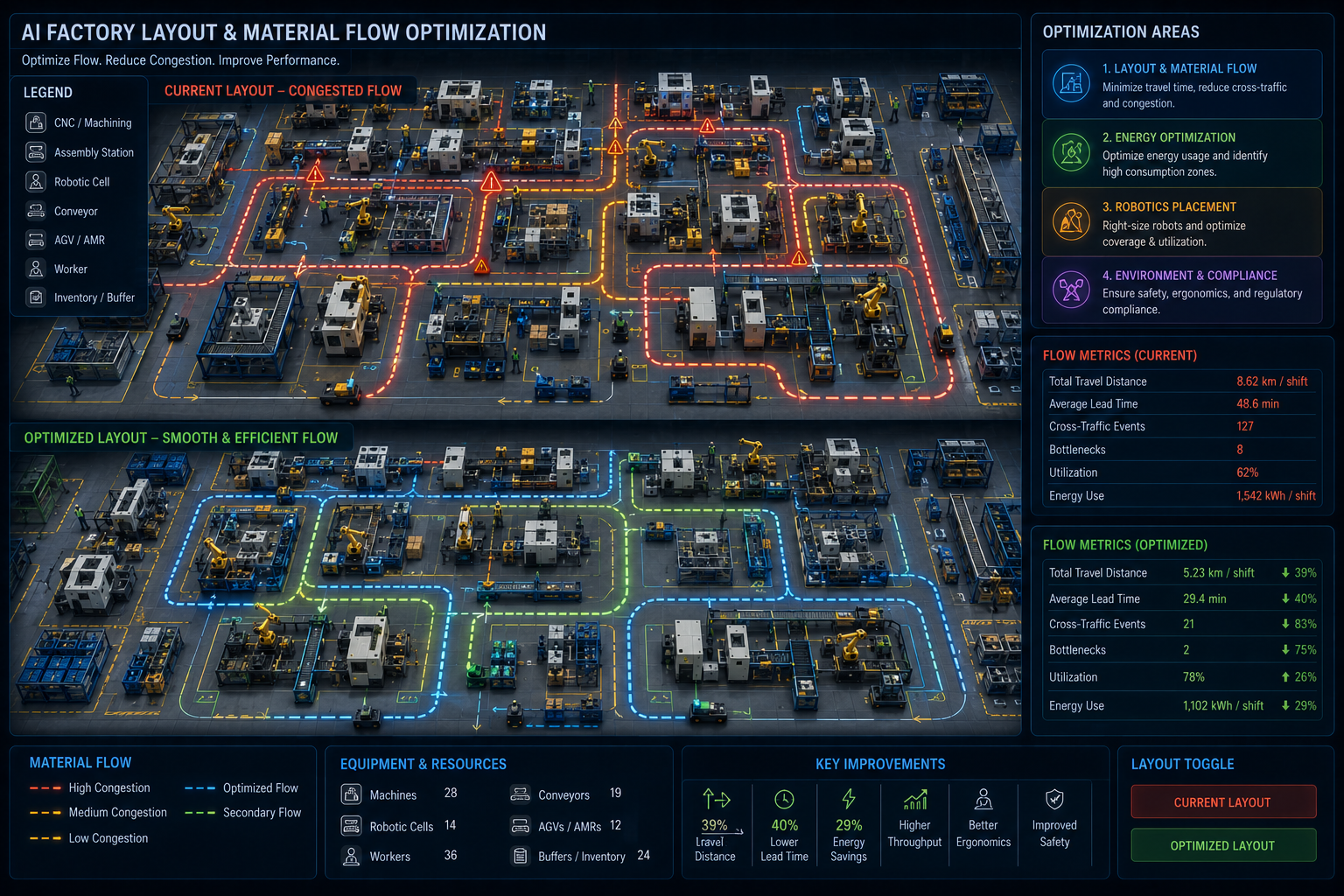
The downtime cost argument: Most manufacturers still shut down production to test process changes, losing $260,000 per hour in unplanned downtime. For a manufacturer running two shifts, even a single day of downtime to test a layout change costs over $4 million. Factory simulation does not just improve the quality of the layout decision. It eliminates the production cost of testing it.
From Parametric to Generative: How AI Explores Options Humans Cannot
Traditional factory planning is constrained by the number of options a planning team can evaluate manually. A team of engineers can assess maybe a dozen layout variations before a deadline forces a decision. AI-driven generative factory design evaluates hundreds or thousands of variations against defined objectives: throughput targets, material travel distance, worker ergonomics, equipment utilization, energy consumption, and regulatory clearances simultaneously.
The shift is the same one that happened in product design with generative design for parts: the engineer defines the constraints and objectives, the AI generates and evaluates the options, and the human selects and refines from a shortlist that emerged from a search space no human team could have covered manually.
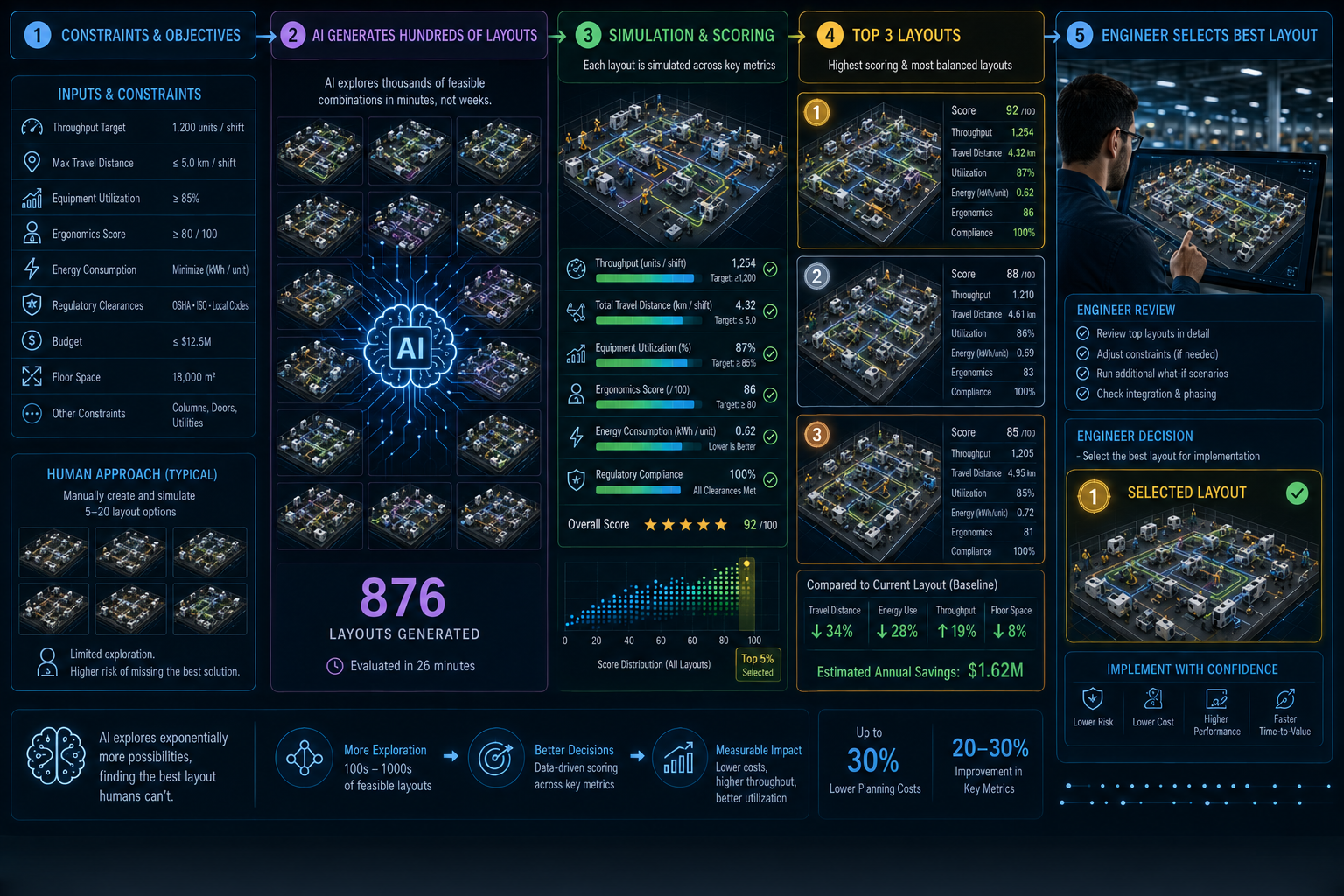
The parametric layer sits underneath the generative layer. Parametric factory design means the layout responds to variable inputs in real time: change the ceiling height, and the crane radius updates. Change the inbound dock location, and the material flow paths recalculate. This is a different capability from generative design, though both are sometimes marketed under the same "AI planning" label. Understanding the distinction matters when evaluating tools.
| Capability | What It Does | Practical Manufacturing Use | Representative Tools |
|---|---|---|---|
| Parametric design | Layout responds dynamically to variable changes (height, clearances, flow paths) update automatically | Rapid iteration on a single layout concept as constraints change | Autodesk Revit, Siemens NX, parametric CAD platforms |
| Generative factory design | AI generates and evaluates multiple layout configurations against defined objectives simultaneously | Finding the optimal layout from a search space too large for manual evaluation | Siemens + NVIDIA industrial stack, Autodesk Generative Design for facilities |
| Digital twin simulation | Physically accurate simulation of production behavior in a proposed or existing layout | Testing flow, downtime scenarios, robotics placement before physical commitment | NVIDIA Omniverse, Siemens Tecnomatix, Dassault 3DEXPERIENCE |
| Energy modeling | Predicts energy consumption by zone, equipment, shift patternern, and HVAC configuration | Identifying energy efficiency gains during design, before construction locks in the profile | IES VE, DesignBuilder, integrated modules in major BIM platforms |
What Mid-Market Manufacturers Can Do Now
BMW's virtual factory running on NVIDIA Omniverse is not the relevant benchmark for a 150-person manufacturer planning a line reconfiguration. The relevant question is what simulation capability is accessible at a cost that makes sense for a plant that cannot justify a seven-figure digital twin deployment.
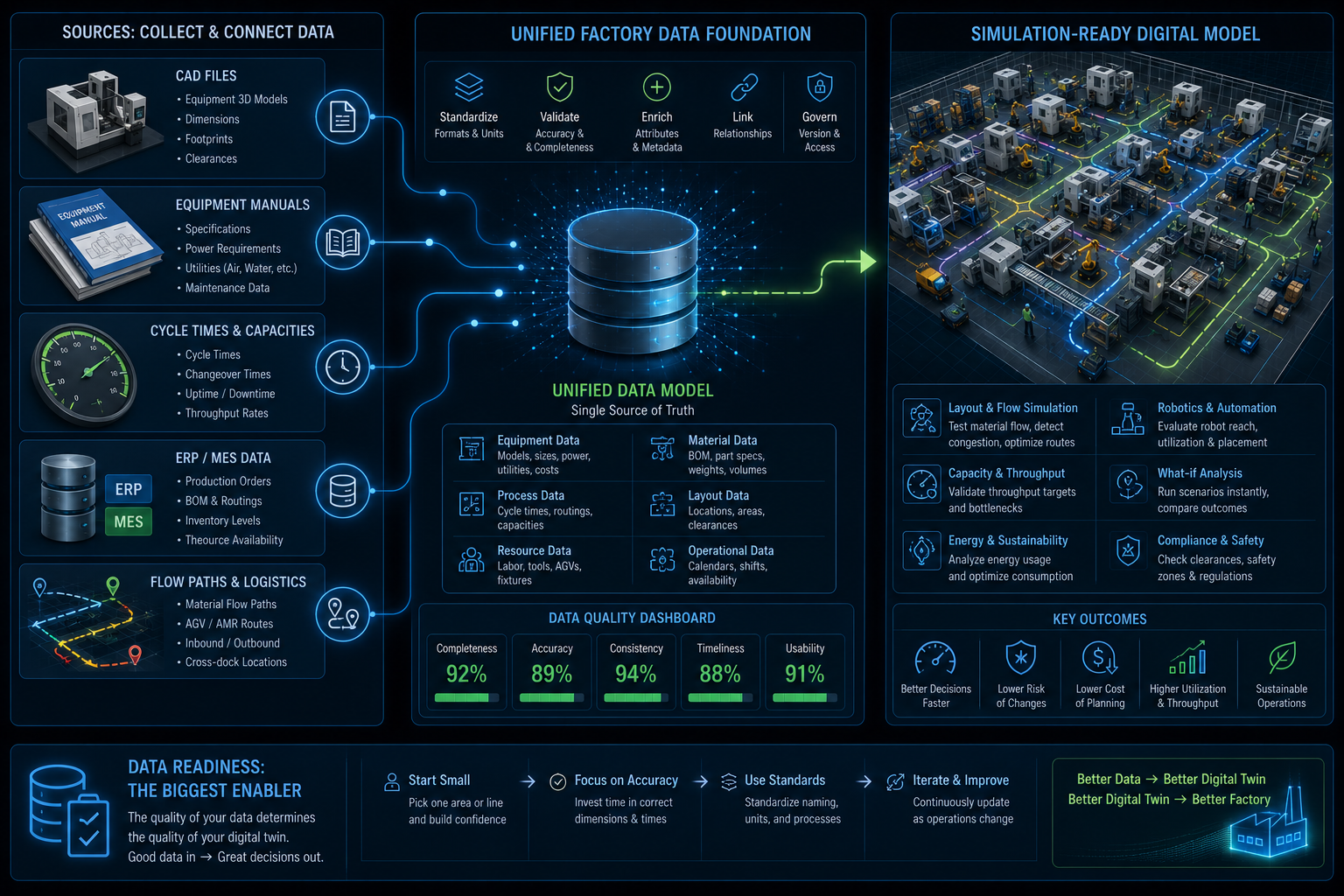
The answer is that the cost of factory simulation has dropped significantly. Several platforms now offer facility layout simulationout simulation at a price point accessible to mid-market manufacturers, and the NVIDIA Omniverse Enterprise platform that powers BMW's deployment has a version available to smaller operations. The more significant barrier is not cost. It is data readiness.
Factory simulation requires accurate facility data: equipment dimensions, weight, power requirements, cycle times, throughput targets, and flow paths. In most mid-market plants, some of this data exists in CAD files, some exists in equipment manuals, and some exists only in the production planner's head. Building the data foundation for meaningful simulation is typically a four-to-eight week effort before any simulation tool is productive.
- Start with a single reconfiguration question. Pick one planned layout change (a new line addition, a dock relocation, a cell reconfiguration) and use simulation to evaluate it rather than planning meetings. This builds organizational capability for simulation while answering a real operational question.
- Audit facility data before selecting a tool. Equipment dimensions, current cycle times, and material flow paths need to be documented before simulation produces accurate output. This audit also reveals institutional knowledge gaps that simulation will eventually surface anyway.
- Use simulation to quantify decisions already being made. If a plant manager is already planning to add a second AGV to a route, simulation can verify whether the second vehicle improves throughput or creates a congestion problem. The decision is already being made; simulation makes it better-informed.
- Connect to existing digital infrastructure. Factory simulation tools that connect to MES and ERP data produce more accurate models than those running on static inputs. The connection is not required to start, but it determines how much the simulation will improve over time.
Ready to Assess Your Factory Planning Data Foundation?
GrayCyan's AI Readiness Assessment identifies the data and system readiness for factory simulation, maps the highest-value facility planning questions AI can answer for your operation, and builds a sequenced roadmap before any simulation investment is made.
Book an AI Readiness AssessmentFrequently Asked Questions